How Does Plug-In Solar Work?
Trace solar energy from photons to household loads, including synchronization, backfeed, meters, clouds, export and anti-islanding.

WattRank is reader-supported: we may earn a commission if you buy through links in this guide. This never affects our rankings.
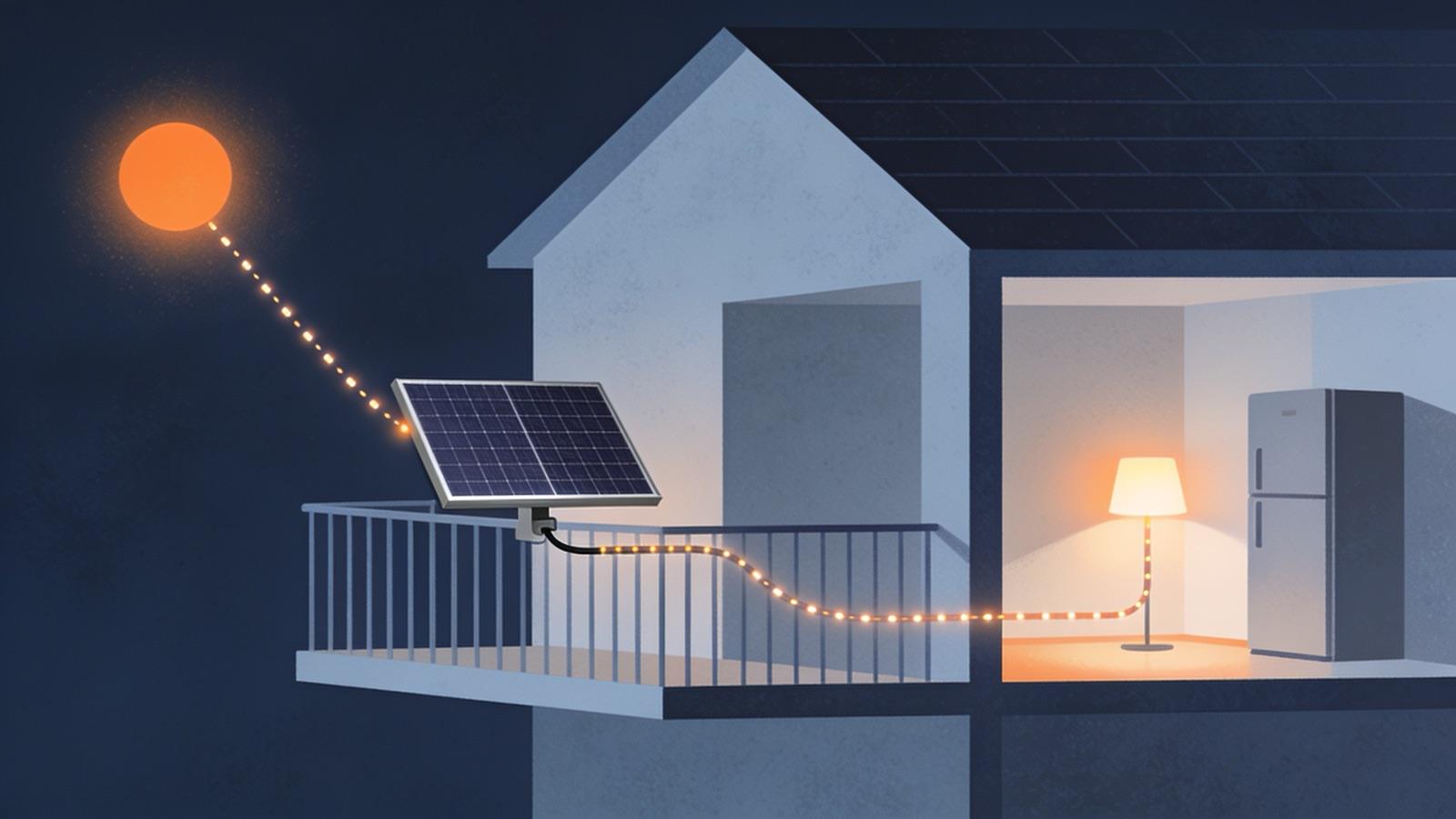
Key facts
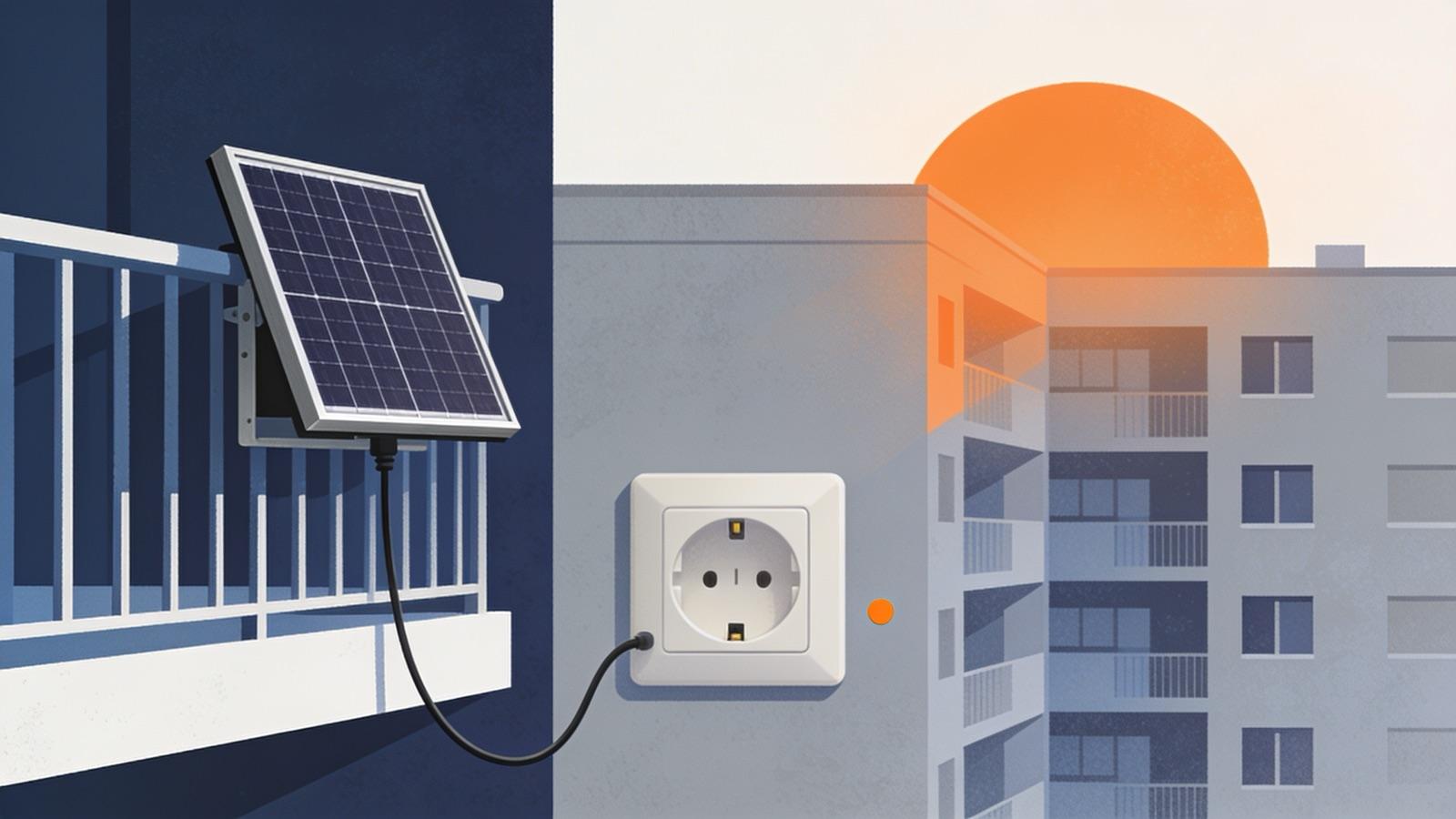
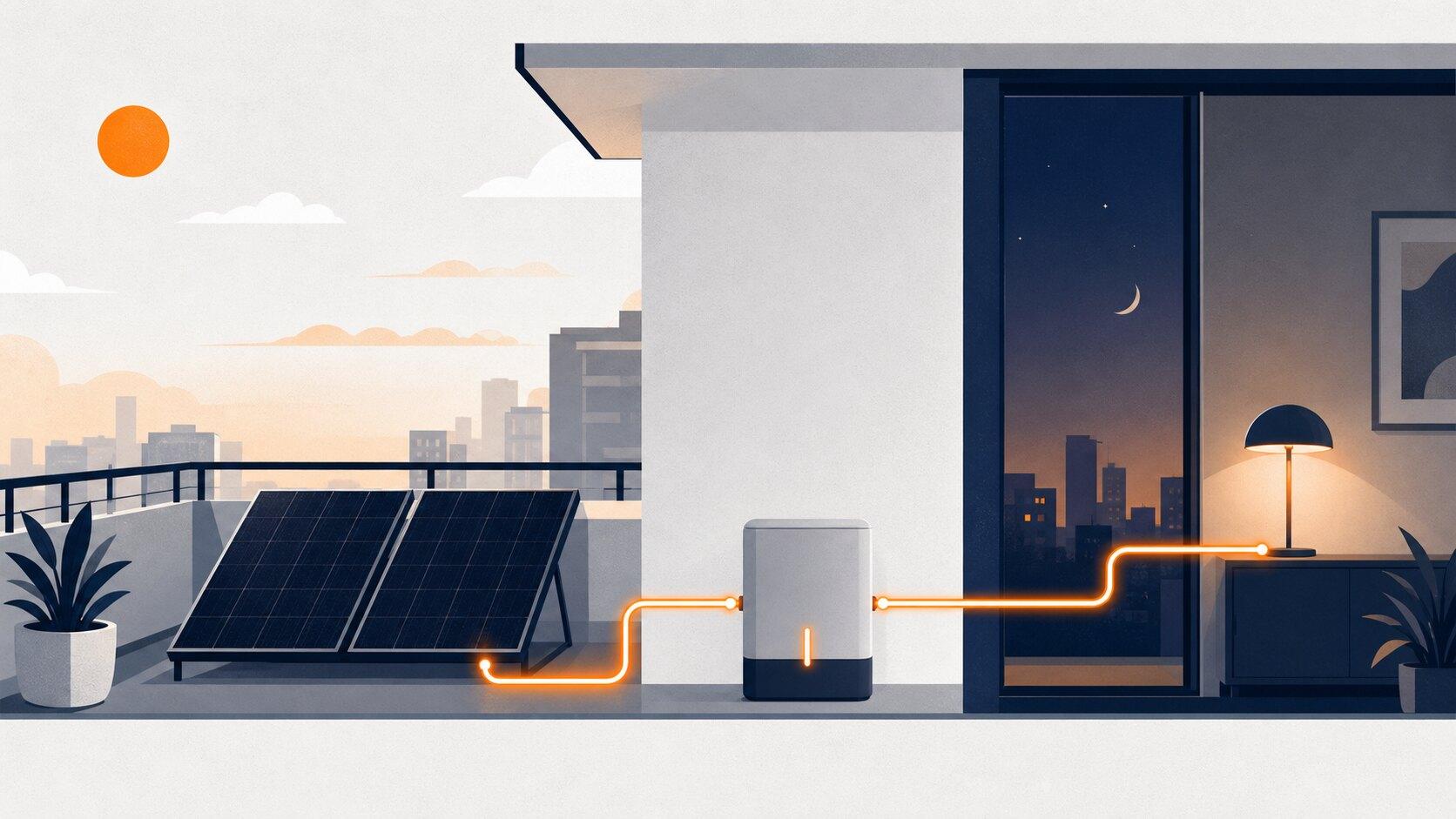
- Energy flows panel → DC cable → microinverter → AC cable → permitted outlet → home loads.
- Inverter AC output—not panel DC nameplate—is the figure usually compared with a legal watt cap.
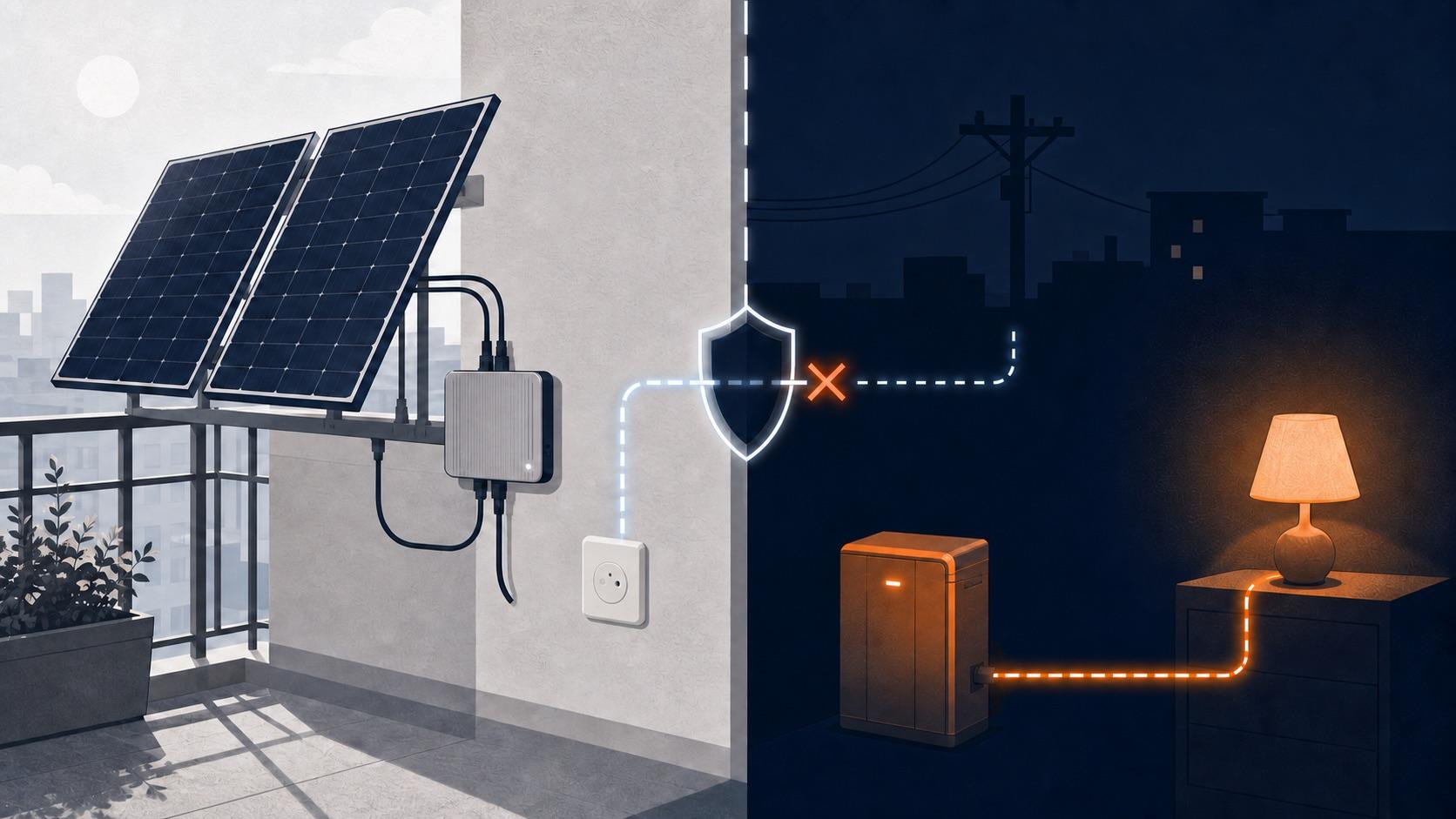
- Grid-tied inverters stop producing during an outage through anti-islanding; panels being sunlit does not keep the home energized.
- Clouds reduce output continuously; they do not normally make a grid-tied system switch the home on and off.
What path does the electricity follow?
The diagram is a functional sequence, not an installation plan. Photovoltaic cells release electrons when light reaches the semiconductor. Wired cells and modules produce DC. The microinverter tracks the panel operating point, converts DC to AC, matches the grid’s voltage, frequency, and phase, and sends current through the system’s specified AC cable and plug. The receptacle connects that source to the branch circuit and distribution panel.
Why do appliances use solar power first?
Electricity does not carry labels or wait in line. At each instant, voltage conditions and impedances determine current flow. A local inverter injects current onto the household circuit while appliances draw current. From the meter’s perspective, local generation reduces the net power imported from the grid. If a 500 W system is producing while the home uses 800 W, net grid import is roughly 300 W, ignoring small losses and phase-specific details.
| Solar output | Home demand | Approximate meter-side result |
|---|---|---|
| 0 W | 500 W | 500 W imported |
| 300 W | 500 W | 200 W imported |
| 500 W | 500 W | Near-zero net flow |
| 700 W | 500 W | About 200 W exported or curtailed/stored, depending on system and rules |
This “self-consumption first” description is an accounting shorthand for simultaneous local generation and demand. It does not guarantee that every jurisdiction credits export, that an old meter behaves correctly, or that a battery follows the same control logic. Those details must be checked for the actual utility, meter, and system.
What does the microinverter do?
- Finds an efficient panel operating point as irradiance and temperature change.
- Converts variable panel DC into household-frequency AC.
- Synchronizes output with the utility waveform before injecting current.
- Limits output to its rated AC power even if panel DC nameplate is higher.
- Monitors abnormal grid conditions and disconnects output when required.
- May report production and faults through an app; monitoring is not a substitute for protective hardware.
Why can panel watts exceed inverter watts?
Panel nameplate output is measured under standard test conditions that real installations reach only sometimes. Designers may pair, for example, more DC panel capacity with a lower AC inverter limit so the inverter reaches useful output during weaker light. At strong irradiance, the inverter caps or “clips” output at its rating. Legal plug-in limits generally concern delivered AC output, but the governing text must be read precisely.
What is backfeed?
Backfeed simply means power enters wiring from the load side rather than only arriving from the utility side. With purpose-designed equipment and a permitted pathway, controlled backfeed is how plug-in solar offsets demand. Uncontrolled or improvised backfeed can create overload, contact, protection, and worker-safety hazards. UL Solutions cited overload, hazardous contact, and current flowing in the wrong direction when it announced its UL 3700-based program in January 2026.
A common mistake is to think an outlet’s normal load rating automatically proves it can accept generation. Circuit conductor size, breaker rating, other loads, receptacle condition, connection location, protective devices, and jurisdiction-specific rules all matter. Follow the exact system instructions and legal pathway; do not use power strips, extension cords, gender-changing adapters, or a homemade double-ended lead.
How does anti-islanding protect the grid?
An island is a section of wiring that remains energized by local generation after utility supply is lost. A grid-tied inverter watches grid voltage and frequency. When the reference disappears or moves outside allowed limits, it stops exporting and disconnects. It later waits for acceptable grid conditions before reconnecting. This prevents a small generator from energizing lines that residents or utility crews may believe are dead.
Anti-islanding is why ordinary plug-in solar does not provide outage backup even at noon. A product with a battery may power dedicated, electrically isolated backup outlets. Supplying fixed house circuits during an outage requires an approved isolation or transfer arrangement; never attempt it by leaving a grid-tied plug connected or by feeding another outlet.
What happens at the electricity meter?
While output remains below household demand, the meter generally records lower net import. When generation exceeds demand, surplus reaches the service connection. A bidirectional meter may record export, but payment or credit depends on the tariff. Some frameworks allow small uncompensated export; some systems use a meter or current sensor to limit export; and some utilities require registration or a meter change.
| Meter/system situation | Possible outcome | What to verify |
|---|---|---|
| Modern bidirectional meter | Separately records import and export | Tariff and registration |
| Export not compensated | Surplus leaves the home without bill credit | Whether zero-export or a battery improves economics |
| Zero-export control | System reduces output or charges storage | Sensor placement, response and approved configuration |
| Legacy meter | Behavior may be unsuitable or disallowed | Utility meter requirements before connection |
What happens at night, under clouds, and in winter?
At night, panel voltage is insufficient and the inverter stops producing; the grid supplies loads as usual. Under clouds, output usually falls rather than vanishing. Passing clouds cause rapid variation, while diffuse light may sustain a smaller output. The grid continuously fills the difference, so appliances do not flicker merely because solar generation changes.
Winter production falls where days are shorter, the sun is lower, and snow or persistent cloud covers modules. Cold cells can be electrically efficient when illuminated, but that does not compensate for poor irradiance or shading. Vertical balcony mounting often sacrifices summer peak yield but may shed snow and sometimes captures low winter sun better than a shallow, obstructed orientation. Site-specific modeling beats a generic annual claim.
Do batteries change the energy flow?
Yes. Depending on architecture, panels may charge a battery on the DC side before inversion, or surplus AC may charge through a bidirectional converter. Controls decide whether energy serves current loads, charges storage, is curtailed, or exports. A battery can raise self-consumption by shifting midday production into evening, but conversion losses, finite cycle life, standby consumption, added cost, and backup limitations must be included.
What limits output in practice?
| Limit | Effect |
|---|---|
| Sun angle and irradiance | Changes available DC power minute by minute |
| Shade | Reduces one module or input; bypass and multi-input design affect severity |
| Panel temperature | Hot cells generally deliver less power than their nameplate condition |
| Inverter AC rating | Hard ceiling on delivered AC output |
| Legal/system setting | May impose a lower configured cap |
| Zero-export or battery controls | May curtail output when demand or storage capacity is low |
| Dirt, mismatch and wiring losses | Reduce usable energy over time |
Sources and next steps
Technical and safety context is based on UL Solutions’ plug-in solar program announcement, the ANSI record for UL 3700, and Clean Energy States Alliance’s Plug-In Solar PV report. Connection rules vary; use the actual inverter manual, certification directory record, state law, electrical authority, and utility instructions for a real installation.
- UL Solutions: hazards and UL 3700-based program
- ANSI record: UL 3700 publication status
- CESA: Plug-In Solar PV technical report
What measured efficiency actually looks like
Spec sheets quote peak conversion efficiency; independent lab measurements tell a more useful story. Under realistic low household loads (150-250 W — a home at idle), measured conversion efficiency on current battery-integrated systems drops to roughly 69-75%, meaning a quarter or more of the panel energy becomes heat rather than usable power. Grid-charging paths measure around 85% on weaker units. And round-trip battery efficiency — panel to battery to home — lands meaningfully below the marketing figure once low-power night-time discharge is included, with independent German testers measuring down to ~70% on some popular systems.
Two practical lessons follow. First, app dashboards are not measurements: reviewers have documented companion apps displaying physically impossible figures (identical input and output watts, implying 100% conversion), so an independent metering plug is the honest way to know what your system delivers. Second, efficiency differences of this size move payback math by years — which is why our rankings weight independent test evidence over spec-sheet claims, and why the same logic should apply to any kit you shortlist.
How zero-export systems work
A standard grid-tie inverter pushes whatever the panels produce; if the home consumes less, the surplus flows out through the meter. Zero-export systems add a control loop: a smart meter with current-transformer clamps at the breaker panel measures household draw in real time and tells the inverter to produce no more than the home is consuming at that moment. Nothing leaves the property, which is the design argument vendors like CraftStrom use to position kits as compatible with utility rules in states without a plug-in framework.
Understand both halves of that claim. Technically, the mechanism is real and measurable — the meter throttles the inverter within seconds, and installation guides walk through clamp placement carefully because reversed clamps break the control loop. Legally, zero-export is a design property, not a permission: it removes the back-feed objection, but interconnection rules vary by utility, and no WattRank page treats a zero-export label as a substitute for checking your state page and asking your utility.
The app layer: cloud, monitoring and control
Modern plug-in systems are cloud products as much as power electronics, and the software layer deserves the same scrutiny as the inverter. Most major systems require account registration and a permanent internet connection to function fully — German reviewers coined the criticism Cloudzwang (forced cloud) — and setup typically asks for your home Wi-Fi credentials and precise location. Security researchers have also demonstrated real weaknesses in this layer, including one popular system where knowing a device serial number could expose the installation address. None of this changes the electrical safety picture, but it belongs in a buying decision.
What to check before buying: whether the system operates (at least in a degraded mode) without cloud connectivity, whether energy data can be read locally (open integrations such as Shelly meters or home-automation APIs), what the vendor charges for premium app features — some paywall tariff-optimization behind monthly subscriptions — and the vendor's security-update track record. The systems in our ranking differ meaningfully on every one of these axes.
Frequently asked questions
Where does plug-in solar electricity go first?
It offsets loads operating on the home electrical system at that moment. If generation is below demand, the grid supplies the remainder. If generation exceeds demand, the surplus may export, charge a compatible battery, or be curtailed. The exact behavior depends on wiring, phases, controls, meter and utility rules.
Will plug-in solar work when the grid is down?
Ordinary grid-tied plug-in solar will not. Anti-islanding makes the inverter stop when utility voltage or frequency disappears, even in bright sun. Only an approved isolated backup output or transfer system can supply loads during an outage; a battery label alone does not prove whole-home backup capability.
Can solar power run the meter backwards?
Do not assume so. A modern bidirectional meter can record export, but billing credit depends on the tariff and registration. A legacy meter may behave differently and may require replacement. Ask the utility what meter and export treatment apply before connecting a system.
What happens when a cloud covers the panels?
Output falls with irradiance and rises when light returns. The grid automatically supplies the changing shortfall, so normal household loads continue operating. Production can remain above zero under diffuse light, but shade, orientation, module electronics and inverter limits determine the actual curve.
Why is a microinverter necessary?
Panels produce variable DC while household circuits use grid-synchronized AC. The microinverter performs that conversion, controls panel operation, limits AC output, monitors grid conditions, and stops exporting during abnormal conditions. A bare panel or generic adapter cannot safely perform these functions.
Does excess plug-in solar power get wasted?
It depends. Excess may flow to the grid, charge compatible storage, or be curtailed by export controls. If the utility offers no export credit, exported energy may have no bill value even though it is physically used elsewhere. That makes daytime self-consumption central to savings.
Check your location
Framework status and exact product eligibility are separate checks.
The best plug-in solar kits of 2026, ranked
Now you know how it works — here are the kits we track, compared by configuration, AC output, verified price and certification evidence.
| Product | Exact configuration | Output | Panels / storage | Verified offer | Availability | UL 3700 evidence |
|---|---|---|---|---|---|---|
| EcoFlow STREAM Microinverter | STREAM Microinverter — bare unit | 1,200 W grid-tie | Not included | $299 · USD | UT · region only | not-verified |
| EcoFlow STREAM Ultra + Microinverter | STREAM Ultra + STREAM Microinverter | 1,200 W grid / 800 W hardware | 1,920 Wh | $1,459 · USD | UT · region only | not-verified |
| CraftStrom 400 Watt Plug&Play Solar | 400 W Eco-Line kit | 350 W grid / 400 W hardware | 2 panels | $499 · USD | US · in stock | not-verified |
| CraftStrom 800 Watt Plug&Play Solar | 800 W complete kit | 700 W grid / 800 W hardware | 4 panels | $2,031 · USD | US · in stock | not-verified |
| CraftStrom 1600 Watt Eco-Line Plug&Play Solar | 1600 W Eco-Line kit | 1,400 W grid / 1,600 W hardware | 8 panels | $3,187.5 · USD | US · in stock | not-verified |
| Bright Saver Flex180 single-panel kit | Flex180 single-panel kit | 180 W grid-tie | 1 panels | $399 · USD | US · in stock | not-verified |
| Plug In Solar Utah 3 Panel EcoFlow STREAM Kit | 3-panel EcoFlow STREAM kit | 1,200 W grid-tie | 3 panels | $1,299 · USD | UT · region only | not-verified |