What Is Plug-In Solar? Complete Guide
A precise, evidence-led guide to grid-tied plug-in solar, system types, suitability, safety standards, and legal frameworks.

WattRank is reader-supported: we may earn a commission if you buy through links in this guide. This never affects our rankings.
Key facts
- Germany has about 1 million registered plug-in systems and an estimated 4 million installed systems (CESA).
- European plug-in systems commonly cap inverter output at 800 W; France and Switzerland use 600 W (CESA).
- UL 3700 was published in December 2025 as an Outline of Investigation, not yet a consensus ANSI/UL standard.
- In July 2026, the US tracker counted 8 states with signed laws and 18 with pending legislation; local implementation still matters.
What exactly counts as plug-in solar?
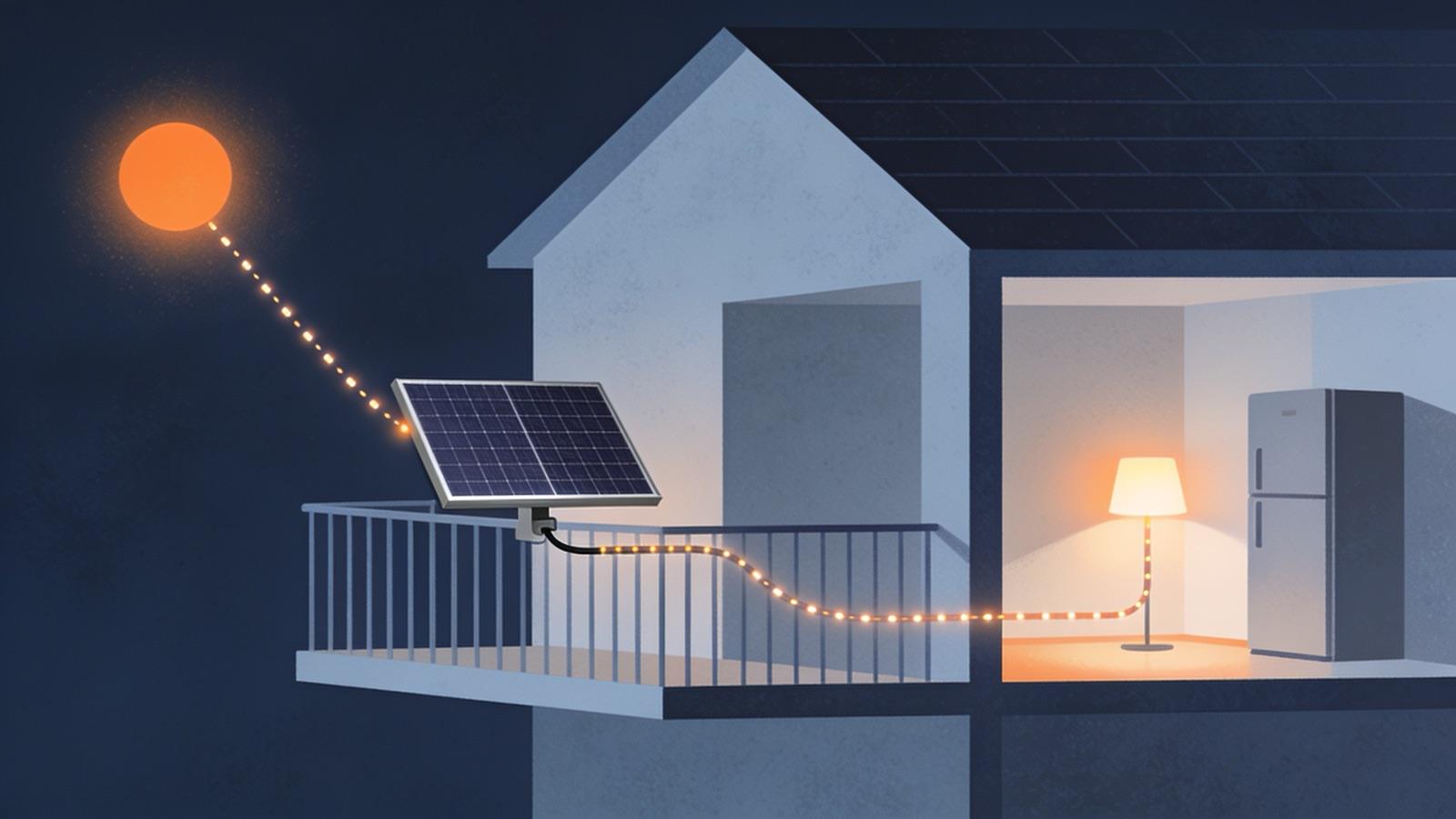
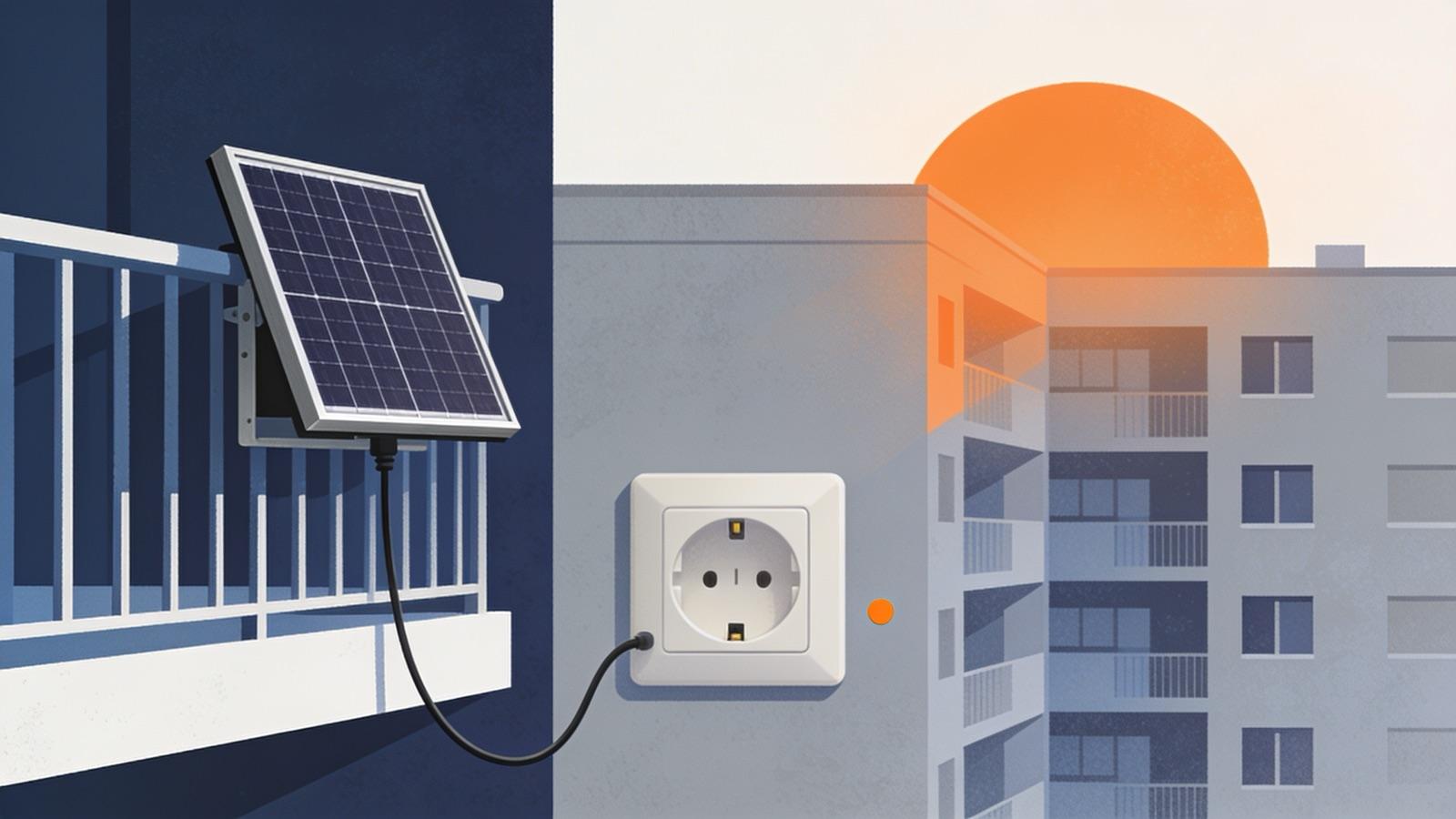
A grid-tied plug-in solar system has photovoltaic panels, an inverter designed for the system, mounting hardware, cabling, and an AC plug or approved plug-in connection. Sunlight creates direct current (DC). The inverter converts it to alternating current (AC), synchronizes with the utility waveform, and supplies the branch circuit through the outlet. Loads operating in the home consume this power first; the utility supplies any shortfall.
The decisive test is not size, balcony placement, or whether a product is sold as a “kit.” Ask whether its AC output intentionally enters fixed household wiring and operates in parallel with the utility. If yes, it is grid-tied plug-in solar. That connection creates electrical, equipment, utility, and legal questions that do not apply to an isolated portable power station.
How is plug-in solar different from a solar generator or panel-only kit?
| System | Where power goes | Grid-parallel? | Typical purpose |
|---|---|---|---|
| Grid-tied plug-in solar | Through an approved outlet into home circuits | Yes | Offset live household demand |
| Solar generator | Panel charges a portable battery; battery powers its own outlets | No, unless a separately approved transfer system exists | Backup, camping, portable loads |
| Panel-only kit | Raw DC output to a separate controller/inverter | Not by itself | A component for a custom system |
A solar generator normally contains a charge controller, battery, inverter, and user-facing outlets. Appliances plugged into it form a small off-grid circuit. It must not be improvised into a house outlet. A panel-only package is even less complete: panels cannot be connected directly to a household receptacle, because their voltage and current are DC and uncontrolled for that purpose.
Why did balcony solar become a distinct category?
The category grew by reducing the scale and administrative burden of conventional rooftop solar. Renters and apartment residents could mount one or two modules on a balcony, terrace, wall, shed, or small garden and take the system with them. Germany became the clearest proof of scale: CESA reports one million registered systems, estimates four million installed, and says 435,000 were registered during 2024 out of one million new photovoltaic systems that year.
CESA estimates those four million German systems represent roughly 3 GW of daytime generation, beside about 100 GW of German distributed and utility-scale solar. That comparison matters: plug-in solar is not a substitute for the entire power system, but millions of small systems can become meaningful distributed generation.
The US wave followed later. Utah’s HB 340 created a plug-in solar category up to 1,200 W connected through a standard 120 V outlet and took effect May 7, 2025. By July 2026, the PlugInSolarMap snapshot counted 8 states with signed laws, 18 with pending bills, 6 considering action, and 19 with no known activity. These categories change quickly and do not replace primary state, electrical, utility, lease, or building rules.
Who is plug-in solar for?
- A household with a sunny, structurally suitable balcony, terrace, wall, yard, or outbuilding and meaningful daytime electricity use.
- A renter who has written landlord approval and a compliant mounting and cable route, and wants removable generation rather than a permanent rooftop array.
- An owner who cannot justify or install rooftop solar but can legally connect a small verified system.
- Someone willing to check state or national rules, utility requirements, equipment evidence, circuit suitability, and mounting loads before buying.
Who should not buy one yet?
Wait if your location lacks a clear pathway, your utility has not implemented the relevant framework, the complete system’s safety evidence cannot be verified, or your landlord, HOA, insurer, or building authority objects. It is also a poor fit for a deeply shaded site, a household that uses almost no electricity while the sun is up, a damaged or overloaded circuit, or any installation that depends on an extension cord or improvised adapter.
What does a complete system contain?
| Part | Job | Evidence to check |
|---|---|---|
| PV module | Turns sunlight into DC electricity | Electrical ratings, connector compatibility, fire classification where required |
| Microinverter | Converts DC to synchronized household AC | Exact model, output limit, anti-islanding and applicable listing |
| AC cable and plug | Carries inverter output to the permitted connection | System-specified cable, plug type, weather rating, strain relief |
| Mounting | Resists wind, movement and falling | Manufacturer load limits and building/landlord approval |
| Monitoring | Reports production and faults | Optional; confirm data does not substitute for electrical protection |
| Battery, if offered | Shifts solar energy to later use | Capacity, operating modes, system compatibility and certification scope |
Is plug-in solar legal worldwide?
There is no worldwide yes-or-no answer. European countries often define simplified small-system pathways, but their output limits, registration, plug, export, and electrician requirements differ. CESA identifies 800 W AC as a common European threshold and notes 600 W in France and Switzerland. A product appropriate in Germany is not automatically appropriate in the UK or US because plugs, voltage, grid codes, and legal pathways differ.
In the US, distinguish four states of play: an effective law; a signed law with a future effective date; a pending bill; and no explicit statewide framework. “No framework” does not by itself mean “illegal.” It means you need current answers from the authority having jurisdiction and utility. Even an effective statute may leave permits, dedicated-circuit details, landlord or HOA consent, insurance, and utility implementation unresolved.
What does UL 3700 mean?
UL Solutions launched a testing and certification program based on UL 3700 on January 8, 2026. UL describes hazards including overload, hazardous contact, and current flowing in the wrong direction. UL 3700 itself was published December 11, 2025 as an Outline of Investigation. Therefore, identify the exact standard, model, and certification scope; do not treat a listing on one internal component as proof that the complete plug-in system has system-level UL 3700 certification.
What should you verify before choosing a kit?
- The legal status and effective date in your location, plus current utility and local authority instructions.
- The system’s maximum AC output—not only the panels’ larger DC nameplate total—and the applicable watt cap.
- System-level certification evidence tied to the exact model; WattRank currently marks evidence not verified when a directory record is unavailable.
- A safe, code-appropriate outlet and branch circuit, correct plug and voltage, no extension lead, and installation exactly as instructed.
- Secure mounting, wind and structural loads, weather exposure, cable routing, and written landlord or HOA approval where relevant.
- Your daytime base load, likely self-consumption, electricity price, shade, orientation, and the treatment of exported energy.
Sources and next steps
Core sources: UL Solutions’ January 2026 program announcement; the ANSI record for UL 3700; Clean Energy States Alliance, Plug-In Solar PV; Utah HB 340 and Utah Code Title 54, Chapter 15; and the July 2026 PlugInSolarMap tracker snapshot. Product, law, and certification claims require rechecking because they change.
- UL Solutions: plug-in solar testing framework
- ANSI record: UL 3700 Outline of Investigation
- CESA: Plug-In Solar PV report
- Utah HB 340 enrolled bill
- PlugInSolarMap legislation tracker
The market in 2026: who actually makes these systems
The category has moved from niche importers to major consumer-electronics brands, and knowing the landscape helps decode product pages. Six names cover most of what a buyer will encounter this year.
| Brand / line | Class | Market position in 2026 |
|---|---|---|
| EcoFlow STREAM | Grid-tied + battery ecosystem | First major US launch (Utah), 1,200 W output, aggressive introductory pricing |
| Anker SOLIX Solarbank | Battery-integrated systems | The storage-segment reference in Europe: its line won the Stiftung Warentest 2026 storage test |
| Jackery Navi | Battery-integrated systems | Portable-power veteran entering balcony solar; strong hardware ratings (IP65, LFP) |
| BLUETTI Balco | Battery-integrated systems | Newest entrant (May 2026), aggressive pricing per kWh, no independent tests yet |
| CraftStrom | Grid-tied kits, zero-export | Longest-shipping US vendor (5 years, ~4,000 systems), ETL-certified inverters |
| Bright Saver | Entry panel kits | California nonprofit selling at cost to members — the lowest-priced US entry point |
Two structural notes behind the table. European brands compete mainly on battery systems because the grid-tied basics are commoditized there; the US market is still shaped by legality, so vendors either concentrate on legal states (EcoFlow in Utah) or sell zero-export designs positioned as compliant everywhere (CraftStrom). Both strategies are rational answers to the same regulatory map — and both appear throughout our rankings with their certification evidence stated explicitly.
Five misconceptions worth clearing up
Plug-in solar attracts confident wrong answers in comment sections. The five most persistent, corrected:
- It is illegal in the US. Not as a blanket statement — four states have effective frameworks, four more are signed, and elsewhere the truthful status is usually unregulated-and-utility-dependent rather than prohibited. State-by-state facts beat forum folklore.
- It powers the house during a blackout. The opposite: grid-tie inverters must shut down when the grid fails (anti-islanding). Backup power requires a battery product designed for it.
- A 800 W kit gives you 800 watts. Nameplate is a ceiling, not an average. Real output follows sun angle, season and temperature — a well-placed system delivers its rating for brief peaks and much less most of the time.
- Any solar panel can be plugged in. The plug-in part is the certified microinverter and its safety behaviour, not the panel. A bare panel wired to an outlet is not a plug-in system; it is a hazard.
- It requires rewiring the home. A compliant kit uses an existing outlet and circuit. What it requires is discipline about which circuit — covered in our installation guide — not an electrician's rebuild.
Frequently asked questions
Can I just plug a solar panel into an outlet?
No. A bare panel produces variable DC power and cannot connect directly to a household AC outlet. A compliant plug-in system needs a matched inverter, protective functions, specified cabling and connection hardware, suitable mounting, and permission under local rules. Never build the connection from adapters or extension cords.
Does plug-in solar work during a power outage?
A normal grid-tied plug-in system shuts down when the grid fails because anti-islanding prevents it from energizing wiring utility workers may expect to be dead. Some battery products can provide power through isolated backup outlets, but that is a separate operating mode—not permission to backfeed home wiring during an outage.
Is balcony solar the same as plug-in solar?
Not exactly. Balcony solar describes a placement or marketing category; plug-in solar describes the electrical connection. A balcony can hold an off-grid panel charging a battery, a panel-only setup, or a grid-tied plug-in system. Apply the grid-parallel test rather than relying on the word “balcony.”
Do I need an electrician for plug-in solar?
That depends on the jurisdiction, utility pathway, circuit condition, and system instructions. A simplified legal category may permit consumer connection of specified equipment, but it does not make every outlet suitable. If circuit capacity, grounding, protection, weather exposure, or local requirements are uncertain, use a qualified electrician.
How much power can a plug-in solar kit produce?
The binding figure is usually inverter AC output. CESA describes 800 W as a common European threshold and 600 W in France and Switzerland; Utah’s law caps its category at 1,200 W. Panel DC ratings can be higher than inverter AC output, so compare the correct rating with your local cap.
Can renters install plug-in solar?
Potentially, but permission and practical safety matter. Obtain written landlord approval, confirm balcony and façade rules, verify structural and wind loads, route the cable without creating damage or trip hazards, and check utility and local requirements. A removable system is still electrical generation connected to a building.
Check your location
Framework status and exact product eligibility are separate checks.
The best plug-in solar kits of 2026, ranked
Now you know how it works — here are the kits we track, compared by configuration, AC output, verified price and certification evidence.
| Product | Exact configuration | Output | Panels / storage | Verified offer | Availability | UL 3700 evidence |
|---|---|---|---|---|---|---|
| EcoFlow STREAM Microinverter | STREAM Microinverter — bare unit | 1,200 W grid-tie | Not included | $299 · USD | UT · region only | not-verified |
| EcoFlow STREAM Ultra + Microinverter | STREAM Ultra + STREAM Microinverter | 1,200 W grid / 800 W hardware | 1,920 Wh | $1,459 · USD | UT · region only | not-verified |
| CraftStrom 400 Watt Plug&Play Solar | 400 W Eco-Line kit | 350 W grid / 400 W hardware | 2 panels | $499 · USD | US · in stock | not-verified |
| CraftStrom 800 Watt Plug&Play Solar | 800 W complete kit | 700 W grid / 800 W hardware | 4 panels | $2,031 · USD | US · in stock | not-verified |
| CraftStrom 1600 Watt Eco-Line Plug&Play Solar | 1600 W Eco-Line kit | 1,400 W grid / 1,600 W hardware | 8 panels | $3,187.5 · USD | US · in stock | not-verified |
| Bright Saver Flex180 single-panel kit | Flex180 single-panel kit | 180 W grid-tie | 1 panels | $399 · USD | US · in stock | not-verified |
| Plug In Solar Utah 3 Panel EcoFlow STREAM Kit | 3-panel EcoFlow STREAM kit | 1,200 W grid-tie | 3 panels | $1,299 · USD | UT · region only | not-verified |