Is Plug-In Solar Safe? The Evidence, Risk by Risk
Shock, overload, fire, mounting and battery risk examined against standards, independent tests and the German track record.

WattRank is reader-supported: we may earn a commission if you buy through links in this guide. This never affects our rankings.
Key facts
- Germany has about 1 million registered plug-in systems and an estimated 4 million installed (CESA) operating under a framework built on safety analysis.
- Grid-tie inverters must stop exporting within roughly 2 seconds of losing the grid under IEEE 1547 anti-islanding requirements; certified units are tested for this.
- UL 3700, the US safety outline for plug-in systems, was published in December 2025 and is not yet a consensus standard — no product currently holds verified system-level certification.
- In Stiftung Warentest's 2026 lab test of balcony-solar batteries, three of five products exceeded electromagnetic-interference limits — certification evidence matters more than brand size.
What the evidence base actually says
Safety questions about plug-in solar deserve better than reassurance or alarm, so start with the largest real-world dataset that exists. Germany — where plug-in systems are called Balkonkraftwerke — has roughly 1 million systems registered in the national Marktstammdatenregister and an estimated 4 million installed once unregistered units are counted, according to the Collaborative Economy and Sharing Association (CESA). These systems have operated for years, at scale, in ordinary rented apartments, under a legal framework whose 800-watt output cap and product requirements were built on precisely the safety analysis this guide walks through.
That track record is why the policy direction in other countries has moved toward permitting these systems rather than banning them. The UK government commissioned dedicated safety research before announcing its plan to allow sub-800 W systems on standard sockets, and the resulting DESNZ consultation focuses on the same technical controls Germany relies on: inverter behaviour, protection against live pins, and clear product requirements. In the US, the UL 3700 Outline of Investigation and state laws such as Utah's HB 340 follow the same logic — define the safety conditions, then permit the product class that meets them.
None of that means every kit sold online is safe. It means the category is safe when four specific risks are controlled: shock at the plug, circuit overload, fire, and mechanical failure of the mounting. Here is each one, with what actually controls it.
Shock risk: why the plug pins are not live
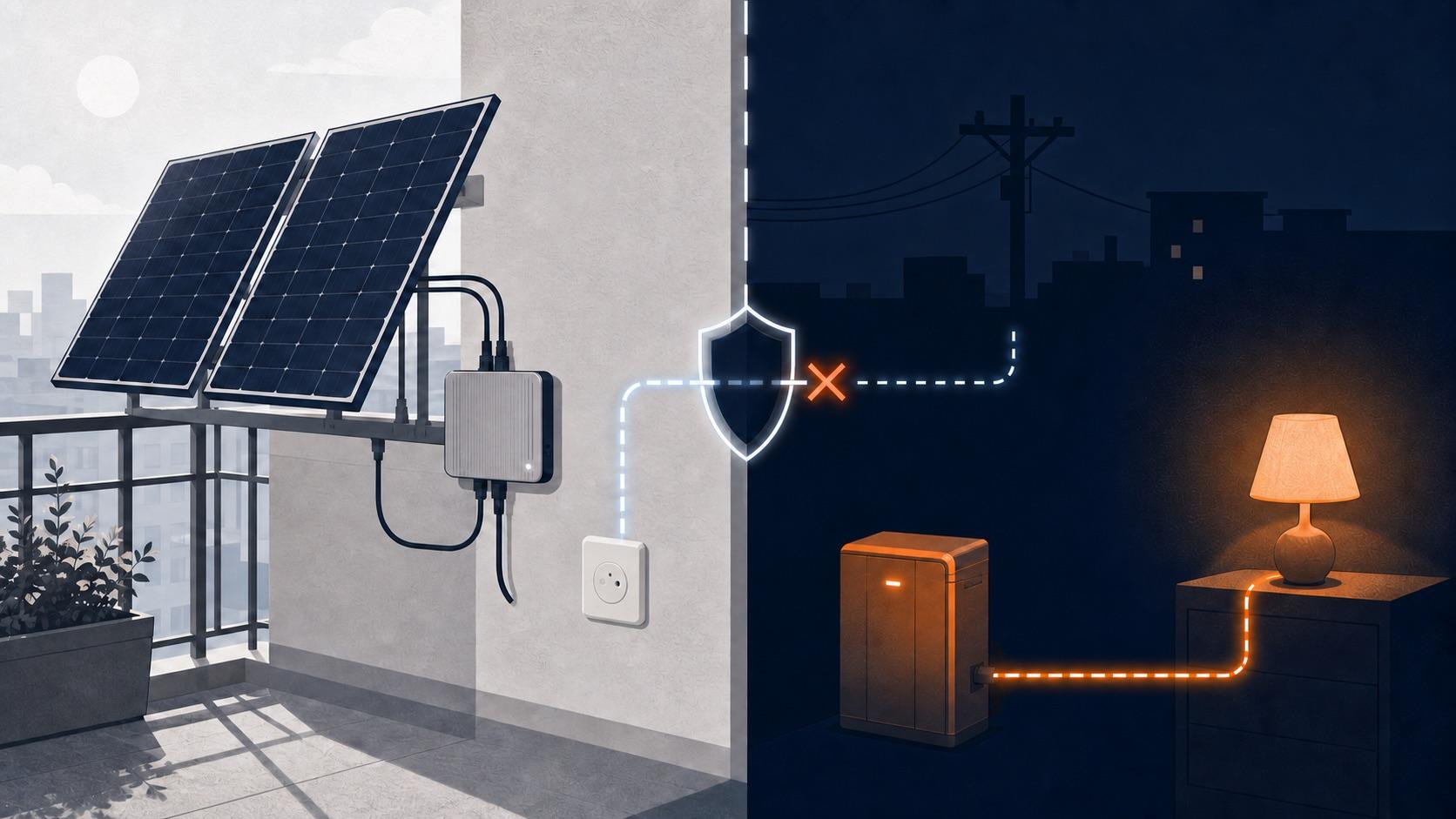
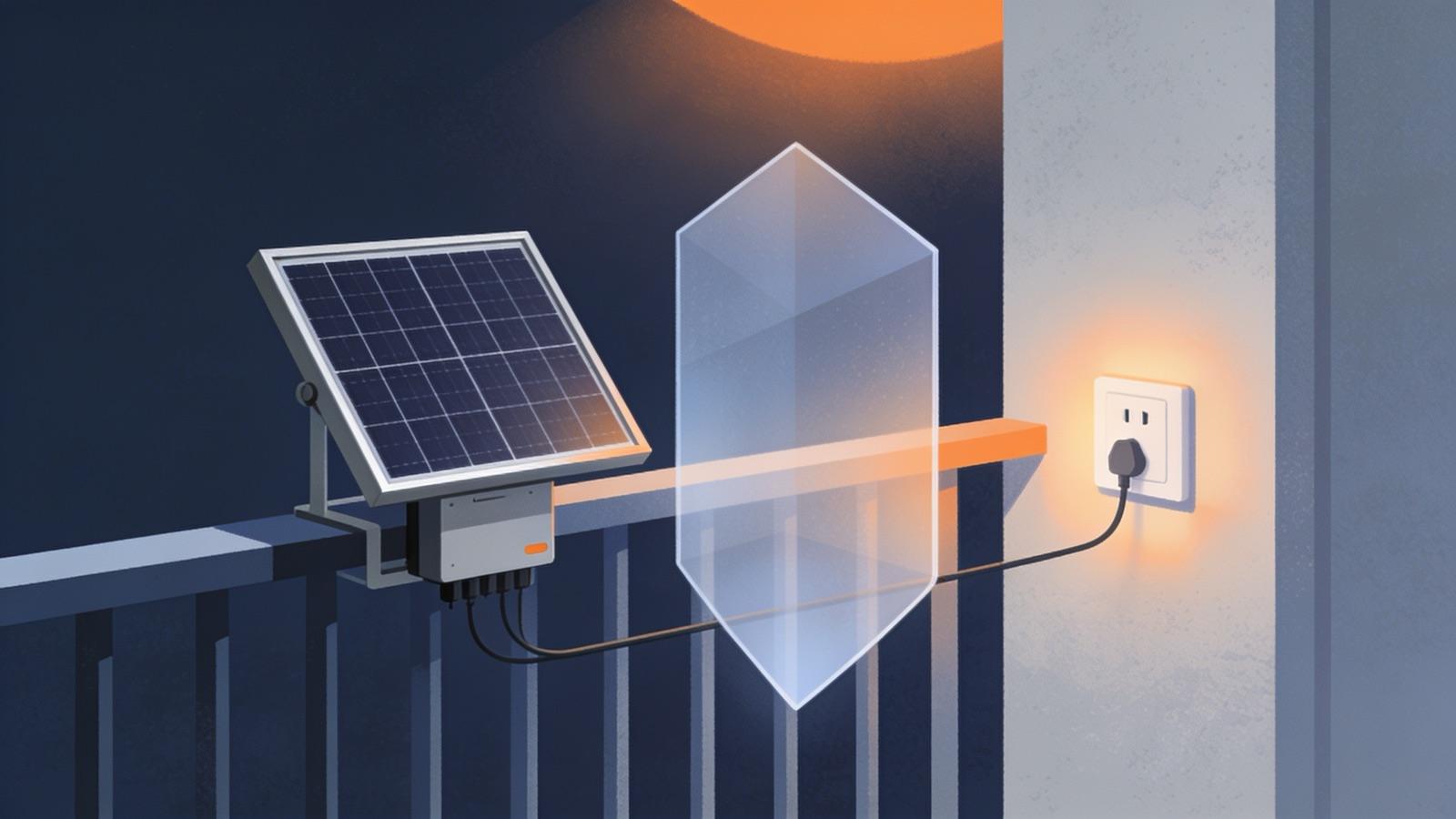
The most intuitive fear — touching exposed pins that carry solar power — is the one modern equipment engineers most thoroughly design out. A grid-tie microinverter does not push power blindly; it can only export while it detects a live grid waveform to synchronize against. Pull the plug from the outlet and that reference disappears, so the inverter stops producing output. This behaviour, called anti-islanding, is a certification requirement, not a courtesy feature: under IEEE 1547, inverters must cease energizing within roughly two seconds of losing the grid, and certified units are lab-tested against it. The same protection is what prevents a plug-in system from back-feeding a de-energized line while a utility worker repairs it.
The practical consequence: on a compliant system, the plug is de-energized almost immediately after disconnection. The UK's interim product specification work goes further still, examining protection against 'hazardous live' pins as an explicit product condition. When you evaluate a kit, the question to ask is not whether it has a plug — it is whether the inverter carries certification evidence for anti-islanding behaviour (UL 1741 in the US, VDE-AR-N 4105 grid-connection compliance in Germany, G98 in the UK).
Overload risk: the one the breaker cannot see
The subtlest electrical risk has nothing to do with the plug. A circuit breaker protects a branch circuit by tripping when too much current flows through it from the panel. A plug-in system feeds current into the circuit from the other end — after the breaker. In an extreme scenario, a 15-amp circuit could carry its full breaker-limited load plus the solar contribution on the same wire, and the breaker would not know.
This is exactly why serious frameworks cap output. At 800 W, a European system adds at most about 3.5 A on a 230 V circuit; the same 800 W is closer to 6.7 A at 120 V. UL Solutions identifies several system-level controls for US branch circuits, including a dedicated circuit, integrated overcurrent protection or a power control system. A generic energy meter is not automatically a safety control. Use only the circuit mode evaluated for the exact product and allowed by the current local pathway; never use extension cords or multi-plug adapters.
Fire risk: what separates certified kits from cheap imports
Fires attributed to balcony solar are rare enough in Germany that individual incidents make national news — but 'rare' is doing work there that certification explains. A grid-tie inverter manages real power with real heat, DC connectors carry current for decades outdoors, and a battery adds stored energy to the equation. The difference between a product engineered for that duty cycle and a cheap import is invisible in a product photo and decisive in year seven.
Independent testing keeps finding that difference. In Stiftung Warentest's 2026 laboratory test of balcony-solar storage systems, three of the five products tested — including units from major brands — emitted electromagnetic interference above permitted limits, and only one product achieved a satisfactory overall grade. Electromagnetic interference is not itself a fire hazard, but it is a proxy for engineering discipline: filters, shielding and thermal design cost money precisely where corner-cutting is profitable. Component-level certifications (an ETL- or UL-listed inverter, TÜV- or VDE-tested hardware) are the evidence a manufacturer can show today; treat their absence as a decision, not an oversight.
| Risk | What controls it | What you verify before buying |
|---|---|---|
| Shock at the plug | Anti-islanding shutdown (IEEE 1547 / UL 1741 / VDE-AR-N 4105) | Inverter certification evidence, not marketing language |
| Circuit overload | Output caps plus an evaluated dedicated or protected shared-circuit method | Exact system evidence, local pathway and verified branch-circuit arrangement |
| Fire | Certified components, thermal design, quality connectors | ETL/UL/TÜV component listings; independent test results |
| Falling equipment | Rated mounts, correct anchoring, wind-load margins | Manufacturer mount rating for your railing type and exposure |
| Battery incidents | LFP chemistry, IP rating, temperature management | Chemistry (LiFePO4), IP65-class enclosure, operating temperature range |
Mounting: the most underrated risk
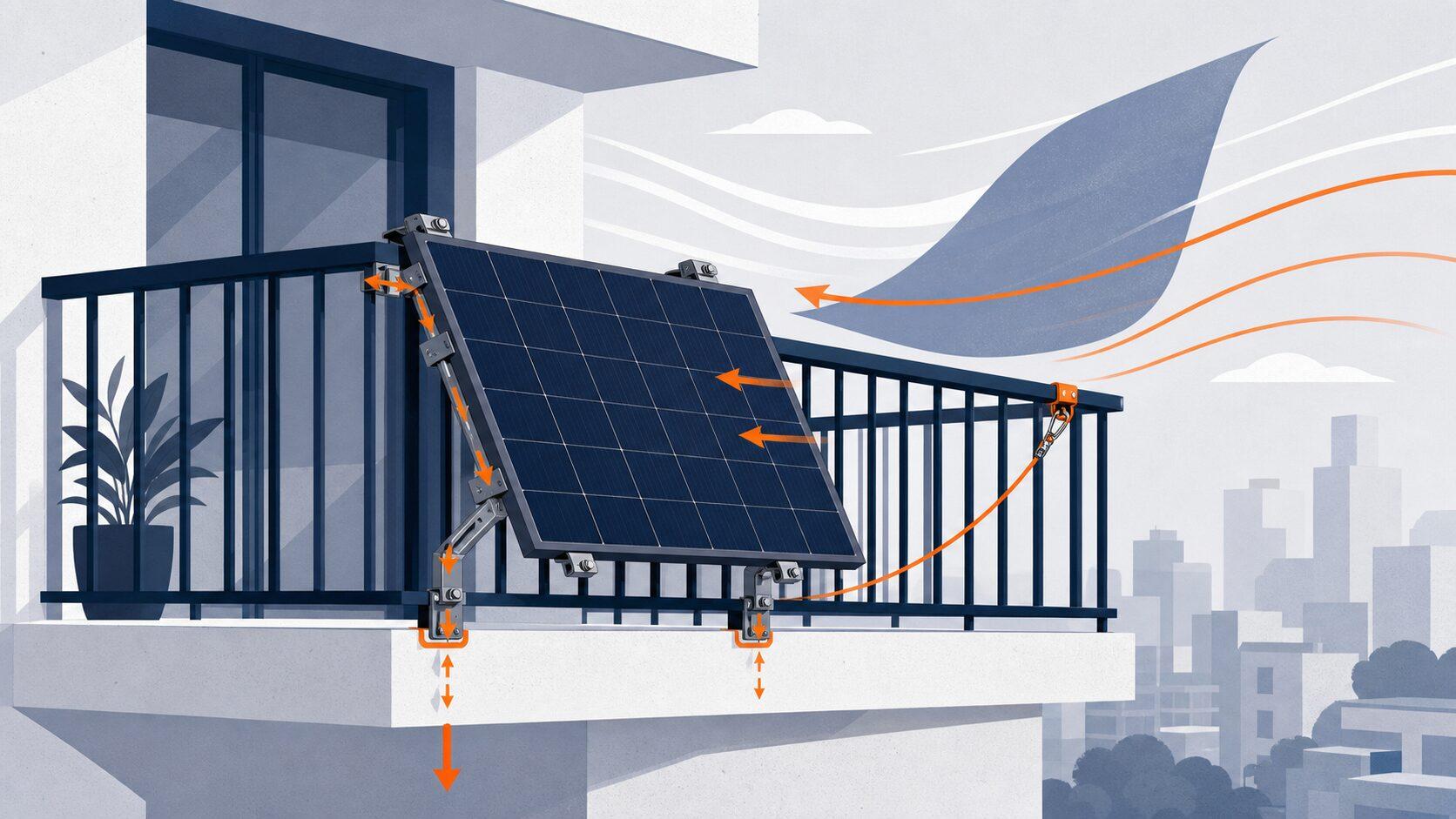
Electrically, plug-in solar is a heavily engineered product category. Mechanically, it is a sail. A rigid panel on a fifth-floor balcony railing faces wind loads that rise sharply with height and exposure, and a panel that falls is a life-safety event no inverter feature can mitigate. This risk is almost entirely in the installer's hands — which, for a plug-in product, means yours.
Use the manufacturer's mounting system or one explicitly rated for your railing type, keep the tilt and orientation within what the mount is rated for, and check torque on clamps after the first storm and each season. Never improvise with zip ties, hooks or ballast the mount was not designed for, and never let a mount reduce the structural integrity of the guardrail itself. If the balcony is above a public walkway, treat the mounting question with the seriousness of the drop below it. Renters should get written landlord consent before drilling or clamping anything — a requirement that is legal as much as it is practical.
Batteries: chemistry and enclosure ratings matter
Battery-backed plug-in systems concentrate the fire question into one component, and two specifications carry most of the safety weight. The first is chemistry: reputable balcony systems use lithium iron phosphate (LFP/LiFePO4), which is substantially more thermally stable than the NMC chemistry in many older power banks and e-bike packs — LFP cells resist thermal runaway at much higher temperatures. The second is the enclosure: an outdoor battery should carry an IP65-class rating against rain and dust and a specified operating temperature range with active management at the edges of it (Jackery's Navi 2000, for example, specifies IP65 and −20 °C to 55 °C operation; BLUETTI's Balco series ships integrated heating for cold-weather charging).
The buying test is the same as for inverters: certification evidence for the cell chemistry and pack (UN 38.3 transport testing at minimum, UL 9540A-style thermal-runaway data where offered), a real IP rating, and a warranty long enough that the manufacturer shares your interest in longevity. A battery is also where the Stiftung Warentest finding above is most relevant: it was storage systems, not bare panels, where the lab found products exceeding interference limits.
The US question: what UL 3700 does and does not mean
US buyers face one honest complication. UL 3700 — the safety standard written specifically for plug-in solar systems — was published in December 2025 as an Outline of Investigation. That is a real document a lab can test against, but it is not yet a consensus ANSI/UL standard, and as of mid-2026 no product on the US market carries verified system-level UL 3700 certification. State laws such as Utah's HB 340 reference the standard as the qualifying condition, which means the certification pipeline matters as much as the law itself.
Until system-level certifications exist, US buyers evaluate evidence the way this guide has throughout: component-level listings (an ETL-certified inverter is a genuine, verifiable claim — CraftStrom's kits are an example of a vendor leading with that evidence), anti-islanding compliance under UL 1741, and the vendor's willingness to show test reports rather than badges. Be suspicious of any US listing that claims 'UL 3700 certified' today; check the claim against the certification body's public directory, and read our state-by-state legal pages to see what your state actually requires.
A safe-buying checklist
- Inverter certification evidence: UL 1741/ETL listing (US), VDE-AR-N 4105 (DE) or G98 (UK) — ask for the document, not the badge.
- Output within your local framework's cap, enforced in hardware or firmware, not by a promise.
- A branch-circuit arrangement explicitly supported by the exact system and local pathway; an unused outlet or an energy monitor alone does not prove protection.
- No extension cords, no travel adapters, no multi-plug strips — ever.
- Manufacturer mounting hardware rated for your railing type, height and wind exposure.
- For batteries: LFP chemistry, IP65-class enclosure, specified temperature range, UN 38.3 evidence.
- Written landlord or HOA consent before any exterior mounting.
- Your state or country's actual connection rules — check the legal pathway tool before the purchase, not after.
- CESA — European plug-in solar market and framework data
- UL 3700 Outline of Investigation for plug-in photovoltaic systems
- IEEE 1547 interconnection standard (anti-islanding requirements)
- Stiftung Warentest — balcony solar storage systems lab test (2026)
- UK DESNZ consultation on plug-in solar (product specification and safety work)
- CleanTechnica — CraftStrom NEC/UL component compliance
Frequently asked questions
Can you get electrocuted by a plug-in solar panel?
Not from the plug of a compliant system under normal conditions. Certified grid-tie microinverters stop exporting within fractions of a second once they lose the grid reference — pull the plug and the pins de-energize. The protection depends on the inverter being genuinely certified for anti-islanding (UL 1741, VDE-AR-N 4105 or G98), which is exactly what you should verify before buying.
Can plug-in solar cause a house fire?
Any electrical product can, but certified plug-in systems are engineered against it and incidents in Germany's multi-million-unit fleet are rare enough to make national news. The realistic fire-risk drivers are uncertified inverters, damaged DC connectors, overloaded circuits and low-quality batteries. Buying certified components and following the kit's circuit instructions controls all four.
Is it safe to plug solar panels into a regular outlet?
Where frameworks permit it, yes — that is the engineering case the German 800 W framework and the UK's DESNZ safety work are built on. The conditions matter: a compliant inverter, output within the local cap, a sound outlet on a circuit you know, and no extension cords or adapters. Where no framework exists, the question is legal as much as technical, so check your local rules first.
Are balcony solar batteries safe?
Quality units are engineered specifically for outdoor residential duty: LFP chemistry that strongly resists thermal runaway, IP65-class enclosures, and managed temperature ranges. But independent testing shows real variation — Stiftung Warentest's 2026 lab test found three of five storage products exceeding electromagnetic-interference limits. Judge each product on its certification evidence, not the category's reputation.
What happens to a plug-in solar system during a power outage?
A grid-tied plug-in system shuts down. Anti-islanding requires the inverter to stop exporting within roughly two seconds of losing the grid, which protects utility workers on the line. Your panels will not power the home during an outage unless the product has a separate off-grid outlet or battery mode designed for that purpose.
Is plug-in solar safe in rain and storms?
Panels and outdoor-rated components are built for weather; the storm risk that matters is mechanical. Wind loads on a railing-mounted panel rise sharply with height and exposure, so use the manufacturer's mount, respect its rating, and re-check clamps after severe weather. Batteries and connection points should carry an IP65-class rating and be installed as the manual specifies.
Check your location
Framework status and exact product eligibility are separate checks.
The best plug-in solar kits of 2026, ranked
Now you know how it works — here are the kits we track, compared by configuration, AC output, verified price and certification evidence.
| Product | Exact configuration | Output | Panels / storage | Verified offer | Availability | UL 3700 evidence |
|---|---|---|---|---|---|---|
| EcoFlow STREAM Microinverter | STREAM Microinverter — bare unit | 1,200 W grid-tie | Not included | $299 · USD | UT · region only | not-verified |
| EcoFlow STREAM Ultra + Microinverter | STREAM Ultra + STREAM Microinverter | 1,200 W grid / 800 W hardware | 1,920 Wh | $1,459 · USD | UT · region only | not-verified |
| CraftStrom 400 Watt Plug&Play Solar | 400 W Eco-Line kit | 350 W grid / 400 W hardware | 2 panels | $499 · USD | US · in stock | not-verified |
| CraftStrom 800 Watt Plug&Play Solar | 800 W complete kit | 700 W grid / 800 W hardware | 4 panels | $2,031 · USD | US · in stock | not-verified |
| CraftStrom 1600 Watt Eco-Line Plug&Play Solar | 1600 W Eco-Line kit | 1,400 W grid / 1,600 W hardware | 8 panels | $3,187.5 · USD | US · in stock | not-verified |
| Bright Saver Flex180 single-panel kit | Flex180 single-panel kit | 180 W grid-tie | 1 panels | $399 · USD | US · in stock | not-verified |
| Plug In Solar Utah 3 Panel EcoFlow STREAM Kit | 3-panel EcoFlow STREAM kit | 1,200 W grid-tie | 3 panels | $1,299 · USD | UT · region only | not-verified |