Plug-In Solar vs Solar Generator: Which One Do You Need?
Grid-tied bill reduction versus portable backup power — the real differences, the hybrid systems blurring them, and a decision framework.

WattRank is reader-supported: we may earn a commission if you buy through links in this guide. This never affects our rankings.
Key facts
- Plug-in solar exports to your home's circuits automatically; a solar generator only powers what you plug into it.
- In a grid outage, plug-in solar must shut down (anti-islanding); a solar generator is at its best — the two failure modes are opposite.
- A solar generator used for daily bill reduction wastes most of its value: its cost per stored kWh is high and cycling it burns warranty life.
- Hybrid balcony-battery systems (EcoFlow STREAM Ultra, Jackery Navi 2000 class) now do both jobs: grid-tied export plus reserve power via dedicated outlets.
Two products that only look alike
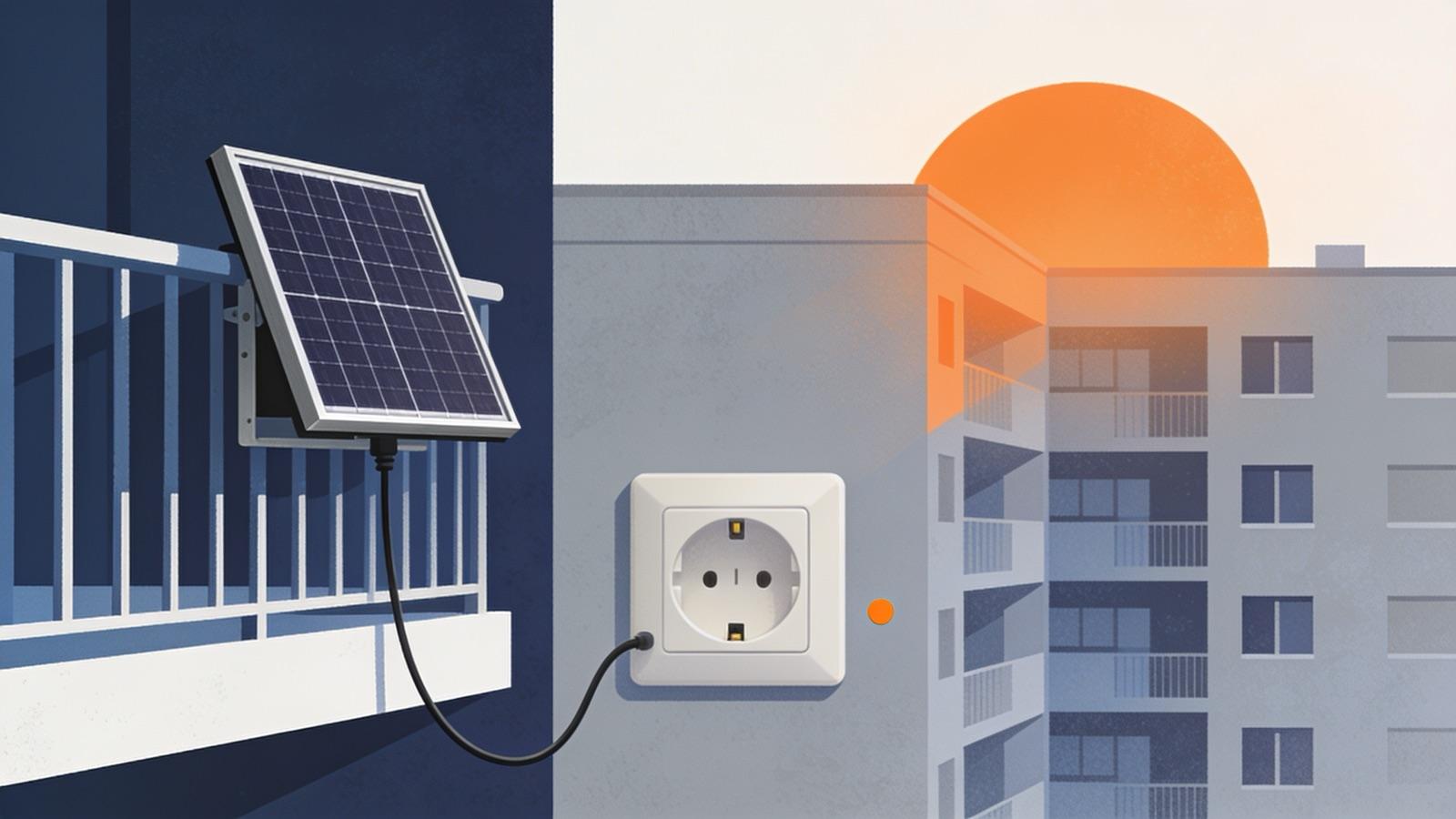
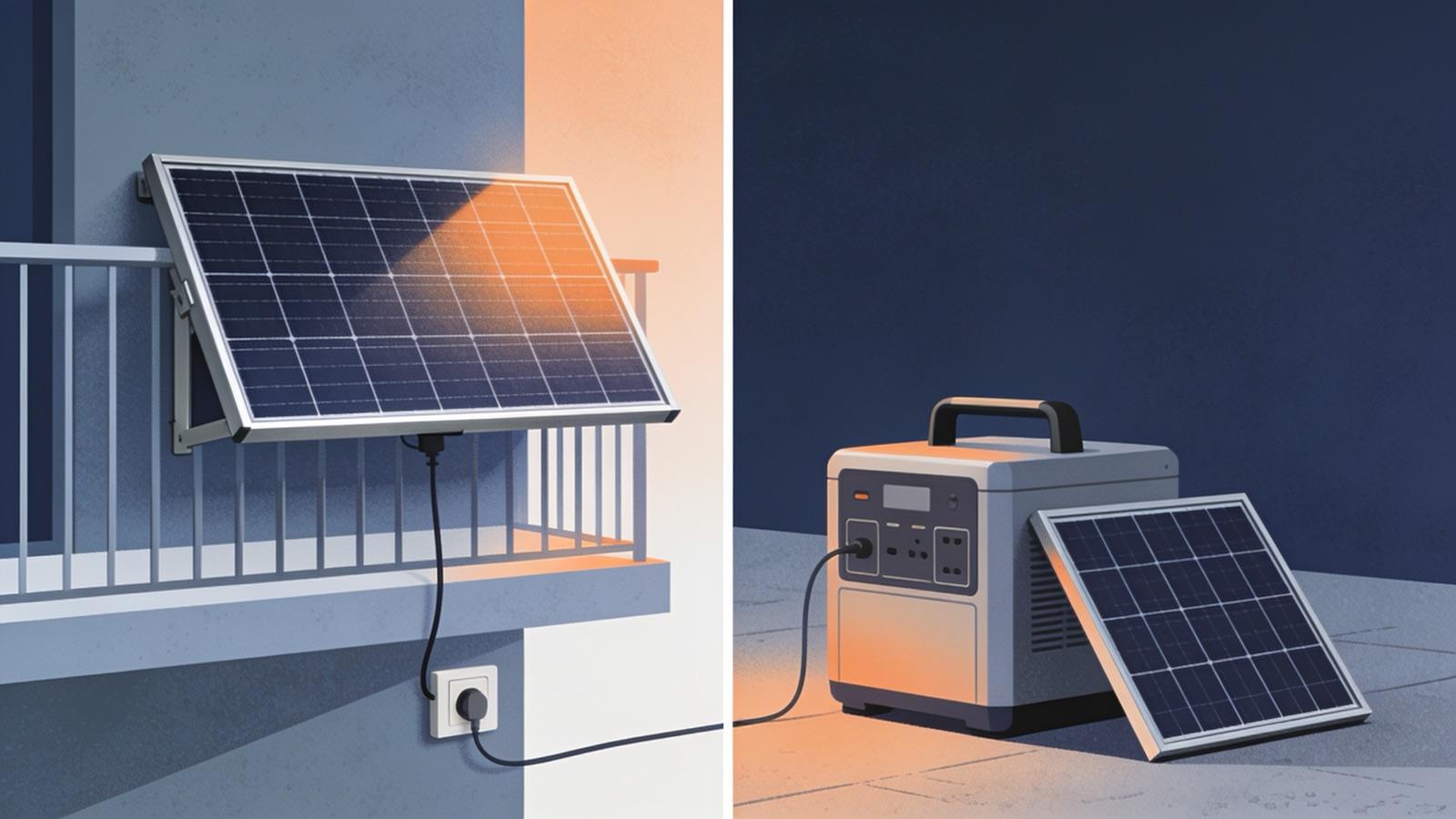
Both come with solar panels and both promise energy independence, and there the resemblance ends. A plug-in solar system is grid-tied infrastructure in miniature: its microinverter synchronizes with the utility waveform and pushes power into your home's wiring, so every lamp and appliance draws solar first without knowing it. A solar generator — the EcoFlow Delta and Jackery Explorer class of products — is a battery in a box with an inverter and outlets: electricity comes out of it only through the devices you physically plug into it, and the grid is irrelevant to its operation.
That single architectural difference — grid-tied versus island — drives every practical consequence that follows: what each does to your bill, what each does in a blackout, what each costs per useful kilowatt-hour, and even what each is legally allowed to do where you live.
| Plug-in solar | Solar generator | |
|---|---|---|
| Core job | Reduce the electricity bill, daily | Portable and backup power, occasionally |
| Feeds home circuits | Yes — automatically, whole home | No — only plugged-in devices |
| During a blackout | Shuts down (anti-islanding, by design) | Fully functional — its best moment |
| Works while you're away | Yes, offsets baseline load | No benefit unless devices are attached |
| Legal framework needed | Yes — grid connection rules apply | None — it never touches the grid |
| Typical cost | $300-2,100 (grid-tied kits) | $500-3,000+ (battery capacity driven) |
| Payback mechanism | Avoided retail electricity, every sunny day | None in normal use — it's insurance and utility |
| Lifespan economics | Inverter warrantied ~10y, panels 20+ | Battery cycles are the consumable |
What plug-in solar does that a generator cannot
Earn, unattended, every day. Because it feeds the home's circuits, a plug-in system offsets the refrigerator at 11 am, the router always, the dishwasher you run at noon — with no behavior change and no cable management. Over a year that is hundreds of kilowatt-hours of avoided retail electricity, which is why plug-in solar has a payback period at all. A solar generator parked in the hallway, fully charged, saves you nothing today: its stored energy only becomes valuable when you route devices through it, and routing your whole kitchen through a box on the floor is not a lifestyle. Owners who buy a generator 'to save on electricity' discover this within a month; the product is simply not shaped for that job.
What a solar generator does that plug-in solar cannot
Exist off-grid — which includes your home during an outage. Plug-in solar must disconnect when the grid goes down: anti-islanding is a certification requirement that protects line workers, so a blackout turns your panels silent precisely when you feel you need them most. A solar generator does not care; it runs the fridge, phones, a CPAP machine or a campsite from its battery and recharges from its panels regardless of what the grid is doing. It is also portable by definition — the same box works at a cabin, a job site, a tailgate. If your actual problem is resilience or mobility rather than the monthly bill, the generator is not the compromise; it is the correct tool.
The hybrids: where the categories are merging
The most interesting products of 2025-2026 sit deliberately between the categories. Balcony-battery systems — EcoFlow's STREAM Ultra, Jackery's Navi 2000, BLUETTI's Balco line — are grid-tied like plug-in solar (they export to your circuits and cut the bill daily) while carrying a real battery that stores midday surplus for the evening, and most offer some off-grid capability through dedicated outlets or backup modes. The trade-offs: price (battery capacity is what you pay for — divide price by usable kWh before buying, as our costs guide shows), weight (large units approach 50 kg; nothing about them is portable), and measured round-trip losses under real household loads. For a household that wants both daily savings and genuine outage cover, one well-chosen hybrid now beats owning one of each — a genuinely new answer that did not exist three years ago.
A decision framework in four questions
- Is the monthly bill your problem? Plug-in solar. It is the only option of the two with a payback period.
- Are outages or off-grid use your problem? Solar generator. Plug-in solar is legally required to fail exactly then.
- Both, with one budget? A balcony-battery hybrid — judged on price per usable kWh and honest efficiency, not marketing coverage claims.
- Neither balcony sun nor outage risk? Neither product. A battery on a cheap overnight tariff, or nothing, beats forcing the wrong tool.
Frequently asked questions
Can a solar generator power my house?
Only the devices you plug into it, and only until its battery empties. It does not feed your home's wiring — that is precisely what distinguishes it from plug-in solar. Whole-home backup requires either a transfer-switch installation (a different, electrician-grade project) or accepting extension cords to the loads that matter during an outage.
Why does plug-in solar stop working during a blackout?
By design and by law. Grid-tie inverters must stop exporting within roughly two seconds of losing the grid — anti-islanding — so they cannot energize a line a utility worker believes is dead. It is a safety feature, not a defect. If outage performance matters to you, that is the signal to look at solar generators or hybrid balcony-battery systems with a backup outlet.
Is a solar generator worth it for daily electricity savings?
No. Its stored energy only offsets your bill if you run devices through the box, its cost per stored kilowatt-hour is far higher than grid-tied solar's cost per generated one, and daily cycling consumes the battery life you bought it for. Buy it for backup and mobility — the jobs it is shaped for — and buy plug-in solar for the bill.
Can I connect a solar generator's panels to a plug-in inverter (or vice versa)?
Check voltages before any mixing. Panels are broadly interchangeable DC sources if connector type, voltage and current fit the input specs — but generator-branded panels often use proprietary connectors, and microinverters cap input voltage (commonly 55-60 V) that series-wired portable panels can exceed, fatally. Match specs on paper first; when in doubt, keep each system's panels with its own electronics.
Do hybrids like the STREAM Ultra or Navi 2000 replace both products?
For a stationary household: increasingly yes — they export to your circuits daily like plug-in solar and hold a reserve with backup capability like a generator. What they do not replace is portability (large units weigh tens of kilograms) and they must be judged on battery price per usable kWh plus real-world efficiency, where independent tests show meaningful differences between brands.
Check your location
Framework status and exact product eligibility are separate checks.
The best plug-in solar kits of 2026, ranked
Now you know how it works — here are the kits we track, compared by configuration, AC output, verified price and certification evidence.
| Product | Exact configuration | Output | Panels / storage | Verified offer | Availability | UL 3700 evidence |
|---|---|---|---|---|---|---|
| EcoFlow STREAM Microinverter | STREAM Microinverter — bare unit | 1,200 W grid-tie | Not included | $299 · USD | UT · region only | not-verified |
| EcoFlow STREAM Ultra + Microinverter | STREAM Ultra + STREAM Microinverter | 1,200 W grid / 800 W hardware | 1,920 Wh | $1,459 · USD | UT · region only | not-verified |
| CraftStrom 400 Watt Plug&Play Solar | 400 W Eco-Line kit | 350 W grid / 400 W hardware | 2 panels | $499 · USD | US · in stock | not-verified |
| CraftStrom 800 Watt Plug&Play Solar | 800 W complete kit | 700 W grid / 800 W hardware | 4 panels | $2,031 · USD | US · in stock | not-verified |
| CraftStrom 1600 Watt Eco-Line Plug&Play Solar | 1600 W Eco-Line kit | 1,400 W grid / 1,600 W hardware | 8 panels | $3,187.5 · USD | US · in stock | not-verified |
| Bright Saver Flex180 single-panel kit | Flex180 single-panel kit | 180 W grid-tie | 1 panels | $399 · USD | US · in stock | not-verified |
| Plug In Solar Utah 3 Panel EcoFlow STREAM Kit | 3-panel EcoFlow STREAM kit | 1,200 W grid-tie | 3 panels | $1,299 · USD | UT · region only | not-verified |