Balcony Solar: The Complete Guide
The physics and practice of solar on a balcony — orientation, tilt, wind loads, honest yields and the legal map.

WattRank is reader-supported: we may earn a commission if you buy through links in this guide. This never affects our rankings.
Key facts
- Germany, the reference market, counts about 1 million registered and an estimated 4 million installed balcony systems (CESA).
- Direction rules of thumb: south = reference yield; east or west ≈ 70-80% of it; north = honest disqualifier.
- Vertical railing mounting typically costs 25-35% of annual yield versus a 20-35° tilt — but performs relatively better in winter's low sun.
- Wind load rises with height and exposure: manufacturer-rated mounts and post-storm re-torque checks are the two habits that prevent the one serious failure mode.
What counts as balcony solar
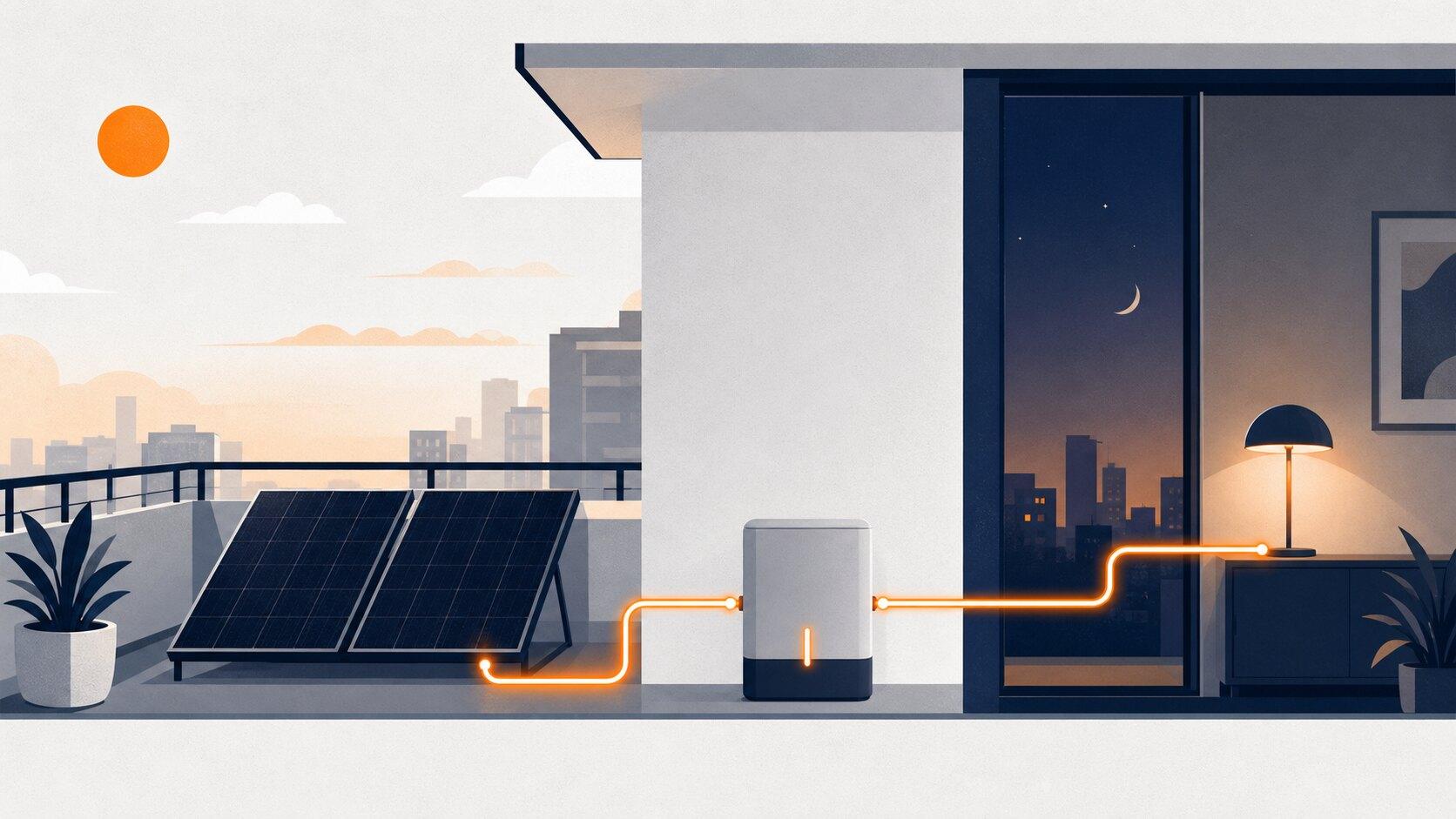
Balcony solar — Balkonkraftwerk in German, the language that named the category — is a small grid-tied photovoltaic system mounted on or beside a balcony and connected through a household outlet. The working parts: one to four panels (usually 350-500 W each), a microinverter that converts their DC output to grid-synchronized AC, mounting hardware for a railing or floor stand, and optionally a compact battery. It is a subset of plug-in solar; what distinguishes it is the setting, and the setting is where all the practical decisions live.
The category's scale still surprises people outside Germany: roughly a million registered systems there, with credible estimates around four million installed, plus fast-growing markets across Europe and the first legal US states. That scale matters to a buyer because it means the hardware is mature — the open questions on a given balcony are physical (sun, wind, mounting) and legal (framework, consent), not technological.
Orientation: the decision already made for you
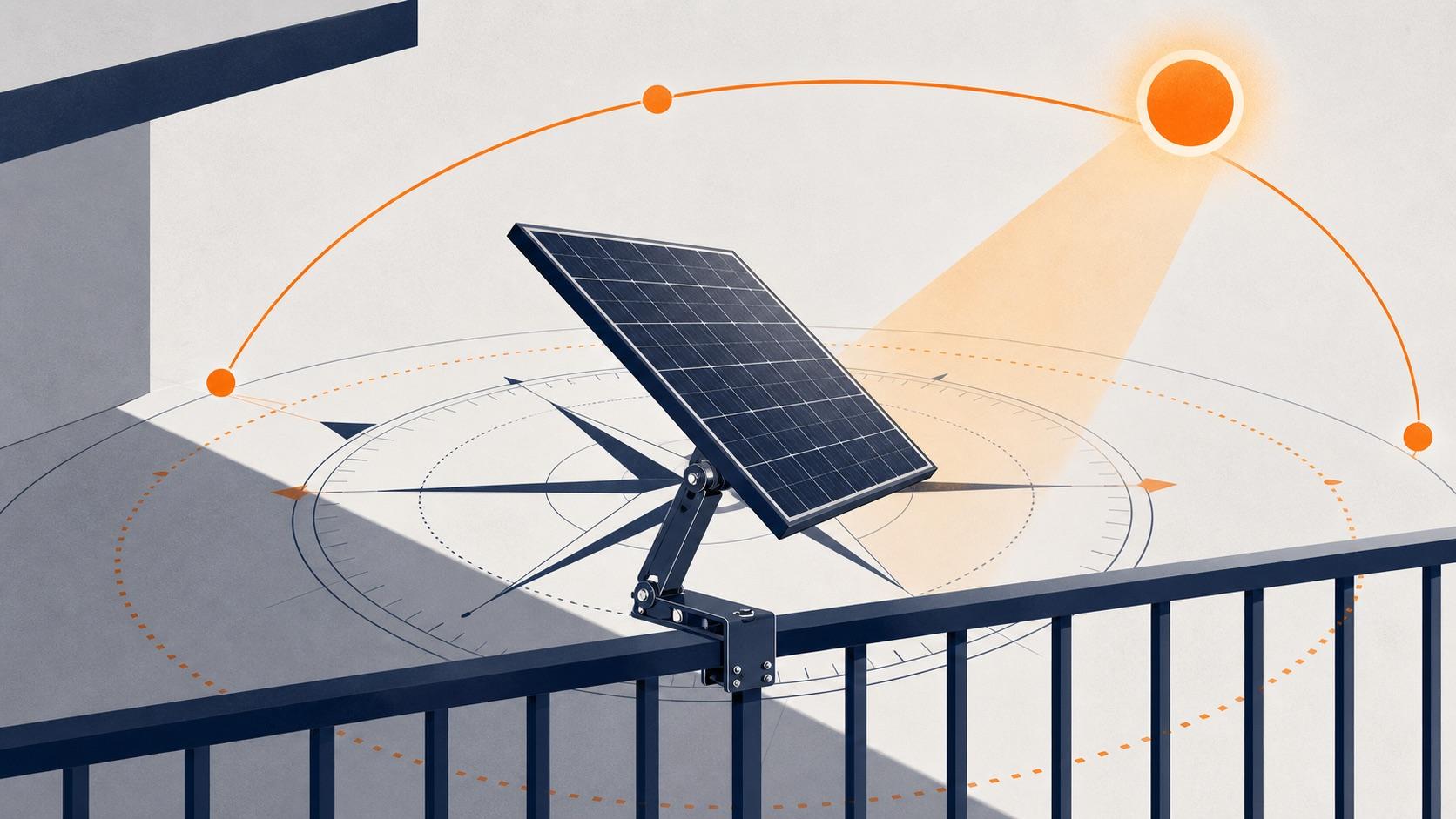
Your balcony faces where it faces, so orientation is less a choice than a diagnosis. South-facing with open sky is the reference case every yield claim assumes. East- or west-facing balconies deliver roughly 70-80% of that annual yield — and the loss is smaller in practice than on paper, because an east balcony produces during morning routines and a west balcony during the evening peak, when homes actually consume. Self-consumption, not gross yield, is what pays; a west-facing panel feeding a real evening load can beat a south-facing one whose midday surplus exports for free.
North-facing balconies (in the northern hemisphere) are an honest disqualifier for generation, and shade is the other one. Before buying, watch the balcony across a sunny day: a railing shaded after 2 pm, a tree that leafs out in May, the building opposite in winter's low sun — each takes a bite no spec sheet shows. Microinverters with per-panel MPPT handle partial shade gracefully, but they mitigate the loss; they do not repeal it. Four honest hours of direct sun is a reasonable floor for the project to make sense.
Tilt: flat against the railing, or angled?
The classic balcony dilemma. Panels hung vertically against the railing look tidy, present less wind surface and rarely bother a landlord — and they cost you roughly 25-35% of annual yield versus panels tilted at 20-35°, because the summer sun stands high overhead and strikes a vertical panel at a glancing angle. The counterpoint: in winter, when the sun hangs low, vertical panels face it almost squarely, so their production holds up relatively better exactly when grid electricity is dearest in many markets. Bifacial panels — increasingly common in balcony kits — sweeten the vertical case further by harvesting light reflected off the building.
The pragmatic ranking: a modest tilt (even 15-20°) captures most of the tilted advantage while keeping wind loads and visual bulk manageable; full vertical is the compromise for strict aesthetics, glass balustrades, or high floors where wind rules; steep tilts belong on floor stands and terraces, not railings. Whatever you choose, choose it with the mount's rating — improvising an angle a bracket was not designed for is how panels meet sidewalks.
Wind: the force that sizes your hardware
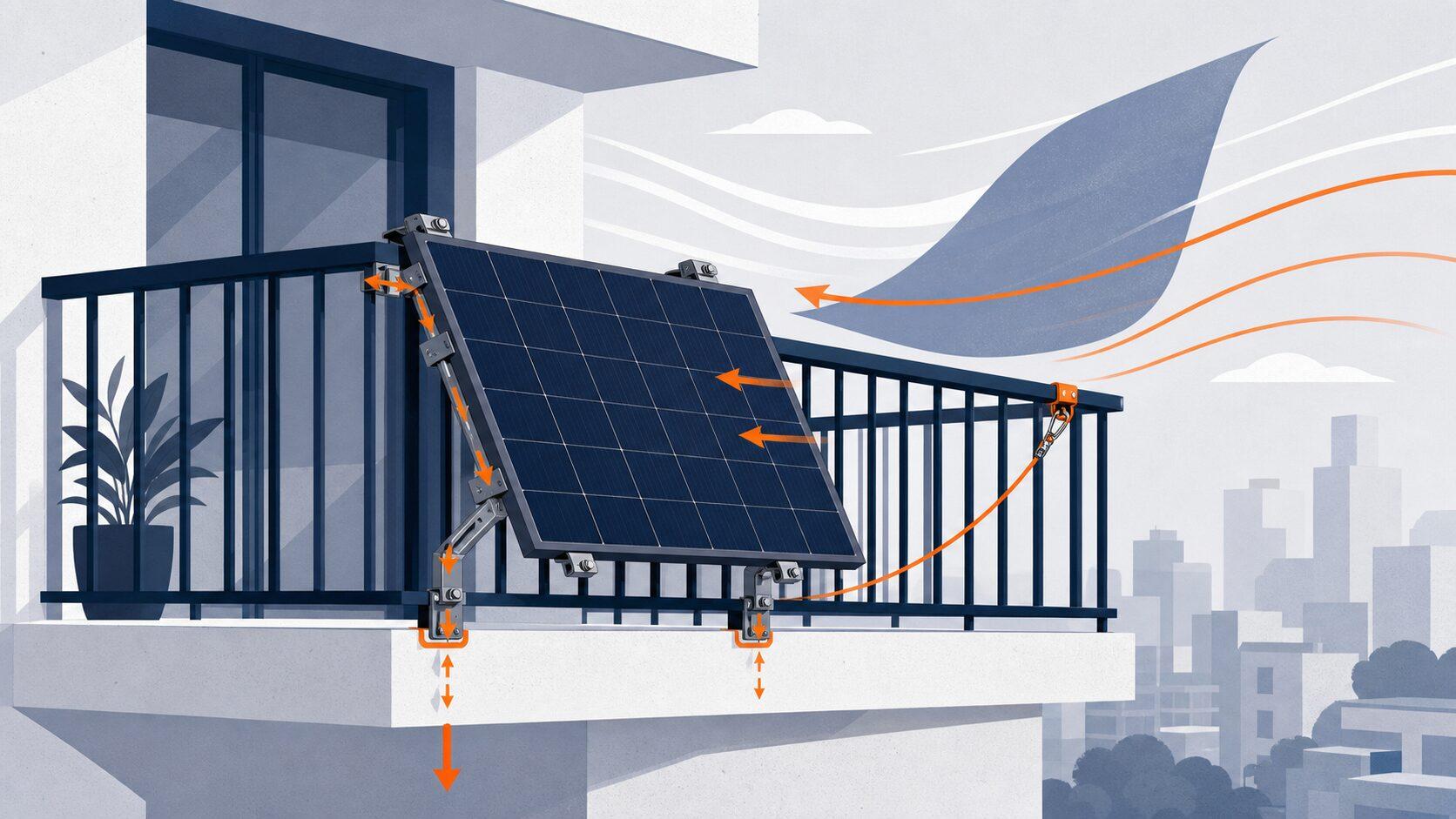
A panel is a rigid sail, and wind load grows with the square of wind speed — which itself rises with height and exposure. A fifth-floor corner balcony in open terrain lives in a different mechanical world from a second-floor courtyard, and mounting hardware is rated accordingly. Use the manufacturer's mount for your railing type, respect its stated tilt and height limits, add ballast where the design calls for it, and never let the mount's grip depend on a component the railing was not built to load. Then adopt the one maintenance habit this category needs: re-check every clamp after the first storm and at season changes. Five minutes with a hex key, twice a year, retires the only failure mode that can hurt someone.
Sizing and what to expect back
European frameworks cluster around 800 W of inverter output, and US state caps land in a similar band (Utah's reaches 1,200 W) — but your real target is the home's daytime baseline, typically 100-300 W in an apartment. Two panels on a decent south or west balcony produce on the order of 600-900 kWh per year in central-European conditions (measured owner logs bear this out); your latitude, direction and tilt scale that number. Self-consumed, that offsets electricity at full retail price; exported, it earns little or nothing in most plug-in frameworks. Size for the load you actually run while the sun shines, and let the savings calculator translate your numbers into a payback figure before any purchase.
Where balcony solar is allowed in 2026
The legal map moves fast; the current shape: Germany is the mature framework (800 W, simple registration, tenant-friendly law), with much of the EU following its pattern. Great Britain's SI 2026/848 is made and creates a solar-only standard-socket route from 27 August 2026, while application of the final specification in Northern Ireland is not yet confirmed. In the US, the first state frameworks are live — Utah, Maine, Maryland and Vermont effective, more signed and pending — each with its own cap and conditions. Our country and state pages track the specifics, and the legal checker turns your location into a concrete answer; treat both as the first step of any purchase, because everything else in this guide assumes connection is permitted where you live.
A worked example: sizing one real balcony
Abstract rules become a decision when you run one concrete case, so here is a typical one. A southwest-facing balcony with 3.2 m of usable railing on a third floor, in a central-European climate, in a two-person apartment with a 180 W daytime baseline (refrigerator, router, two laptops on chargers). The railing hosts two 430 W bifacial panels mounted near-vertically with rated clamps — 860 Wp of capacity feeding a microinverter capped at 800 W output.
Expectation-setting from measured comparables: vertical southwest mounting in that climate yields on the order of 550-700 kWh per year. Of that, a 180 W baseline with some daytime cooking and laundry absorbs roughly 70-80% — call it 450-520 kWh self-consumed. At 30 cents/kWh the system avoids €135-155 of electricity annually; against a €500-700 quality-kit price, payback lands in the 4-5 year range, inside the inverter warranty with margin. Run the same case with your numbers in the savings calculator — the structure of the calculation is the takeaway, not the specific euros.
Note what the example did not do: chase the 800 W cap with a third panel (the baseline cannot absorb it, so the marginal panel mostly exports for free), tilt the panels into the wind for a few extra percent (the mount rating and the landlord conversation both prefer vertical), or add a battery on day one (measure the actual midday surplus for a season first — the costs guide shows the per-kWh math that decision needs).
Month by month: what a year really looks like
Annual figures hide a seasonal swing that shapes how ownership feels. In central and northern Europe, December and January each contribute only a few percent of annual yield — one UK owner measured 30 kWh in a dark January, a tenth of a good summer month — while May through August together deliver roughly half the year's production. Vertical railing mounting softens the winter trough slightly because low winter sun strikes upright panels more squarely; nothing removes it.
| Season | Share of annual yield (typical, central Europe) | What it means in practice |
|---|---|---|
| Winter (Dec-Feb) | ~10-15% | Expect single-digit monthly output; savings feel invisible |
| Spring (Mar-May) | ~30% | Production ramps fast; good season for commissioning and tuning |
| Summer (Jun-Aug) | ~35-40% | Peak months; surplus beyond baseline exports unless a battery shifts it |
| Autumn (Sep-Nov) | ~20% | Honest shoulder season; a good preview of your year-round average |
Plan cash-flow expectations on the year, not the month — and if you commission in autumn or winter, resist judging the purchase until spring. The measured three-year logs in our costs guide all show the same shape: unremarkable winters, emphatic summers, and an annual total that lands close to forecast when the siting was honest.
Frequently asked questions
How much power does balcony solar actually produce?
Two panels on a decently oriented balcony produce roughly 600-900 kWh per year in central-European conditions — measured owner data, not brochure figures. South-facing tilted panels set the ceiling; east/west costs 20-30%; vertical mounting another 25-35%. Your latitude and shade situation scale everything, which is why an honest day of observing your balcony beats any calculator default.
Is vertical mounting against the railing a mistake?
No — it is a trade. Vertical panels lose roughly a quarter to a third of annual yield versus tilted ones because high summer sun strikes them at a glancing angle, but they hold up relatively better in winter, present less wind surface, and pass landlord scrutiny more easily. Bifacial panels narrow the gap. If aesthetics or wind rules force vertical, the project usually still works; just run the numbers with the penalty included.
How many panels fit a normal balcony?
Practically, one to three: a standard panel runs about 1.7-1.9 m long, and a typical railing hosts two comfortably. Frameworks cap inverter output (commonly 800 W) rather than panel count, so some kits over-panel — more DC capacity than the inverter's AC limit — to fatten morning, evening and winter production. That is legitimate design, not a spec error.
Do I need permission for balcony solar?
Two permissions, from different authorities: the electrical framework where you live (state or country rules — check the legal pathway tool), and the property owner's consent for anything mounted on a railing or façade if you rent or share a building. Germany gives tenants a legal presumption in their favor; everywhere else, get it in writing before buying hardware.
What happens in winter?
Production drops hard — northern-latitude winters can deliver a tenth of a summer month (one UK January measured 30 kWh). Vertical panels soften the blow slightly by facing the low sun squarely. Payback math built on annual yields already includes winter; your expectations should too. If winter savings matter most to you, a battery charged on cheap overnight tariffs complements the panels better than more panels do.
Balcony solar vs rooftop solar — which should I choose?
If you own a suitable roof and plan to stay, rooftop wins on scale and cost per kilowatt-hour. Balcony solar wins everywhere rooftop is impossible: rentals, apartments, condos, and anyone unwilling to spend five figures. They are not competitors so much as different answers to different housing situations — and balcony systems move with you.
Check your location
Framework status and exact product eligibility are separate checks.
The best plug-in solar kits of 2026, ranked
Now you know how it works — here are the kits we track, compared by configuration, AC output, verified price and certification evidence.
| Product | Exact configuration | Output | Panels / storage | Verified offer | Availability | UL 3700 evidence |
|---|---|---|---|---|---|---|
| EcoFlow STREAM Microinverter | STREAM Microinverter — bare unit | 1,200 W grid-tie | Not included | $299 · USD | UT · region only | not-verified |
| EcoFlow STREAM Ultra + Microinverter | STREAM Ultra + STREAM Microinverter | 1,200 W grid / 800 W hardware | 1,920 Wh | $1,459 · USD | UT · region only | not-verified |
| CraftStrom 400 Watt Plug&Play Solar | 400 W Eco-Line kit | 350 W grid / 400 W hardware | 2 panels | $499 · USD | US · in stock | not-verified |
| CraftStrom 800 Watt Plug&Play Solar | 800 W complete kit | 700 W grid / 800 W hardware | 4 panels | $2,031 · USD | US · in stock | not-verified |
| CraftStrom 1600 Watt Eco-Line Plug&Play Solar | 1600 W Eco-Line kit | 1,400 W grid / 1,600 W hardware | 8 panels | $3,187.5 · USD | US · in stock | not-verified |
| Bright Saver Flex180 single-panel kit | Flex180 single-panel kit | 180 W grid-tie | 1 panels | $399 · USD | US · in stock | not-verified |
| Plug In Solar Utah 3 Panel EcoFlow STREAM Kit | 3-panel EcoFlow STREAM kit | 1,200 W grid-tie | 3 panels | $1,299 · USD | UT · region only | not-verified |