Plug-In Solar for Apartments and Renters
The renter's playbook: written consent, clamp mounts, portability when you move, and sizing for a real apartment load.

WattRank is reader-supported: we may earn a commission if you buy through links in this guide. This never affects our rankings.
Key facts
- Plug-in systems are removable personal property in most jurisdictions — they move with the tenant, unlike rooftop installations that attach to the building.
- Written landlord/freeholder consent is a separate requirement from electrical legality: state solar laws do not override leases, HOA rules or façade regulations.
- Germany strengthened tenants' rights in 2024: balcony solar is now a 'privileged modification' landlords can only refuse for substantial reasons.
- A typical apartment's daytime baseline (fridge, router, standby) is 100-300 W — one or two panels cover most of it; oversizing wastes money where export is uncompensated.
Why this category was built for renters
Every other form of home solar assumes you own the roof. Plug-in solar assumes the opposite: it was designed around the constraints of tenancy. The mounting hardware clamps to a railing or leans on a stand rather than penetrating the building. The electrical connection is a plug in an outlet you already have, not wiring an electrician must alter. And when the lease ends, the whole system unbolts in an hour and moves to the next address — in most jurisdictions it is personal property, like a washing machine, not a fixture that attaches to the building.
Germany proved the model at scale. The overwhelming majority of its millions of Balkonkraftwerke hang on rented balconies, and in 2024 German law went further, classifying balcony solar as a 'privileged modification' (privilegierte Maßnahme) that landlords may only refuse for substantial reasons — a legal presumption in the tenant's favor. No English-speaking market gives renters that presumption yet, which makes the consent process below the renter's real installation manual.
Consent: the part you cannot skip
A state plug-in solar law makes the electrical connection legal; it says nothing about your right to alter the property. Those are separate permissions from separate authorities, and conflating them is the most common renter mistake. Before buying anything, get written consent from the landlord or property manager for the specific installation: what mounts where, on which railing, with which hardware. In condominiums and HOA communities, check the rules for balconies and façades — visible exterior changes are exactly what such rules regulate. Leaseholders in the UK may need freeholder or managing-agent approval, and listed buildings and conservation areas add planning constraints.
Make the request easy to approve. A one-page note with the product page, the mounting method (emphasize: no drilling, no penetration, reversible, no guardrail modification), the kit's certification evidence and your renter's insurance details answers the questions a cautious landlord would ask. Frame removal explicitly — 'the system leaves with me, the railing is untouched' — because reversibility is usually the deciding factor. A landlord who understands the building is not being altered approves far more often than one imagining a construction project.
Mounting without drilling
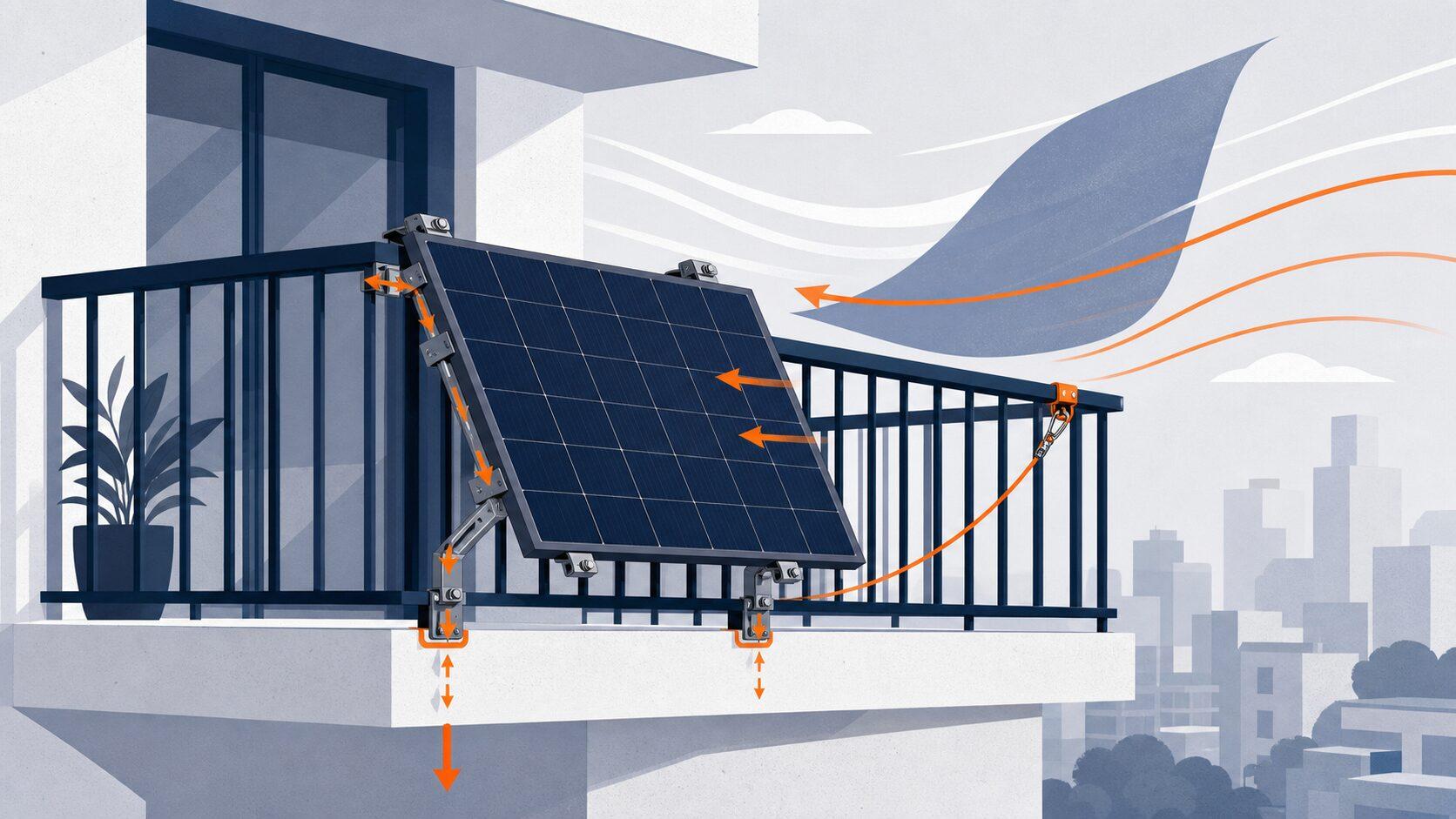
Renter-appropriate mounting comes in three patterns. Railing clamps grip a balustrade between padded jaws — the standard German approach, strong, and completely reversible; verify the clamp is rated for your railing type (round bar, flat bar, glass panels need different hardware) and your floor's wind exposure. Freestanding tilt stands sit on the balcony floor or a terrace with ballast weight holding them down — zero contact with the structure, ideal where even clamping feels contentious, at the cost of floor space. And flexible or lightweight panels can hang against a railing's inner face with straps on some products — the least invasive and least productive option, useful when nothing else is permitted.
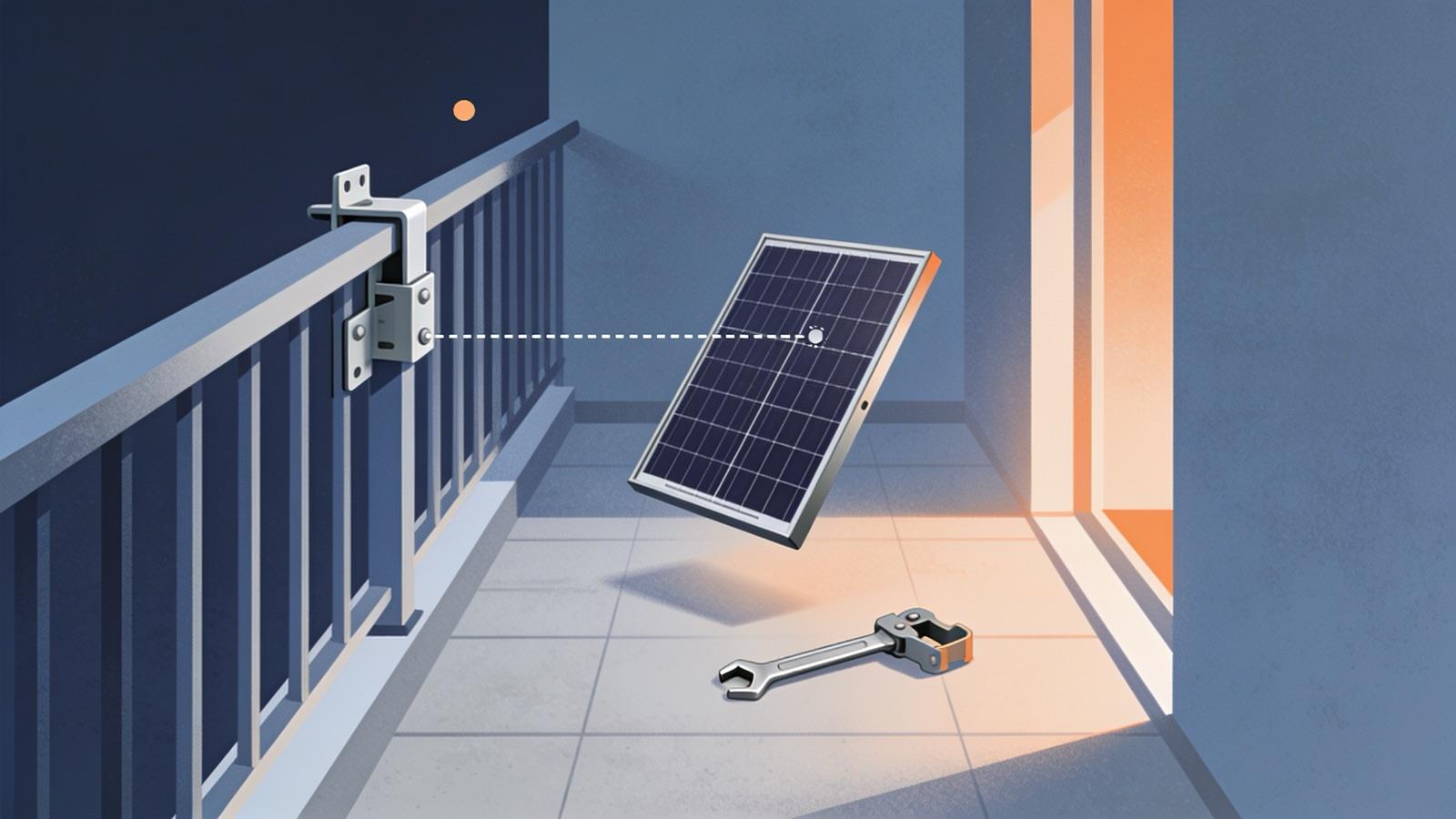
Whatever the pattern, the safety rules from our installation guide apply with extra force at height: manufacturer-rated hardware only, no improvised attachments, nothing that loads a guardrail beyond its design, nothing blocking an escape route, and a re-torque check after the first storm. A falling panel is the one failure mode that turns a money-saving gadget into a liability — treat the drop below your balcony with the respect it deserves.
Sizing for an apartment, honestly
Apartments have smaller baseline loads than houses, and that changes the buying math. While the sun is up, a typical apartment draws a steady 100-300 W — refrigerator, router, standby electronics, maybe a home-office setup. Solar you produce beyond what the home consumes in real time exports to the grid, and in most plug-in frameworks that export earns nothing. One or two panels (400-800 W of capacity, which produce far less than nameplate most of the day) cover a real apartment baseline surprisingly well; a maxed-out system on a small flat mostly donates electricity to the utility.
Balcony orientation sets your ceiling. South-facing with sky view is the reference case; east or west costs roughly a quarter to a third of annual yield but matches morning or evening usage patterns; north-facing or heavily shaded balconies are honest disqualifiers — no hardware overcomes geometry. Vertical rail-mounting (panels flat against the railing) costs another meaningful fraction versus tilted mounting, though it performs relatively better in winter when the sun is low. If your only option is a shaded north balcony, the better renter move is a battery that charges on cheap overnight tariffs — or patience.
Moving day: the renter's superpower
The economics of renter solar include a variable homeowners never think about: the system's second and third address. A clamp-mounted kit unbolts, boxes and reinstalls in an afternoon, so its payback clock keeps running across tenancies. Two practical notes protect that value. Keep the original packaging for the panels — they are the awkward item in a move, and foam corners matter. And before signing the next lease, look at the balcony with solar eyes: orientation, railing type, outlet within cable reach. Renters who plan to carry a system forward effectively add 'south-facing balcony' to their apartment-hunting criteria, which costs nothing and can be worth years of payback.
Battery-integrated systems deserve a special renter note: products in the balcony-battery class are heavy (up to 50 kg for large units). They move like appliances, not like panels — fine for a van move, miserable for a walk-up. If you relocate often, a light grid-tied kit is the portable choice; add storage when you settle.
Frequently asked questions
Can renters install plug-in solar?
Yes — it is the first solar category designed for tenancy: clamp or stand mounting without drilling, an ordinary plug connection, and full removability when you move. The requirements are written landlord consent for the exterior mounting, a legal pathway where you live, and a balcony that actually sees sun. Germany's market — millions of systems, mostly on rented balconies — is the proof.
Do I need my landlord's permission for balcony solar?
For anything mounted on a railing, façade or shared structure: yes, in writing, and separately from electrical legality. State solar laws do not override leases or HOA rules. Requests that emphasize no-drill reversible mounting, certified equipment and complete removal at move-out get approved most often. Germany is the exception that proves the rule — its 2024 law created a presumption in the tenant's favor.
What size solar kit makes sense for an apartment?
Match your daytime baseline, not the biggest cap you're allowed: a typical apartment draws 100-300 W while the sun is up, which one or two panels cover well. Beyond that, uncompensated export eats the return. A small, well-oriented system beats a large, half-wasted one in payback terms almost every time.
Can I take my plug-in solar system when I move?
Yes — it is personal property in most jurisdictions, like an appliance. Clamp-mounted grid-tied kits unbolt and reinstall in an afternoon; keep the panel packaging for the move. Heavy battery-integrated units (some approach 50 kg) move like appliances rather than panels. Renters who expect to move should weigh portability as a real specification when choosing hardware.
My balcony faces north or sits in shade — is there any point?
For solar generation, no — orientation is physics no product overcomes, and an honest disqualification saves you money. Two alternatives still work at a rented address: a battery charged on cheap overnight tariffs (which earns arbitrage savings with zero sun), or waiting for the next apartment and choosing it with a solar-ready balcony in mind.
Does balcony solar raise issues with renter's insurance?
Usually it is straightforward, but tell your insurer: a mounted exterior object at height is exactly the kind of fact policies want declared. Liability cover for a falling object matters more than cover for the panel itself. Some landlords ask for proof of liability insurance as a consent condition — having it ready speeds the approval.
Check your location
Framework status and exact product eligibility are separate checks.
The best plug-in solar kits of 2026, ranked
Now you know how it works — here are the kits we track, compared by configuration, AC output, verified price and certification evidence.
| Product | Exact configuration | Output | Panels / storage | Verified offer | Availability | UL 3700 evidence |
|---|---|---|---|---|---|---|
| EcoFlow STREAM Microinverter | STREAM Microinverter — bare unit | 1,200 W grid-tie | Not included | $299 · USD | UT · region only | not-verified |
| EcoFlow STREAM Ultra + Microinverter | STREAM Ultra + STREAM Microinverter | 1,200 W grid / 800 W hardware | 1,920 Wh | $1,459 · USD | UT · region only | not-verified |
| CraftStrom 400 Watt Plug&Play Solar | 400 W Eco-Line kit | 350 W grid / 400 W hardware | 2 panels | $499 · USD | US · in stock | not-verified |
| CraftStrom 800 Watt Plug&Play Solar | 800 W complete kit | 700 W grid / 800 W hardware | 4 panels | $2,031 · USD | US · in stock | not-verified |
| CraftStrom 1600 Watt Eco-Line Plug&Play Solar | 1600 W Eco-Line kit | 1,400 W grid / 1,600 W hardware | 8 panels | $3,187.5 · USD | US · in stock | not-verified |
| Bright Saver Flex180 single-panel kit | Flex180 single-panel kit | 180 W grid-tie | 1 panels | $399 · USD | US · in stock | not-verified |
| Plug In Solar Utah 3 Panel EcoFlow STREAM Kit | 3-panel EcoFlow STREAM kit | 1,200 W grid-tie | 3 panels | $1,299 · USD | UT · region only | not-verified |