Does Plug-In Solar Need a Dedicated Circuit?
A safety-first decision method for plug-in solar circuits, breaker masking, system protection and market-specific connection rules.

WattRank is reader-supported: we may earn a commission if you buy through links in this guide. This never affects our rankings.
Key facts
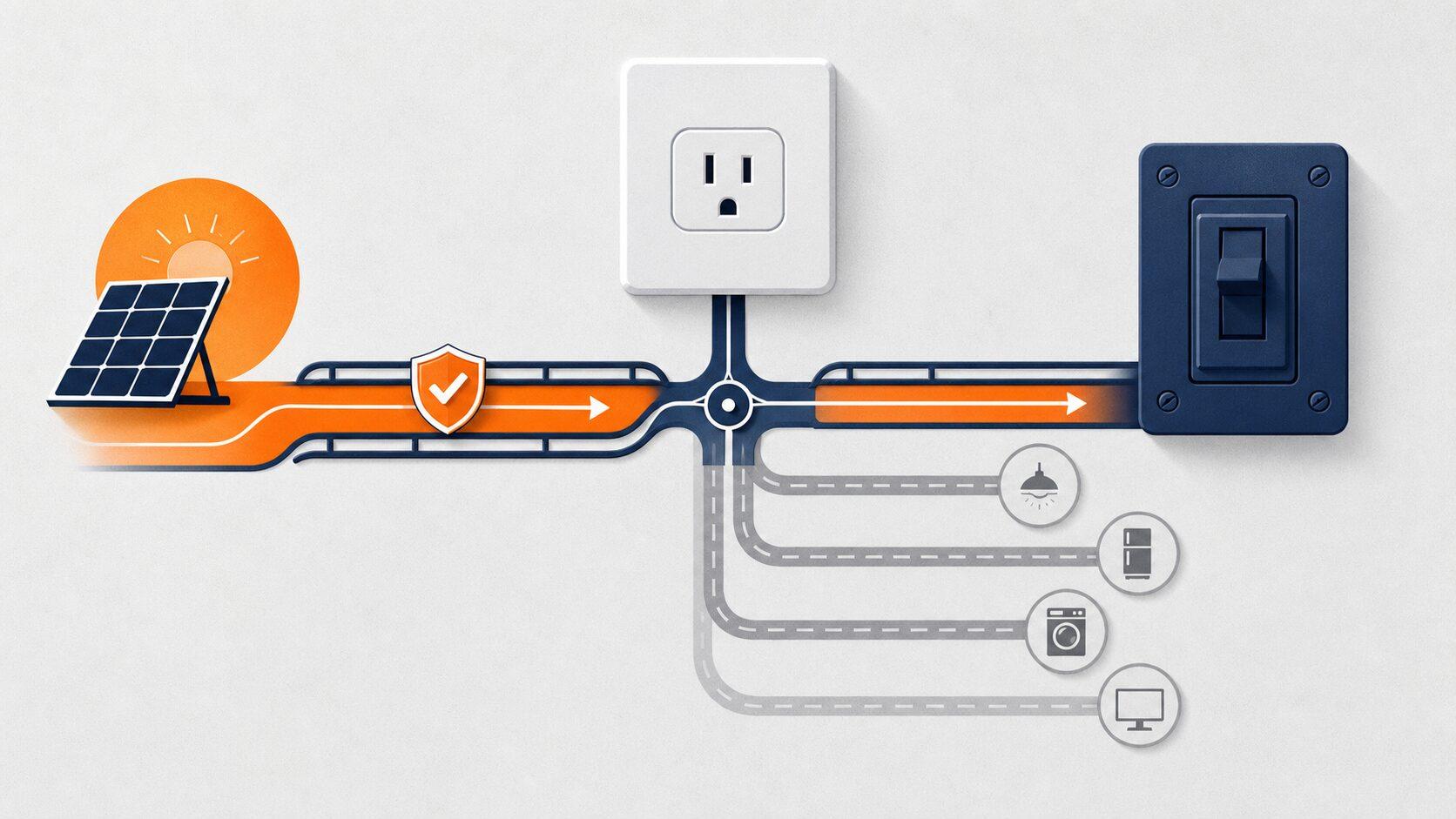
- A dedicated circuit is identified at the protective device and wiring—not by whether an outlet happens to be unused.
- UL Solutions identifies dedicated circuits, integrated overcurrent protection and power control systems as different ways to control branch-circuit overload risk.
- At nominal voltage, 800 W corresponds to about 6.7 A at 120 V but 3.5 A at 230 V; rules from one voltage system do not transfer automatically.
- Maine permits up to 420 W AC per service address under one tier; above 420 W and up to 1,200 W, state law requires a licensed electrician and a dedicated circuit with a single outlet.
- Germany's current DIN VDE V 0126-95 product pathway reaches 800 VA AC, while separate installation rules govern final-circuit conductor protection.
Does your plug-in solar system need its own circuit?
Use a dedicated circuit when the law, utility pathway, product certification, installation manual or qualified design requires one. Do not replace that instruction with a lower output setting or a promise to avoid using nearby sockets. Conversely, do not assume every compliant plug-in system worldwide needs new wiring: some frameworks permit a protected shared final circuit when the complete product and installation method address the same electrical risks.
The correct answer belongs to the complete configuration: jurisdiction, AC output, nominal voltage, exact product, protection architecture, plug and receptacle, branch-circuit layout and condition. Panel watts alone cannot answer it. A panel-only package or portable solar generator also falls outside this decision because neither is permission to feed AC into fixed household wiring.
| What the evidence says | Circuit decision | Next action |
|---|---|---|
| Law or utility says dedicated circuit with one outlet | Required | Use the named connection and qualified installer if required |
| System instructions specify dedicated circuit | Required for that system | Do not substitute a shared outlet or adapter |
| Approved product explicitly supports a shared circuit with integrated protection | Potentially allowed | Verify the exact listing, output and local pathway |
| Only the outlet is known; circuit map or protection is unknown | Not established | Pause and have the circuit identified |
| No current framework covers the system or connection | Research required | Ask the authority or utility; do not infer permission from the plug |
What does “dedicated circuit” actually mean?
A branch or final circuit begins at its overcurrent protective device and supplies wiring downstream. In ordinary conversation, a “dedicated outlet” may mean a receptacle no one else is using. Electrically, that is not enough. Other receptacles, lights or fixed loads can share the same breaker even when they are in another room, garage or exterior wall. A circuit is dedicated only when its documented wiring and protective arrangement serve the permitted plug-in solar connection and no disallowed loads.
Requirements can be narrower still. Maine's higher-output tier specifies a dedicated circuit with a single outlet. UL Solutions describes a dedicated-circuit strategy paired with a unique plug-in PV receptacle so the product cannot simply be moved to an ordinary shared circuit. Read the exact wording: “dedicated circuit,” “individual branch circuit,” “single outlet,” “unique receptacle” and “one device per circuit” are related ideas, not interchangeable labels.
| Observation | What it proves | What it does not prove |
|---|---|---|
| Nothing else is plugged into the same duplex outlet | Only that receptacle is presently unused | No other outlets or fixed loads share the breaker |
| Breaker label says “patio” or “garage” | The panel has an intended description | The label is complete, current or correct |
| Other sockets turn off with the same breaker | They share that protective device | The circuit is dedicated |
| A separate breaker feeds one verified receptacle | Strong evidence of a dedicated branch | That its rating, wiring, GFCI/AFCI or RCD protection suits the product |
| The inverter app limits output | A configured operating ceiling | A certified branch-circuit protection function |
Why can backfeed hide an overload from the breaker?
A conventional circuit breaker measures current arriving from the panel. Plug-in PV adds a second source downstream. UL Solutions explains that utility current and inverter current can combine on part of a shared branch circuit, allowing conductors or connections to carry more current than the breaker sees. The breaker can therefore remain below its trip value while a downstream segment supplies a larger group of loads. This is often called breaker masking or an undetected conductor overload.
The simplified example below shows the logic, not a wiring design. Imagine loads drawing 18 A on a circuit segment while a plug-in inverter contributes 5 A from downstream. The panel supplies the remaining 13 A, so a 15 A breaker can see 13 A even though the load-side segment carries 18 A. Actual current directions depend on the locations of every source, splice and load; only a circuit assessment can establish the real case.
| Illustrative quantity | Current | What the panel breaker sees |
|---|---|---|
| Combined downstream loads | 18 A | Not necessarily the full 18 A |
| Plug-in PV contribution | 5 A | Injected after the breaker |
| Utility contribution | 13 A | 13 A at the breaker |
| Risk signal | 18 A on a load-side segment | Breaker can remain below 15 A |
Voltage changes the current associated with the same power. Dividing AC watts by nominal voltage gives a planning approximation: 400 W is about 3.3 A at 120 V, 800 W about 6.7 A and 1,200 W about 10 A; 800 W at 230 V is about 3.5 A. Use the nameplate current and applicable apparent-power rules for the real product. The arithmetic explains why an 800 W European pathway cannot be pasted onto a 120 V US circuit.
A dedicated circuit is one protection architecture—not a magic label
Removing other loads prevents their current from combining with the plug-in source, but a safe system still needs the correct conductors, protective device, receptacle, grounding, fault protection, touch-safe plug behavior, anti-islanding and installation condition. A dedicated circuit does not cure damaged insulation, corrosion, reversed wiring, a loose receptacle, an oversized breaker or an uncertified inverter.
UL Solutions lists several engineered approaches for plug-in PV. The options are not DIY substitutions: each must be evaluated as part of the complete system and match the installation rules. A generic smart plug, clamp meter, app schedule or current graph is monitoring, not automatically a safety-certified power control system.
| Protection approach | How it addresses the risk | Evidence needed |
|---|---|---|
| Dedicated circuit and controlled receptacle | Removes ordinary downstream loads from the source circuit | Circuit design, permitted receptacle and product instructions |
| Integrated overcurrent protection | Limits current at the connection or protected segment | System-level evaluation for the exact configuration |
| Power control system (PCS) | Actively keeps current within defined conductor or bus limits | Certified function, sensors, failure behavior and installation method |
| Unique plug and receptacle | Prevents relocation to an uncontrolled ordinary circuit | Matched listed hardware and circuit arrangement |
| Bidirectional ground-fault protection | Maintains shock protection with possible reverse current | Compatibility proven for the complete product and circuit |
| Lower verified output tier | Reduces possible inverter contribution | An explicit local and product pathway—not a user-invented threshold |
How the answer changes by country and state
No global electrical rule makes one circuit answer portable. Household voltage, branch topology, plugs, protective devices, product standards and legal pathways differ. Use country and state examples to understand the method, not to authorize a system somewhere else.
| Market example | Current evidence | Practical conclusion |
|---|---|---|
| United States generally | UL 3700 is an Outline of Investigation used for a testing program; state, local and utility pathways still control use | Verify the exact system listing and local circuit method |
| Maine | Up to 420 W AC is one statutory tier; above 420 W through 1,200 W requires a Maine-licensed electrician and a dedicated circuit with one outlet | Do not apply the lower tier to a higher-output system |
| Germany | DIN VDE V 0126-95:2025-12 covers qualifying products up to 800 VA AC; DIN VDE V 0100-551-1 governs conductor protection and final-circuit integration | Use a conforming product and the applicable final-circuit rules; do not import US 15 A assumptions |
| Great Britain | SI 2026/848 was made on 16 July 2026 and comes into force on 27 August; the final product specification defines the complete solar-only device and tested circuit conditions | Wait for commencement, then use only an exact compliant product under current G98 and consumer guidance |
| Any other location | Rules may define a special socket, electrician work, notification, output limit or no simplified category | Use current primary sources and product instructions |
Maine is a useful counterexample to blanket advice because the same law creates different connection obligations at different combined inverter outputs. Germany is useful for the opposite reason: its current product standard and final-circuit installation framework were developed around 230 V household circuits and product-level limits. Neither example proves what a renter in another US state, the UK or Australia may do.
Great Britain's 2026 safety study deliberately tested representative ring-final and radial circuits without installing dedicated generation circuits. Under its controlled conditions, including simultaneous import and inverter export, the report found no localized thermal hotspots in the completed ring and spur configurations. That is evidence for the government's defined product pathway—not a live test of your outlet, approval of a battery system, or proof that every imported microinverter is safe.
How to identify the circuit without doing energized electrical work
Start with documents, not a screwdriver. Record the exact regional manual, nameplate AC current, plug, required protective devices and every statement about shared or dedicated use. Photograph the receptacle and panel directory from outside. Note all visible damage, heat discoloration, looseness, weather exposure and adapters. If the product or law already requires electrician installation, stop the user-side audit there.
A cautious circuit map can show which ordinary outlets and lights lose power when the correctly identified breaker is switched off, but it should not involve removing a panel cover, opening receptacles, changing a breaker or touching conductors. Protect computers, medical equipment, alarms and other sensitive loads before any planned interruption. If the directory is uncertain, the circuit is multiwire, protection type is unclear or safe isolation cannot be confirmed, use a qualified electrician.
| Audit item | User-visible evidence | Escalate when |
|---|---|---|
| Product requirement | Regional manual and certification record | The exact model or circuit mode is missing |
| Circuit membership | Breaker directory and controlled loss-of-power map | Labels conflict or hidden/fixed loads may share it |
| Protective devices | External markings only | GFCI, AFCI, RCD, RCBO or bidirectional behavior is uncertain |
| Outlet condition | Firm faceplate, no heat, damage, moisture or corrosion | Any looseness, odor, scorching, cracked parts or water ingress |
| Wiring capacity | No reliable user-side proof beyond records | Conductor size, topology, splices or breaker coordination matter |
| Property permission | Written landlord or building approval | New wiring, exterior work or common property is involved |
- Never increase the breaker rating to make a circuit “handle” more current; conductor and equipment protection must be designed together.
- Never use an extension lead, power strip, travel adapter, timer or generic smart plug unless the complete approved system explicitly includes that exact device and use.
- Do not treat an inverter setting, CT clamp or home-energy monitor as certified overload protection unless the system evidence says it performs that safety function.
- Do not connect more than one plug-in source to a circuit unless the applicable product pathway expressly evaluates that arrangement.
- Stop using any connection that becomes warm, loose, noisy, discolored, wet or intermittent and have the cause assessed.
When is a new dedicated circuit the sensible choice?
Install a new dedicated circuit when it is mandatory, when no existing branch can be verified for the required arrangement, or when the cost and certainty are preferable to relying on a more complex protection system. A qualified design can select the conductor, breaker or RCBO, ground-fault protection, receptacle, weather enclosure, routing, disconnect and labeling together. It can also preserve spare panel capacity and avoid sharing with high-demand garage, kitchen, laundry or HVAC loads.
An existing circuit can qualify only if its full route and protection meet the requirement. A single outdoor receptacle may still be a spur from a busy indoor circuit. A garage breaker may also feed lights, a freezer and multiple workbench sockets. Disconnecting those loads for sunny hours does not transform the wiring into a dedicated circuit when the law or product requires a fixed dedicated arrangement.
What should the electrician receive?
- The exact product model, regional installation manual, AC output current and certification record.
- The current state, country, utility and building requirements, including any single-outlet or unique-receptacle language.
- The intended panel, inverter and receptacle locations plus cable length and outdoor exposure.
- Known existing circuit loads, protective devices, previous alterations and property constraints.
- A request for the final circuit schedule, test results and labels so the connection remains identifiable after installation.
Battery systems and solar generators need a separate answer
A battery product that intentionally exports AC into household wiring can create a different and sometimes larger operating envelope than a solar-only microinverter. Do not assume a solar product standard or statutory definition includes plug-in batteries. Germany's DIN VDE V 0126-95 product FAQ says systems with electrical storage need additional requirements, and Britain's SI 2026/848 plus the final Interim Product Specification exclude plug-in battery systems from the first solar-only route.
A portable solar generator normally powers appliances through its own isolated outlets and is not grid-parallel. It does not need the branch-circuit decision in this guide unless an approved transfer or grid-interactive system connects it to fixed wiring. Never feed a portable inverter into a household receptacle with a double-ended cable; that is not plug-in solar and defeats intended isolation and protection.
The five-gate circuit decision
| Gate | Pass condition | If it fails |
|---|---|---|
| 1. Pathway | The current jurisdiction and utility route covers the complete system | Pause; research required does not mean blanket prohibition |
| 2. Product | Exact model evidence names its output, plug and circuit protection mode | Choose a documented system |
| 3. Circuit | Wiring, loads, protective devices and receptacle match that mode | Use a qualified assessment or new circuit |
| 4. Installation | Mounting, cable route, weather protection and property consent are resolved | Redesign before connection |
| 5. Record | Manual, certification, circuit map, test results and notification are saved | Do not rely on memory or a retailer card |
The deliverable should be one evidence-backed sentence: “This exact system may use this exact connection mode at this output under this current pathway, and the branch circuit or integrated protection has been verified accordingly.” If the sentence substitutes a neighboring country's rule, a panel-watt label or the fact that an outlet looks empty, the circuit gate has not passed.
Sources and next steps
The overload mechanism and protection options come from UL Solutions' plug-in photovoltaic safety material and UL 3700 program announcement. The tiered dedicated-circuit example comes from Maine Public Law 2025, chapter 644 and current Versant Power guidance. Germany's product and final-circuit distinction comes from VDE/DKE. Great Britain's status and circuit-testing context come from the July 2026 government response and DESNZ electrical safety study.
- UL Solutions — Safety considerations for plug-in photovoltaic systems
- UL Solutions — UL 3700 testing and certification framework
- Maine Public Law 2025, chapter 644 — enacted plug-in system requirements
- Versant Power — Maine balcony solar connection guidance
- VDE/DKE — DIN VDE V 0126-95 product standard FAQ
- VDE — Current plug-in solar devices FAQ
- GOV.UK — July 2026 plug-in solar consultation outcome
- GOV.UK — Plug-in solar electrical safety study
Frequently asked questions
Can I use a normal outlet for plug-in solar?
Only when the current local pathway and exact system instructions permit that outlet and circuit arrangement. A normal-looking receptacle does not prove correct wiring, fault protection, weather rating or circuit capacity. Some systems require a dedicated or unique receptacle; others are evaluated for protected shared circuits. Verify the complete connection rather than the faceplate style.
How do I know if an outlet is on a dedicated circuit?
Confirm which breaker supplies it and whether any other receptacles, lights or fixed loads share that protective device. A label or an unused socket is not conclusive. Do not open a panel or receptacle to investigate. When the product requires a dedicated circuit, have a qualified electrician verify the route, conductor, breaker, protection and single-outlet requirement.
Why does plug-in solar not always trip the breaker during an overload?
The inverter injects current downstream of the panel breaker. On a shared circuit, a load-side conductor can receive current from both the utility and the inverter while the breaker measures only the utility contribution. The breaker may therefore remain below its trip value. Dedicated circuits or evaluated protection systems are designed to control that hidden-current condition.
Does an 800W balcony solar system need a dedicated circuit?
There is no worldwide answer. At 120 V, 800 W is about 6.7 A; at 230 V it is about 3.5 A, and circuit architectures differ. Maine's higher-output tier requires a dedicated single-outlet circuit, while Germany has a product and final-circuit framework for qualifying 800 VA devices. Follow the exact location and product evidence.
Can a power control system replace a dedicated circuit?
Potentially, but only when the complete plug-in PV system, certification and local rules explicitly accept that protection mode. UL Solutions identifies power control and integrated overcurrent protection as engineered alternatives for some non-dedicated configurations. A generic energy monitor, smart plug, CT clamp or app limit is not automatically a safety-certified power control system.
Do plug-in solar batteries follow the same circuit rules?
Do not assume so. A grid-interactive battery can charge and discharge under conditions that differ from a solar-only microinverter, and some current product standards or proposals exclude storage. Verify the battery system's exact grid-tied, backup and isolated-output modes plus its circuit requirements. A portable power station should power its own outlets, never backfeed a wall socket.
Check your location
Framework status and exact product eligibility are separate checks.