
UK Plug-In Solar vs Rooftop Solar
 By Daniel Okafor · Last reviewed
 A side-by-side guide to two different UK solar routes, using official cost bases, bounded output examples and the permissions each route actually needs.
Key facts
- SI 2026/848 comes into force on 27 August 2026; before then, do not treat the future route as permission to connect.
- The first Great Britain plug-in route is solar-only, with an 800 W rated AC ceiling; the final specification also states 800 VA and 3.5 A.
- DESNZ observed European 800 W plug-in systems around £400 to £600 or less, excluding installation and ancillary costs; this is not a verified UK retail price.
- Energy Saving Trust currently describes a typical domestic rooftop system as about 4.5 kWp and £7,600 installed.
- DESNZ’s 800 W examples produced 378 to 690 kWh a year and about £70 to £110 of self-consumption savings under specific 2026 assumptions.
- Neither route automatically grants property permission, planning approval, DNO acceptance or export-payment eligibility.
| Decision factor | Plug-in solar | Rooftop solar |
|---|---|---|
| Best fit | Roof access, tenure or capital is the binding constraint; a small suitable outdoor area and daytime load are available | You control a suitable building and want to use more roof area for higher annual generation |
| Electrical route | Qualifying complete solar-only device through its supplied BS 1363 plug and a suitable socket under the new bounded route | Professionally designed fixed PV installation connected through dedicated electrical equipment |
| Scale | No more than 800 W rated AC under SI 2026/848; 800 VA and 3.5 A in the final specification | Sized to the roof, electrical design, DNO pathway and budget; Energy Saving Trust’s current domestic example is about 4.5 kWp |
| Installation | Ordinary-person assembly only within the exact product instructions; fixed wiring or uncertain conditions still need a professional | Installer-led roof, structural, weatherproofing, DC and AC work, with commissioning and handover records |
| Moving home | Potentially removable, but permissions, mounting, circuit and DNO checks must be repeated at the new address | Usually remains attached to the building and forms part of the property decision |
| Export value | Treat self-consumption as the base case unless a supplier confirms the exact export arrangement | More established route to SEG eligibility, still subject to metering, evidence and supplier terms |
| First-route battery | Excluded from the final plug-in specification | Can be designed as part of a separate professionally installed system |
These are two connection architectures, not two panel types
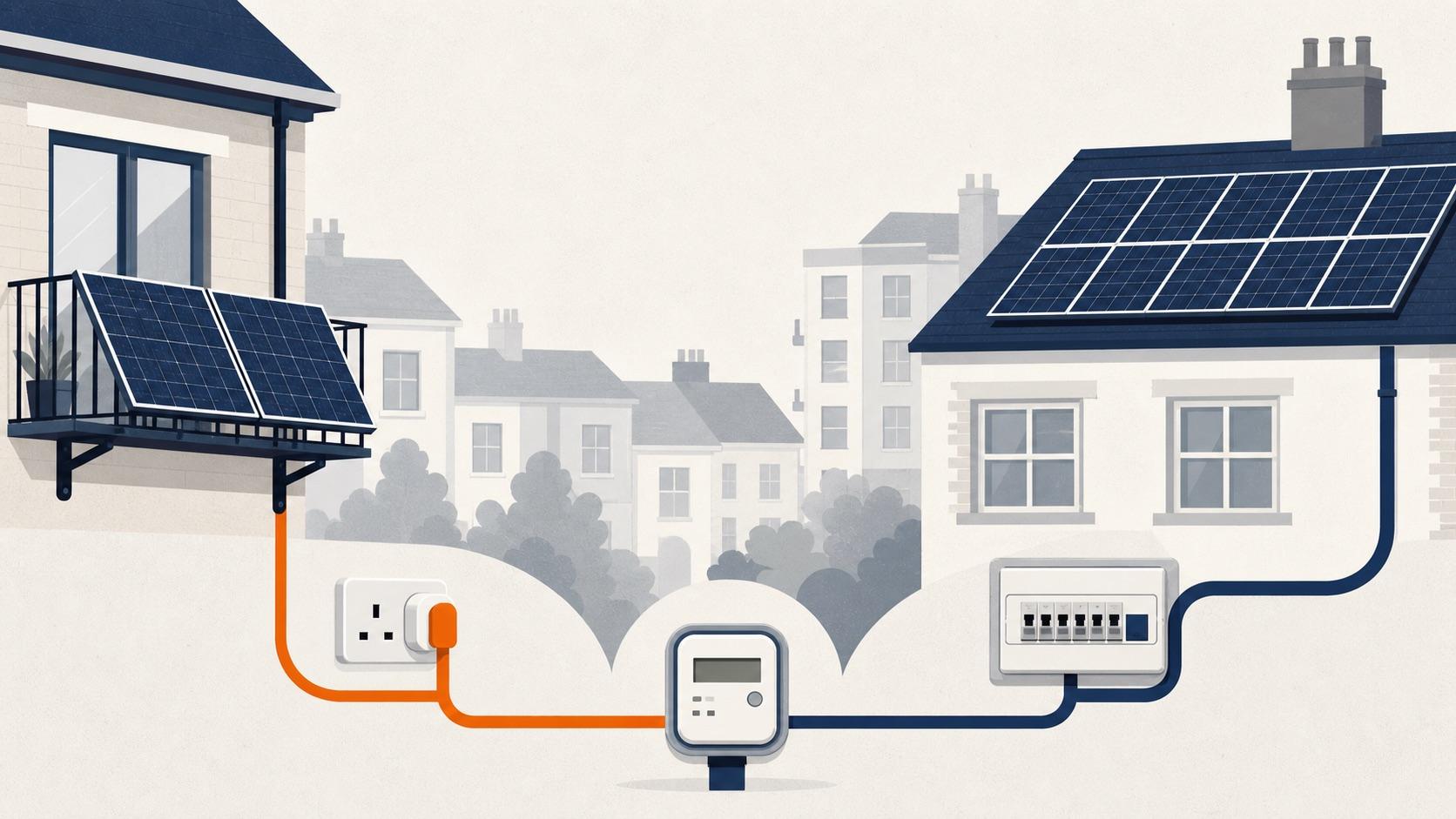
Both systems start with photovoltaic modules, but the useful comparison begins after the panels. A qualifying plug-in device combines its declared modules, grid-following inverter, cables, supplied plug, instructions and mounting system into one bounded consumer product. From 27 August 2026, SI 2026/848 creates a Great Britain route for that solar-only product at no more than 800 W rated AC output.
A rooftop array is a fixed electrical installation. The design can use much more roof area, but it also has to address roof structure, weather tightness, DC layout, inverter placement, fixed AC wiring, commissioning and handover. The current MCS solar PV installation standard requires an annual generation estimate and a building assessment by a competent professional within its scheme.
A low plug-in purchase price and a larger rooftop quote are therefore not alternative prices for the same output. The small route buys access and removability. The roof route buys a site-specific installed system with a higher generation ceiling.
Compare costs on the same boundary
DESNZ’s final-stage impact assessment observed European 800 W plug-in systems around £400 to £600 or less, excluding installation and ancillary costs. This supports a lower entry-cost category, not a current UK shop price. WattRank has not verified a qualifying UK retail offer, and a user may still need an approved mount, property consent, planning work or an electrician for a suitable external socket or fixed-wiring change.
For rooftop PV, the same assessment cites a 2025/26 median installed cost of £1,595 per kW for Great Britain systems at or below 4 kW, based on DESNZ official cost data. Energy Saving Trust’s current consumer guide uses about 4.5 kWp and £7,600 as its typical domestic example. Roof access, scaffolding, panel type, roof repairs, electrical work and a battery can move an individual quote in either direction.
| Cost record | What it includes | How to use it |
|---|---|---|
| About £400 to £600 or less | DESNZ observation of European 800 W plug-in products, before installation and ancillary costs | Category evidence only; do not treat it as a UK offer or a complete installed budget |
| £1,595 per installed kW | DESNZ 2025/26 median for Great Britain small-scale rooftop systems at or below 4 kW | A historical installed-cost benchmark, not a quote and not directly comparable with a product-only price |
| About 4.5 kWp and £7,600 | Energy Saving Trust’s current typical domestic rooftop example | A planning reference that still needs a site survey and itemised quotation |
| Your whole-project total | Product, approved mounting, permissions, labour, wiring, access work, metering and any storage | The only total suitable for a payback decision |
Output depends on position and household timing
Rated power is not annual energy. DESNZ modelled two 800 W plug-in arrangements for a Great Britain household with average irradiance, little or no shade, no battery and a home-all-day demand pattern. The model used July to September 2026 electricity prices and counted only electricity consumed in the home. It excluded exported-energy value.
| DESNZ 800 W example | Maximum annual output | Used in home | Illustrative annual saving |
|---|---|---|---|
| 30-degree tilt, south-facing | 690 kWh | 428 kWh at 62% self-consumption | About £110 |
| Vertical, east-west | 378 kWh | 272 kWh at 72% self-consumption | About £70 |
The range matters when choosing between the two routes. A small system can offset a useful daytime base load, but a vertical or shaded position can narrow the result. A rooftop system can usually devote more area to generation and may offer a better orientation, yet its output still depends on location, shade, roof geometry and the inverter design. Ask a rooftop installer for the documented annual generation estimate, and use the WattRank savings calculator for a plug-in scenario with your tariff and self-consumption.
Do not compare the 800 W AC legal ceiling directly with a rooftop kWp figure as if they were identical ratings. The plug-in regulation and final specification bound mains output; rooftop quotations commonly headline module-side DC capacity. Annual kWh, measured or modelled on a consistent basis, is the cleaner comparison.
Installation effort moves rather than disappears
The final DESNZ Interim Product Specification, version 2.0, is designed for installation and operation by an ordinary person within a complete product’s instructions. It still requires a declared mounting system, supplied connection method, anti-islanding, circuit and protective-device guidance, and bounded environmental use. It excludes plug-in batteries and integrated-battery devices.
Self-installable does not mean every home is suitable. An older or unclear consumer unit, a required fixed-wiring change, an external socket, uncertain circuit protection or a mounting question can move work back to an electrician or another competent professional. DESNZ’s electrical safety study supports a controlled route under tested conditions; it also found product variation and does not validate an unknown kit or property.
Rooftop PV starts with professional work because the roof and fixed installation are part of the job. The MCS standard requires building suitability, structural and weather-tightness considerations, system design, commissioning checks and handover records. That work documents a system expected to remain on the building.
Ownership and planning may decide before economics
A homeowner with a sound, sunny roof can evaluate both routes. A renter or leaseholder may not control the roof at all, which makes the rooftop option unavailable before price enters the calculation. Plug-in solar can reduce the scope of the building work, but the user may still need written permission for a balcony, wall, railing, shared area or cable route. The UK renter permission guide separates the product, network, property and planning files.
In England, roof-mounted solar often falls within permitted development only when the detailed limits and conditions are met. The Planning Portal also notes separate issues for flat roofs on designated land, listed-building settings and leaseholder permission. Building regulations normally cover roof loading and electrical work. Planning is devolved, so do not treat the England route as a UK-wide rule.
Export payments change the value of surplus
Ofgem’s Smart Export Guarantee guidance covers eligible solar PV generators up to 5 MW and requires participating suppliers to offer a tariff above zero. Eligibility, evidence, metering and supplier terms still decide whether a particular installation is paid. The plug-in amendment creates an electrical product route; it does not create an automatic export contract.
Rooftop systems have an established path through installer records, metering and supplier applications. A plug-in buyer should ask a supplier to confirm the exact device and metering arrangement rather than count export income from a generic tariff page. Until that evidence exists, value plug-in generation at the retail rate only when it is used in the home and value surplus at zero. This conservative boundary keeps an unconfirmed export assumption from deciding the purchase.
| Choose this route when | Why | Stop condition |
|---|---|---|
| Plug-in solar: no roof control, limited capital, suitable removable location and useful daytime demand | It opens a smaller route that can avoid a full roof project | No exact compliant product, no approved mount/location, unsuitable circuit or missing property permission |
| Rooftop solar: roof control, long occupancy horizon, suitable structure and demand for more generation | It can use more area and has an established installer, metering and export pathway | Roof repair due soon, structural/access issue, poor site economics or permissions not resolved |
| Neither yet | Waiting can be the correct outcome when the evidence file is incomplete | Do not use a low headline price or a 27 August date to bridge a product, building or network gap |
Can you start small and add rooftop solar later?
A removable plug-in device can be a first solar step, but it should not be sold as a guaranteed down payment on a later rooftop system. The hardware, inverter, mounting and electrical architecture are different. If rooftop PV is added later, give the installer and DNO the plug-in product record so the total generation, meter, protection and connection pathway can be reviewed together.
Do not assume the 800 W ceiling is an extra allowance outside an existing rooftop approval. The proposed combined system may need a different DNO decision or electrical arrangement. A competent installer can then decide whether the plug-in device should remain, move to another approved address or be removed.
Next steps
If the small route fits, verify the launch status and exact complete device, then use the UK safety and wiring guide before choosing a socket. If rooftop PV fits, obtain an itemised site-specific quotation with an annual generation estimate, roof and electrical scope, DNO process, handover evidence and export-meter plan. Compare both using annual kWh and the complete installed cost, not panel count or headline watts.
This page is general research, not legal, planning, structural, electrical or financial advice. The plug-in route is made but not yet in force on the review date. Check current official consumer guidance, the exact product record, your DNO, supplier and property permissions before acting.
Primary sources
- UK Statutory Instrument 2026 No. 848: made text and commencement
- DESNZ: plug-in solar consultation outcome and final specification
- DESNZ: Plug-in Solar Device Interim Product Specification, version 2.0
- DESNZ: plug-in solar final-stage impact assessment
- DESNZ: solar PV cost data, 2025/26 release
- MCS: Solar PV Systems Installation Standard MIS 3002, issue 6.0
- Energy Saving Trust: solar panel costs, savings and system planning
- Ofgem: Smart Export Guarantee guidance for generators
- Planning Portal: domestic roof-mounted solar conditions in England
Frequently asked questions
Is plug-in solar cheaper than rooftop solar in the UK?
The entry cost is lower, but the two totals buy different amounts of generation. DESNZ observed European 800 W plug-in systems around £400 to £600 or less before installation and ancillary costs. Energy Saving Trust currently describes a typical 4.5 kWp domestic rooftop system at about £7,600. Neither figure is a quote for your property or proof of UK plug-in availability.
Can plug-in solar replace a rooftop solar system?
Usually not when the goal is maximum annual generation. Great Britain’s first plug-in route caps rated AC output at 800 W, while Energy Saving Trust uses about 4.5 kWp as its typical domestic rooftop example. Plug-in solar is better treated as a smaller access route for a suitable location and daytime load, not a miniature version of every rooftop installation.
How much electricity can an 800 W plug-in solar system produce in the UK?
DESNZ modelled two illustrative, unshaded, home-all-day scenarios at average UK irradiance. A 30-degree south-facing setup produced up to 690 kWh a year, while a vertical east-west setup produced 378 kWh. Those are policy-model examples, not promises. Location, shade, mounting, inverter limits, downtime and household demand change the result.
Will I get Smart Export Guarantee payments from plug-in solar?
Do not assume so. Ofgem’s Smart Export Guarantee creates positive-rate export tariffs for eligible small-scale generators, but SI 2026/848 does not itself create tariff eligibility. A supplier may require an eligible installation, export-capable metering and supporting evidence. Model a plug-in purchase around self-consumed electricity unless a supplier confirms the exact arrangement in writing.
Is plug-in solar better for UK renters?
It can be, because the system may use a removable mount and avoids a full rooftop installation. The electrical route does not grant property permission, though. A tenant or leaseholder may still need written approval from the landlord, freeholder or managing agent, and planning constraints can apply to balconies, façades, listed buildings and protected areas.
Can I use plug-in solar alongside existing rooftop panels?
Do not connect a second generation route without a current system review. Existing rooftop capacity, inverter settings, the proposed plug-in device, circuit arrangement, meter and DNO record all matter. Ask the DNO and a competent solar or electrical professional how the combined installation should be classified and connected. The 800 W plug-in ceiling is not an allowance that sits outside every other limit.
Does the first Great Britain plug-in solar route include a battery?
No. The final DESNZ specification covers solar-only plug-in devices and excludes plug-in batteries and plug-in solar devices integrated with batteries. A portable solar generator that powers appliances from its own outlets is another category. A rooftop battery may be part of a professionally designed system, but it should not be treated as evidence for the new standard-socket route.