
UK Plug-In Solar for Renters: Permission Guide
 By Daniel Okafor · Last reviewed
 A dated, renter-specific route through the new electrical rules, property permission, planning and safe mounting—before money changes hands.
Key facts
- SI 2026/848 was made on 16 July 2026 and comes into force on 27 August 2026.
- The legal ceiling is 800 W rated AC output; the final product specification uses an 800 VA and 3.5 A output limit.
- The first route is solar-only: plug-in batteries and solar-plus-battery devices are outside its scope.
- The final specification allows one device per final ring circuit, while its publication note says current G98 limits this to one per household.
- Compliance belongs to the complete device—including its panels, inverter, BS 1363 lead, cables, instructions and mounting system—not a badge on one component.
What changes for renters on 27 August 2026?
The Plugs and Sockets etc. and Electricity Safety regulations amendment, SI 2026/848, was made on 16 July, laid before Parliament on 17 July and comes into force on 27 August 2026. It defines a plug-in microgenerator as solar generation with no more than 800 W rated AC output, connected by a standard plug and socket, operating in parallel with the distribution network and not designed to import electricity for storage.
That is a product-and-electrical route, not a blanket right to alter rented property. The instrument lets an eligible device comply through the government’s final product specification. It does not transfer ownership of a balcony railing, vary a tenancy clause, grant planning consent, certify an imported kit or prove that a particular mount is safe on your building.
| Date | Position for a renter | What not to assume |
|---|---|---|
| 30 July 2026 (this review) | The regulations are made, but the new route is not yet in force. | An announcement, preorder or retailer listing is not permission to connect early. |
| 27 August 2026 | The amendments commence. An exact compliant, battery-free device can use the new route, subject to all other gates. | The date does not make every existing EU kit, DIY combination or battery product compliant. |
| After commencement in Great Britain | Follow DESNZ consumer guidance, the current G98 process, manufacturer instructions and property approvals. | Northern Ireland is not covered by an equivalent confirmed route; socket connection does not erase other duties. |
The four approvals are separate
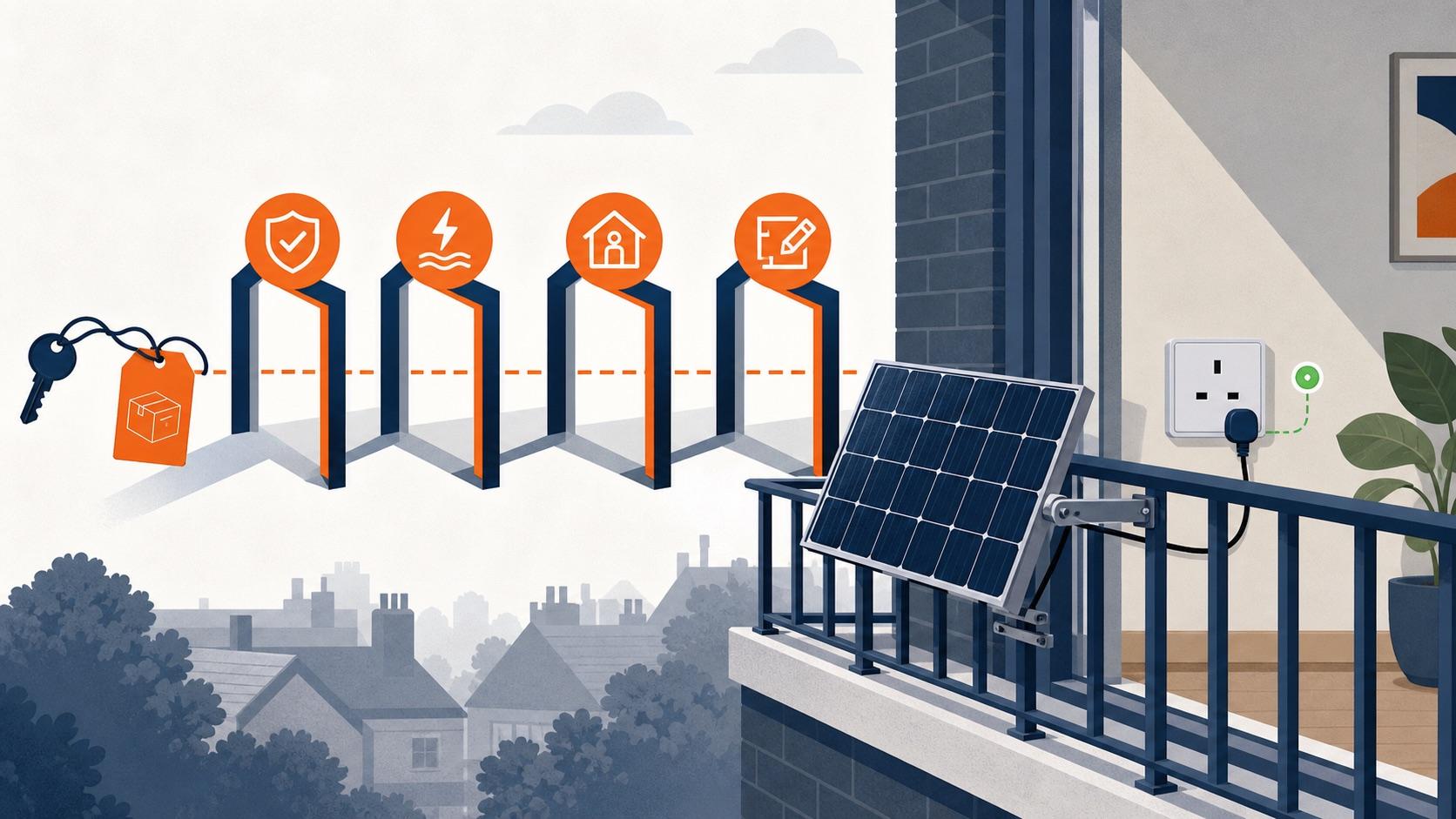
A useful renter test is to keep four evidence files. Passing one file does not pass the others. This separation is the main protection against the two most common mistakes in the current search results: treating “legal from 27 August” as landlord consent, or treating a landlord’s yes as proof that the electrical product qualifies.
| Gate | Who or what controls it | Evidence to keep |
|---|---|---|
| 1. Product and electrical | SI 2026/848, the final DESNZ Interim Product Specification and the exact manufacturer | Declaration and test evidence for the complete model; UK plug, output, cables, instructions and supplied mount |
| 2. Distribution network | G98 and your Distribution Network Operator in Great Britain; a separately confirmed route would be needed in Northern Ireland | The current notification or registration record and the device’s type-test information |
| 3. Property permission | Tenancy, lease, landlord, freeholder, housing association or managing agent | Written approval for the exact location, fixing method, cable route, removal plan and responsibilities |
| 4. Planning and building | The relevant nation, local planning authority, protected-building rules and any building-control requirement | Written confirmation, permitted-development assessment or consent where required |
Which products qualify under the first Great Britain route?
The final Plug-in Solar Device Interim Product Specification, version 2.0, describes a complete device: at least one PV module, a grid-following inverter, a factory-assembled lead with a BS 1363 plug, associated DC cables and connectors, and a mounting system. The plug supplied by the manufacturer is the connection method. Mixing panels, an inverter, a lead and a third-party bracket does not by itself prove that the resulting assembly is the tested product.
The main limits are 800 VA and 3.5 A on the AC side, with up to 2,000 W of total panel nameplate power. Above 960 W of panel capacity, the manufacturer must advise the consumer to consider a professional assessment of the existing electrical installation. Outdoor components and outdoor plug/socket arrangements must achieve at least IP55. The scope excludes plug-in batteries and PV devices integrated with batteries.
| Buyer check | Acceptable evidence | Red flag |
|---|---|---|
| Exact product identity | Model-level evidence for the complete device and its supplied mounting option | A marketplace claim that only names the inverter certificate |
| UK connection | Manufacturer-supplied non-rewireable BS 1363 plug and instructions for a BS 1363 socket | Schuko lead, travel adaptor, changed plug or extension lead |
| Output | No more than 800 VA and 3.5 A AC, with the panel configuration documented | Seller markets panel watts as though they were the legal AC limit |
| Storage | No energy-storage function beyond permitted control or auxiliary functions | Battery, hybrid or solar-generator mode presented as part of the first route |
| Mounting | Supplied or specified mount with structural evidence for the declared balcony, wall, fence or ground use | Generic hooks, loose ballast or a claim that every railing is suitable |
How to ask a landlord or freeholder
Ask before buying, and make the request easy to decide. “Can I put solar on the balcony?” gives the property owner no usable risk information. Submit the exact product, installation and removal proposal. If the flat is leasehold, the tenant’s landlord may not control the external wall, railing or common area; the freeholder or managing agent may need to decide separately.
- 1Identify the exact complete device, rated AC output and final UK compliance evidence.
- 2Mark the panel, inverter, cable route and socket on photographs or a simple plan.
- 3State whether the proposal clamps, drills, penetrates a wall, rests on the ground or affects a shared area.
- 4Attach the manufacturer’s wind, structural, fire, weather and mounting instructions for that position.
- 5Explain how drainage, ventilation, guardrails, escape routes and neighbours below remain protected.
- 6Set out who owns, inspects, removes and makes good the equipment, including at the end of the tenancy.
- 7Ask whether the building insurer, freeholder, housing association or planning authority must also approve.
- 8Request a dated written answer tied to this configuration; do not treat silence or a verbal comment as approval.
| Occupancy | Likely property decision-maker | Question to resolve first |
|---|---|---|
| Private tenant in a house | Landlord or agent; sometimes a mortgagee or insurer sits behind the decision | Does the tenancy permit exterior equipment, and who controls the proposed wall, garden or roof? |
| Tenant in a block of flats | Landlord plus, where applicable, freeholder or managing agent | Is the balcony, railing, façade or cable route demised to the flat or controlled as a common/exterior part? |
| Housing-association or council tenant | The housing provider under its alterations policy | What written alterations process and building-safety review applies? |
| Leaseholder | The lease and freeholder or managing agent | Does the lease permit attachments or changes to the exterior, and is consent required? |
| Shared owner | The housing provider or freeholder as well as the occupier’s lease | Which party can approve the exact mounting surface and electrical proposal? |
Planning rules depend on the UK nation
“No planning permission” is not a safe UK-wide promise. Permitted development is conditional, and planning permission does not replace property consent. A clamp-on balcony proposal can still affect an exterior elevation or protected building; a freestanding ground system can fall under different limits from equipment fixed to a wall or roof.
| Nation | Official starting point | Renter-specific conclusion |
|---|---|---|
| England | Part 14, Class A | The permitted-development class can cover solar equipment on a dwellinghouse or block of flats, but detailed limits, protected sites and other approvals still apply. Confirm how the exact balcony installation is classified. |
| Wales | Welsh Government solar planning guidance | The guidance says residents of flats should contact the local planning authority. Do not transfer the house rules to a flat without confirmation. |
| Scotland | mygov.scot guidance for the outside of flats | Some solar-panel changes can be permitted development, subject to conditions. The same page says a person who does not own the land must obtain the landowner’s permission. |
| Northern Ireland | nidirect photovoltaic-panel guidance | Check with the divisional planning office before installation. The final product specification says its application in Northern Ireland is subject to further consideration and may require amendment, so the Great Britain launch route is not confirmed there. |
Balcony and circuit checks a renter cannot skip
Portability does not remove load. A panel can act like a sail, and the mount transfers wind force into the railing, wall, ballast or ground beneath it. The final product specification requires a defined mounting system and structural analysis for intended mounting types. It also says unsecured arrangements are not permitted. Use the exact declared mount and position; do not assume a guardrail is designed to carry a solar array.
On the electrical side, follow the product’s screening instructions for the socket, protective devices and final circuit. Use only the manufacturer’s lead and plug. Do not use an extension cable or travel adaptor, and do not route a cable through a door or window in a way that crushes insulation or defeats weather protection. If the instructions call for a professional assessment—or the installation condition is uncertain—stop before connection.
The government’s electrical safety study found that tested systems could operate safely under defined UK circuit conditions, but it also found inconsistent export-limitation and electromagnetic-compatibility performance across products. That supports a controlled complete-product route; it is not proof that an unknown marketplace kit, outlet or building is safe.
What happens when you move?
A removable system can be easier to take to a new home than rooftop solar, but compliance does not travel as property permission. Disconnect and remove it exactly as instructed, restore any agreed surfaces, keep the full device together and obtain new written approval for the new building. Recheck the mounting position, planning context, socket, circuit, DNO area and current product rules before reconnecting.
If a future home includes roof control, use the UK plug-in versus rooftop comparison to reassess cost, output, installation and export options rather than assuming the removable system remains the best fit.
The best next step before buying
Wait for the 27 August commencement and the promised DESNZ consumer guidance, then match one exact compliant product to one approved location. Use WattRank’s mounting and wind-safety method, run the UK socket, circuit and protection checks, and model conservative output in the balcony solar size calculator. For the network layer, read the G98 explainer.
This page is general research, not legal, tenancy, planning, structural or electrical advice. Rules and documents can change before commencement; use the current official guidance for the exact home and product.
Primary sources
- UK Statutory Instrument 2026 No. 848 — made text and commencement
- DESNZ — consultation outcome, government response and final specification
- DESNZ — Plug-in Solar Device Interim Product Specification, version 2.0
- DESNZ — plug-in solar electrical safety study
- England — permitted development, Part 14 Class A
- Wales — planning permission for solar panels
- Scotland — altering the outside of a flat
- Northern Ireland — photovoltaic-panel planning guidance
Frequently asked questions
Can a UK renter legally use plug-in solar now?
The new route is made but not yet in force. SI 2026/848 comes into force on 27 August 2026. In Great Britain, a renter can then use a device that meets the legal definition and the final Interim Product Specification. Until that date, do not treat the future route as current permission. Application of the specification in Northern Ireland is not yet confirmed.
Do renters need landlord permission for balcony solar?
Treat written permission as necessary whenever the panel, cable or mount affects the building, balcony, railing, garden, exterior appearance or a shared area. The plug-in solar regulations change product and electrical rules; they do not rewrite your tenancy or lease. A landlord, freeholder, housing association or managing agent may control different parts of the property.
Can a landlord refuse plug-in solar?
The new electrical regulations do not create a universal renter right or a rule that every refusal is unreasonable. The answer depends on the tenancy, lease, building, proposed mounting and other approvals. Ask for a written decision using a complete evidence pack. If a refusal appears inconsistent with your agreement or housing law, seek tenant-specific advice rather than relying on retailer copy.
Do renters need planning permission for balcony solar?
Sometimes. Planning is separate from landlord permission and differs across the four UK nations. England and Scotland have permitted-development routes that can cover some solar equipment on flats, but conditions and protected-building exclusions apply. Wales advises flat residents to contact the local planning authority, while Northern Ireland recommends checking with the divisional planning office before installation.
Can I use a German or EU balcony kit with an adaptor?
Do not assume so. The Great Britain route is for an exact product compliant with the final Interim Product Specification, including its manufacturer-supplied BS 1363 plug, inverter, panels, cables, documentation and mounting system. A travel adaptor, replacement lead or mix-and-match bundle does not turn a continental product into evidence of compliance.
Can the first UK plug-in solar systems include a battery?
No. SI 2026/848 and the final Interim Product Specification define a solar-generation route and exclude plug-in battery systems and solar devices integrated with batteries. A solar generator that powers appliances from its own outlets is a different, usually off-grid product. Do not connect a battery product to the mains as though it were an eligible plug-in microgenerator.
Does a renter need to notify the DNO?
Network rules still apply. The final specification says G98 governs Great Britain and notes that, at publication, it restricts plug-in solar to one device per household. DESNZ said consumer guidance would accompany commencement. Follow the final launch guidance, the exact manufacturer instructions and your DNO’s process; do not assume the socket route removes registration or notification.