
UK Plug-In Solar Safety and Wiring: 2026 Rules
 By Daniel Okafor · Last reviewed
 A safety-first field guide to the new Great Britain route: what the product must prove, what the user must inspect and when an electrician or DNO must take over.
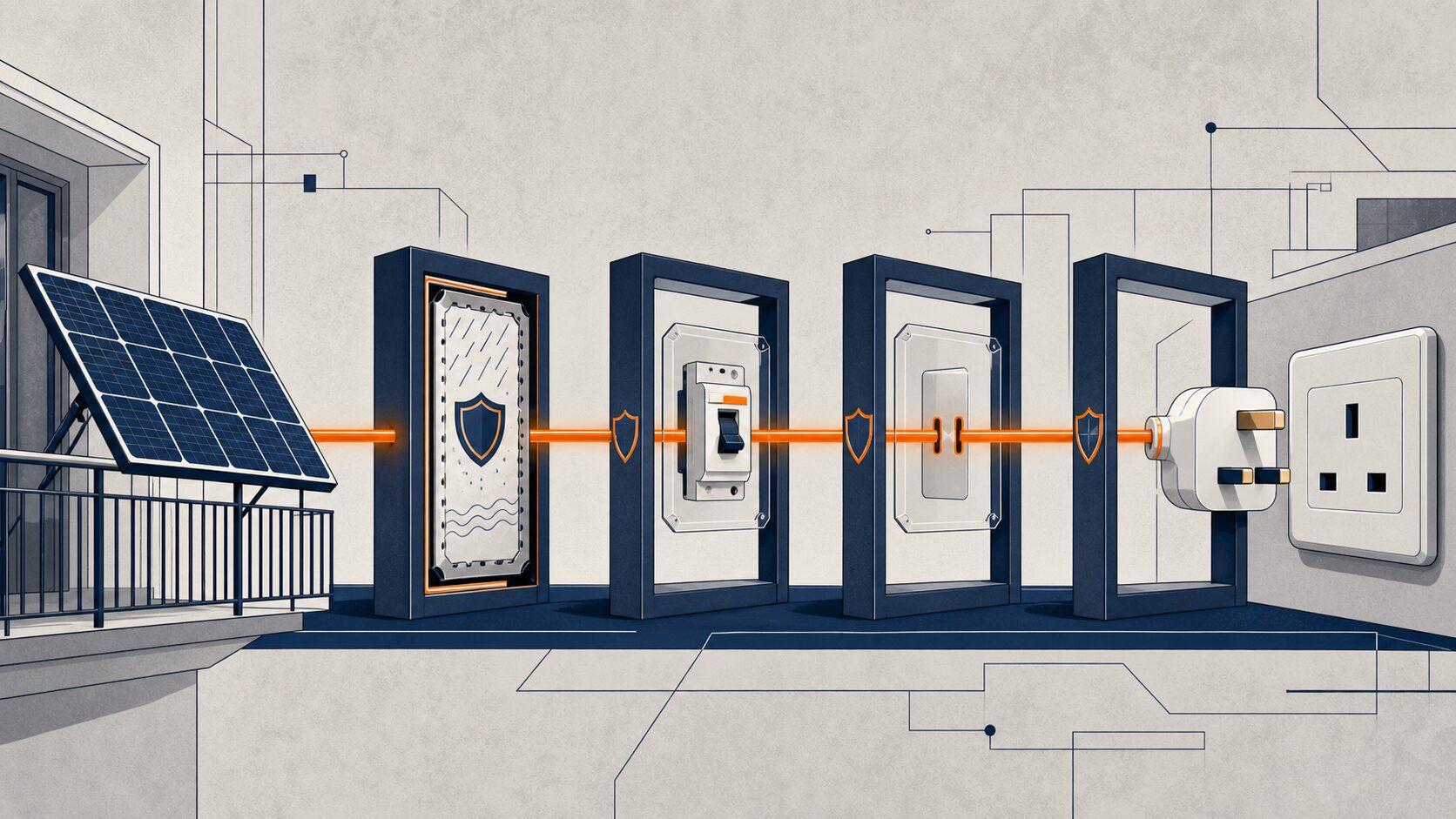
Key facts
- SI 2026/848 comes into force on 27 August 2026; the route is not permission to connect early.
- The final device ceiling is 800 VA and 3.5 A AC, with no more than 2,000 W of PV module nameplate power.
- The manufacturer-supplied plug must be non-rewireable, meet BS 1363 requirements and contain a BS 1362 fuse rated no higher than 5 A.
- Outdoor components, connections, plugs and sockets must achieve at least IP55 under the complete product design.
- The specification prohibits extension leads, multi-way adaptors, RCD adaptors, travel adaptors and plug converters.
- The first route is solar-only; plug-in batteries and solar devices integrated with batteries are outside its scope.
What changes on 27 August—and what does not?
SI 2026/848 was made on 16 July 2026 and comes into force on 27 August. It creates a Great Britain route for a plug-in microgenerator with no more than 800 W rated AC output, powered by solar, connected through a standard plug and socket, operating in parallel with the distribution network and not designed to import electricity for storage.
The commencement date removes one regulatory barrier for eligible products. It does not turn an inverter, an EU balcony kit, a replacement cable or a marketplace bundle into an eligible device. The final DESNZ Interim Product Specification, version 2, applies to the complete assembly and its declared use. Northern Ireland has separate network and electricity rules; the specification says its application there remains subject to further consideration.
| Layer | Evidence required | What does not prove it |
|---|---|---|
| Complete product | Exact panels, inverter, cables, connectors, plug, instructions and approved mounting option covered by the product evidence | An inverter certificate, UKCA language or an 800 W setting on its own |
| Household connection | Manufacturer-supplied fused BS 1363 plug, suitable BS 1363 socket and the product’s permitted circuit arrangement | A travel adaptor, changed plug, extension lead or an unused-looking socket |
| Protection | Specified anti-islanding, live-pin protection, residual-current behaviour and protective-device checks | An app graph, smart plug or claim that low power is automatically harmless |
| Environment | Declared mounting, cable route, ventilation and at least IP55 where the complete assembly is outdoors | A weatherproof sticker on one component or a cable pinched through a window |
| Network | Current G98 evidence and DNO connection/disconnection notification in Great Britain | Assuming a standard socket bypasses the distribution network process |
Start with the complete device, not the inverter
The specification defines a device as at least one PV module, a grid-following inverter, the connecting lead and plug, and a mounting system. It permits one-, two- and multi-component kits, but the manufacturer must define the combinations. For multi-panel products, it limits the arrangement to four modules and no more than two modules in a series string; cables, matching connector pairs and any adaptor cable must be supplied as part of the documented system.
This matters because adding panel wattage is not the same as changing AC output. The product may have up to 2,000 W of panel nameplate power while the mains output remains capped at 800 VA and 3.5 A. Above 960 W of panel capacity, the manufacturer must advise the user to consider professional assessment of the existing electrical installation. Do not copy a seller’s panel list into another inverter or substitute connectors to recreate the headline figures.
How to screen the socket, circuit and consumer unit
A standard faceplate reveals little about the wiring behind it. The final specification requires instructions that help users identify which sockets share a circuit and directs them to an electrician when the consumer unit is unclear, uses older fuse protection or is of unknown condition. It also says the device must connect to a socket circuit—not a lighting circuit or a spur supplying fixed equipment such as a cooker or boiler.
The specification was written for an existing final ring circuit, so a new dedicated export circuit is not a universal condition of this route. But that does not mean every existing circuit is suitable. If the product requires a protective-device change or any fixed-wiring alteration, a qualified electrician must perform it under the applicable wiring rules. Use the separate dedicated-circuit decision guide to distinguish a true separate branch from a socket that merely appears unused.
| What you see | Safe interpretation | Action |
|---|---|---|
| Modern consumer unit, clearly labelled circuit, modern residual-current protection | Useful starting evidence, not automatic approval | Follow the exact product’s identification and test instructions before connection |
| Old fuse box, no individual circuit switching or unknown protection | The user cannot complete the product’s screening confidently | Obtain inspection and assessment by a qualified electrician |
| Socket on an extension, multi-way adaptor or travel adaptor | Outside the permitted connection method | Do not connect; use only the supplied plug and permitted fixed socket |
| Outdoor socket or connection | Weather exposure becomes a system requirement | Confirm the complete arrangement achieves at least IP55 and matches the declared installation |
| Need to change breaker, RCBO, socket or fixed wiring | The proposal has crossed from ordinary assembly into electrical work | Stop and use a qualified electrician |
Why the fused UK plug and anti-islanding both matter
The plug is part of the safety architecture. The final specification requires a non-rewireable moulded BS 1363 plug with partially insulated pins and a BS 1362 fuse no higher than 5 A. It also requires additional contact protection: a mechanical or independent electromechanical measure must prevent access to hazardous pins or remove dangerous contact voltage within two seconds of disconnection.
Anti-islanding addresses a related but separate hazard. When the supply to the socket is lost, the inverter must stop exporting so the household circuit and distribution network are not kept energised by the panels. That is why a compliant grid-following system normally stops in a blackout. A fuse alone cannot provide the inverter control, and an inverter badge alone cannot prove the supplied plug and complete device meet the additional contact-protection requirements.
What the Great Britain safety study did—and did not—prove
DESNZ commissioned a 96-page electrical safety study using representative UK ring-final and spur arrangements. Within its defined no-modification boundary, tested devices generally disconnected on loss of mains, protective devices operated and the completed scenarios did not show sustained unsafe energisation or uncontrolled thermal behaviour.
The study explicitly stops short of declaring every product or home suitable. It observed product-specific variation in export limiting, voltage and frequency response, and electromagnetic compatibility. It was a pre-compliance and feasibility assessment—not full product certification, a live test of your circuit or long-term field evidence. Its information gain is the opposite of “all 800 W kits are safe”: controlled deployment can be technically feasible only when the product and usage conditions are bounded.
| Study result | Reasonable conclusion | Overreach to avoid |
|---|---|---|
| No sustained thermal instability in the representative completed tests | The defined route can be compatible with tested UK circuit arrangements | Every old socket, loose terminal or imported kit is safe |
| Protective devices operated in tested fault scenarios | Inverter export did not inherently defeat the tested protection | Any RCD/RCBO type and cumulative household leakage can be ignored |
| Loss-of-mains performance was generally strong | Anti-islanding is achievable for qualifying products | A product is compliant because it switched off in one informal test |
| Product variation appeared at technical boundaries | Complete model-level evidence and routine testing are necessary | All devices sold under the same watt headline perform equivalently |
Outdoor wiring, DC connectors and fire boundaries
At least IP55 is required for outdoor parts and their connections, including an outdoor plug and socket arrangement. The rating applies to the intended assembled configuration: open covers, mismatched connectors, damaged glands or an improvised cable route can defeat it. Do not disconnect DC connectors under load. The final instructions must tell the user to turn off the AC supply before separating DC connections and must define the safe cable-routing method.
Wiring safety does not end at the cable. The specification treats the mount, supporting surface, ventilation and fire spread as part of the device. It prohibits makeshift reliance on cable ties, rope, string, adhesive tape, bungee cords or straps. It also requires warnings for specified combustible cladding and remediation contexts. Follow the exact mount’s declared surface and load limits; the installation sequence explains how electrical and physical gates fit together.
The safe connection and shutdown sequence
- 1Wait for the 27 August commencement and current official consumer guidance; do not connect during the transition.
- 2Match the exact complete product, supplied plug, panels, connectors, cables and mounting option to its evidence.
- 3Resolve property permission and mounting before routing any cable or placing load on a railing, wall or balcony.
- 4Identify the socket circuit and protective devices only through the manufacturer’s safe user procedure.
- 5Stop for an electrician if the circuit is unclear, protection is old or unknown, or fixed wiring must change.
- 6Check the current G98 and DNO instructions before connection so you know whether the exact case needs prior agreement or a post-commissioning notice.
- 7Connect directly—never through an extension, multi-way adaptor, RCD adaptor, travel adaptor or converted plug.
- 8Send the mandatory connection notice at the process’s stated time; the standard G98 route generally allows notification within 28 days after commissioning.
- 9Periodically inspect fixings, cables and connectors and follow the instructed protective-device test procedure.
- 10For shutdown, follow the manufacturer’s AC-first isolation sequence before handling any DC connection.
- 11Notify disconnection where required, keep the complete device together and do not substitute parts casually.
When to stop and call an electrician
Stop if the consumer unit or circuit cannot be identified safely, protection uses older fuses, the socket is loose, damaged, warm, cracked, corroded or exposed beyond the product’s declared arrangement, or the instructions require a fixed-wiring or protective-device change. Also stop if the proposed panel capacity exceeds 960 W and the product advises professional assessment, or if repeated protective-device tests do not trip immediately.
Do not diagnose by opening the consumer unit, removing a socket or probing conductors. Product assembly by an ordinary person and work on the fixed installation are different scopes. If you rent or live in a managed block, first resolve the separate landlord, freeholder and planning gates; electrical eligibility does not grant permission to alter the building.
Your next four checks
Confirm the current UK launch position, screen whether your circuit arrangement needs a professional decision, complete the product’s installation sequence and follow the G98 connection and notification layer. Keep those records with the exact model and mounting evidence so a future owner, electrician or DNO can identify what is connected.
This page is general technical research, not an electrical design or site inspection. The official consumer guidance, G98 implementation and product register can change around commencement; verify the current documents for the exact home and device.
Primary sources
- UK Statutory Instrument 2026 No. 848 — made text and commencement
- DESNZ — consultation outcome and final product specification
- DESNZ — Plug-in Solar Device Interim Product Specification, version 2
- DESNZ — plug-in solar electrical safety study
- IET — Amendment 4:2026 to BS 7671 publication and transition
- Energy Networks Association — G98/G99 connection guide for a single premises
Frequently asked questions
Can I plug solar into a normal UK socket?
From 27 August 2026 in Great Britain, an exact device that meets SI 2026/848, the final Interim Product Specification and current network rules can use its manufacturer-supplied BS 1363 plug in a suitable BS 1363 socket. A normal-looking socket does not prove that the circuit, consumer unit, protection, product or installation condition is suitable.
Does UK plug-in solar need a dedicated circuit?
The Great Britain specification was designed for an existing final ring circuit and does not universally require a new export circuit. It allows one device per final circuit, although the G98 version cited at publication restricted use to one device per household. Any circuit modification required by the product or installation must be completed by a qualified electrician.
Can I use an extension lead or multi-way adaptor?
No under the final product specification. Its plug marking and instructions must warn against extension cables, multi-way adaptors, RCD adaptors and travel adaptors. Connect only through the manufacturer-supplied non-rewireable fused plug and the permitted socket arrangement. A longer cable or adaptor can alter contact, fuse, weather and mechanical conditions that the product evidence covers.
What should I check in the consumer unit?
Follow the product’s instructions for identifying the circuit and protective devices. The specification tells users to look for modern residual-current protection and good installation condition, and to seek an electrician where protection uses older fuses, the unit is unclear or the condition is unknown. Do not remove covers or probe wiring to identify a circuit.
Will plug-in solar keep working in a power cut?
No. An eligible grid-following device must disconnect when the grid supply is lost so it does not sustain an unsafe island or energise the plug pins and network. That anti-islanding behaviour is a safety requirement, not a backup feature. Appliances need a separate, correctly designed backup system if you want power during an outage.
Can the first UK plug-in solar route include a battery?
No. SI 2026/848 and the final specification cover solar generation and exclude plug-in battery systems and plug-in solar integrated with batteries. A portable solar generator that powers appliances through its own outlets is a different, normally off-grid category. Do not feed a battery product into household wiring as though it were an eligible plug-in microgenerator.
Do I still have to notify the DNO?
Yes, network requirements still matter. The final specification requires product marking to state that DNO notification for connection and disconnection is mandatory, and it points to G98 in Great Britain. Use the current launch guidance and your DNO’s process for the exact device; the standard-socket route does not remove distribution-network obligations.