
Alaska Plug-In Solar Laws
 By Daniel Okafor · Last reviewed
 In short: Alaska has not enacted a plug-in solar exemption. HB 257 ended without passage when the second regular session concluded, and it was not carried into the special session. Its former 1,200 W maximum-power-output proposal created no current route. Ask the serving utility which interconnection, equipment, metering and inspection rules apply before connecting grid-parallel generation.
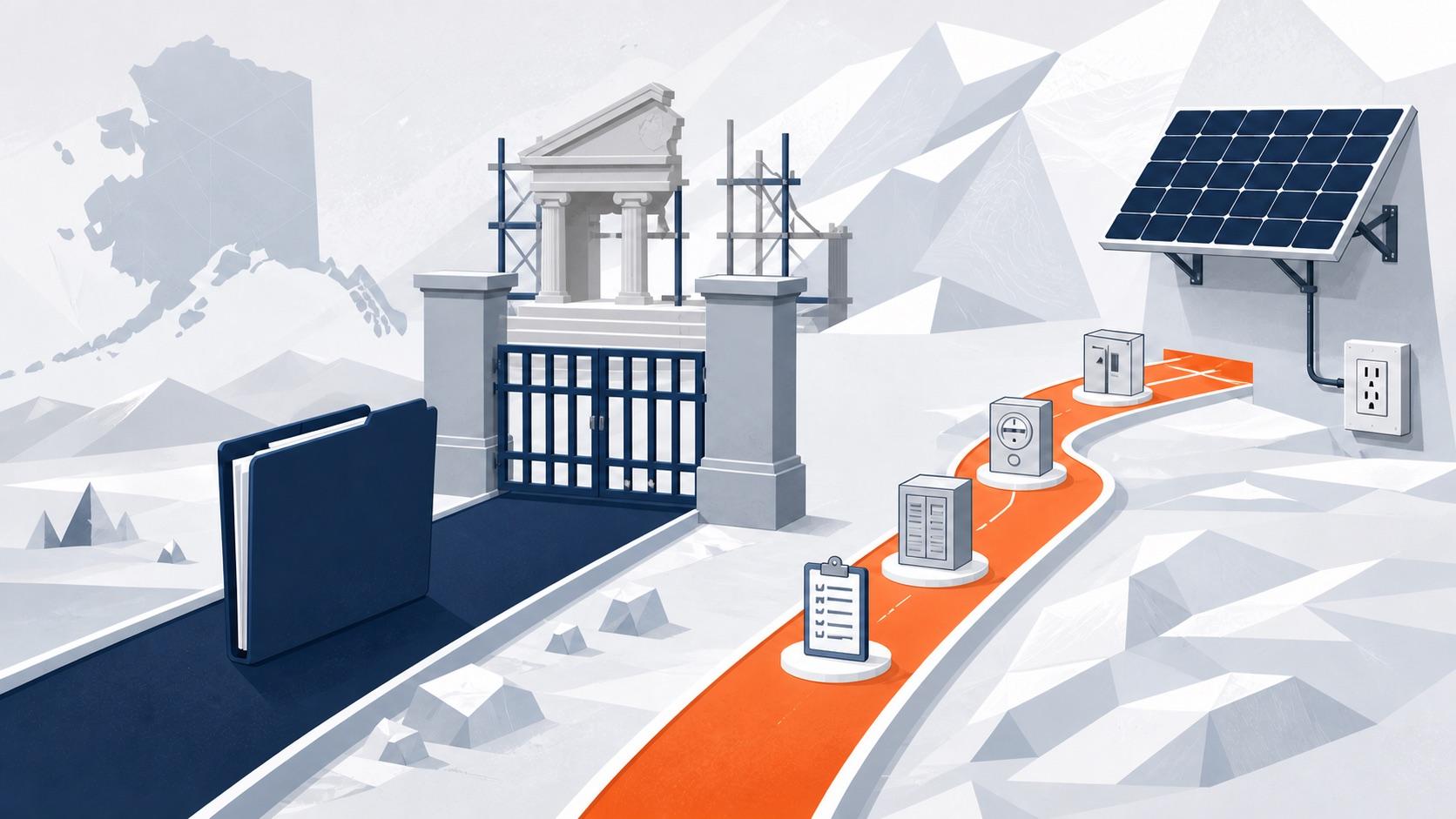
Current status
Session ended without passage
The tracked proposal did not become law and is no longer active. Follow the rules in force today and watch for a separately introduced future bill.
Key facts
- Status: HB 257 ended without passage and is no longer active
- Introduced: January 20, 2026; heard and held three times in February
- Proposed limit: no more than 1,200 W maximum power output
- Proposed connection: a standard 120 V AC outlet
- Proposed evidence: current NEC plus UL or equivalent NRTL certification
- Current route: utility-specific tariff, application and approval requirements
Check your location
Framework status and exact product eligibility are separate checks.
What this means today
The official HB 257 record still lists House Energy as the last committee assignment, with Community and Regional Affairs next. Version A is the only bill version shown. House Energy heard and held it on February 10, February 19 and February 26, 2026, but the bill had no committee report or chamber vote when the second regular session ended on May 20.
SCR 202 carried only HB 381 and SB 280 from the regular session into the second special session. It did not carry HB 257, so the portable-solar proposal ended without passage. Current requirements depend on the serving utility and whether the RCA net-metering rules cover that system. Chugach and MEA use different forms, fees, inspections and meter steps.
Current Alaska process versus HB 257
| Question | What applies today | What HB 257 Version A proposed |
|---|---|---|
| Legal status | Current RCA regulations and serving-utility tariffs apply where their scope covers the system. | The bill ended without passage and created no exemption. |
| Connection route | Use the utility's application, engineering, inspection and agreement process for grid-parallel generation. | A qualifying device would be exempt from commission interconnection and net-metering program requirements. |
| Output threshold | For covered economically regulated utilities, the RCA framework addresses eligible systems up to 25 kW, subject to its exceptions and the utility tariff. | No more than 1,200 W maximum power output; the bill did not label this as panel DC, inverter AC or export power. |
| Utility approval and fees | The utility's current process controls. Chugach currently requires written approval and lists a $270 application fee; MEA says it charges no application fee but may assess interconnection costs. | A utility could not require prior approval, a device-related fee or extra controls beyond those integrated into a qualifying device. |
| Equipment evidence | Utility tariffs may use standards such as UL 1741 for interconnection equipment, alongside other current requirements. | The latest NEC plus certification by UL or an equivalent NRTL, with no test standard named. |
| Meter and export | Confirm the meter and tariff with the utility. MEA describes bidirectional metering and credits under its non-firm rate. | The device would have been used primarily to offset consumption, but the bill contained no export-credit entitlement. |
| Property and local checks | Rental, HOA, structural, fire, electrical and inspection requirements remain separate. | The bill does not grant property permission or waive local requirements. |
What HB 257 says
HB 257 Version A would add AS 42.05.323. A portable solar generation device meeting three conditions would be exempt from interconnection and net-metering program requirements adopted by the Regulatory Commission of Alaska: maximum power output of no more than 1,200 W, compliance with the most recent National Electrical Code and certification by UL or an equivalent nationally recognized testing laboratory. The device would have to be movable, connect through a standard 120 V AC outlet and primarily offset part of the customer's electricity consumption. For a qualifying device, a utility could not require prior approval, a related fee or controls beyond those integrated into the device. The text also gives the utility a liability exemption for damage or injury caused by a qualifying device.
Read the official bill record ↗
HB 257 legislative timeline
| Date | Official event | What it means |
|---|---|---|
| January 20, 2026 | HB 257 introduced | The bill received House Energy and Community and Regional Affairs referrals. No exemption took effect. |
| February 6, 2026 | Representative Costello added as cosponsor | Sponsorship changed, but the bill remained in House Energy. |
| February 10, 2026 | First House Energy hearing | The committee heard and held Version A without reporting it out. |
| February 19, 2026 | Second House Energy hearing | The committee again heard and held the proposal. |
| February 26, 2026 | Third House Energy hearing | The official history still records no committee passage. |
| May 6, 2026 | Representative Carrick added as cosponsor | This is the final HB 257 action listed in the official history. |
| May 20, 2026 | Second regular session ended | HB 257 had not left House Energy or passed either chamber. |
| May 21, 2026 | SCR 202 carried other bills into special session | The resolution named HB 381 and SB 280 only, so it did not continue HB 257. |
What the 1,200 W wording does and does not tell you
HB 257 says maximum power output of no more than 1,200 W. It does not say whether that figure means panel DC nameplate capacity, continuous inverter AC output or export power at the meter. Those measurements are not interchangeable. A seller's 1,200 W panel bundle could use a lower-output inverter, while another configuration could combine several inverters behind one meter.
Keep the former bill's wording intact when describing it. No adopted amendment or final law defined the measurement. The outlet language was clearer: the device would have connected to a building's electrical system through a standard 120 V AC outlet. That definition separated HB 257's device from a panel-only package and from a solar generator that powers isolated loads without operating in parallel with the utility grid.
How Alaska's current utility route works
RCA net-metering rules apply to economically regulated utilities, with exceptions for some independent systems, systems with less than 5,000,000 kWh in annual retail sales, distribution areas with documented stability or operational constraints, and requirements the commission modifies or waives. For covered systems, eligible consumer generation is limited to 25 kW, must include an inverter and connects under the serving utility's tariff. The framework does not create a statewide socket exemption.
Chugach currently tells members to apply before ordering equipment, submit equipment specifications and a one-line diagram, pay the fee shown on its current renewable-generation page, complete the applicable inspection steps, execute an interconnection agreement and receive written approval before energizing. MEA uses its own application and agreement, says it charges no application fee, may charge actual interconnection costs and installs a bidirectional meter after approval. They are examples for those two utilities, not instructions that apply statewide.
The bill leaves the certification standard unspecified
Version A requires certification by UL or an equivalent nationally recognized testing laboratory. It does not name UL 3700, UL 1741 or another test standard, and it does not say whether certification applies to the complete plug-in system or one component. A certification mark alone does not resolve that ambiguity without a model record and named test standard.
For systems within the RCA framework, utility requirements may use UL 1741 or similar standards for inverters and interconnection equipment. UL 1741 is a component and interconnection-equipment standard; it would not have proved that a complete panel, inverter, cable, plug and control package satisfied every HB 257 condition. OSHA also limits each NRTL to its recognized scope. Verify the exact model, configuration, laboratory, mark and standard in the laboratory's public directory.
HB 257 contained no express anti-islanding or outage-isolation clause. Do not infer blackout operation or a specific shutdown time from the former bill. The current utility process, adopted electrical rules, equipment listing and manufacturer instructions remain the evidence for grid-loss behavior.
- Match the exact model and every included component to the certification record.
- Record the named test standard and confirm that it is inside the laboratory's NRTL scope.
- Separate an inverter listing from a complete-system claim.
- Verify the approved circuit, plug, protection and grid-loss behavior for the exact configuration.
Export credit is not part of the proposal
The former bill defined the device around offsetting part of the customer's consumption. It would have exempted a qualifying device from net-metering program requirements, but it did not grant payment or bill credit for surplus generation. A meter can record reverse flow even when the tariff provides no compensation for it.
The serving utility's written tariff controls the current answer. MEA describes a bidirectional meter and credits monthly surplus at its non-firm rate for approved net-metering members. That program does not establish how a device outside net metering would be billed. Model savings from daytime self-consumption unless the utility confirms another treatment in writing.
Property, mounting and local review remain separate
HB 257 addresses commission and utility requirements. Its text does not authorize a renter to use a balcony, alter an exterior receptacle or route a cable across shared property. It also does not waive structural, fire, electrical or inspection requirements. Obtain a written property decision for the exact panel, mount, support, cable route and removal plan.
Mounting has to be assessed for the Alaska site. Snow accumulation, freeze-thaw movement, wind exposure and corrosion can alter loads and inspection needs. Use the manufacturer's rated system and obtain qualified structural or electrical help when the support, circuit, weather exposure or local requirement is uncertain. The bill's status says nothing about whether a railing or wall can carry the installation.
Your serving utility still matters
HB 257 ended without passage. Use the serving utility's current interconnection, metering, equipment and inspection process before connecting grid-parallel generation.
Pre-purchase checklist
- 1Treat HB 257 as ended and look for a new bill number before relying on a similar future proposal.
- 2Identify the serving utility before comparing forms, fees, meter rules or export treatment.
- 3Request the utility's current written process for the exact grid-parallel plug-in configuration.
- 4Record panel DC nameplate watts, continuous inverter AC output and expected export separately.
- 5Preserve HB 257's unclassified 1,200 W maximum-power wording until an official source defines it.
- 6Verify the exact model, configuration, NRTL, certification mark and named test standard in a public directory.
- 7Confirm the branch circuit, protection, receptacle, existing loads and manufacturer-approved connection method.
- 8Obtain written landlord, HOA or other property approval for the mount, cable route and removal plan.
- 9Check structural, snow, wind, fire, electrical and inspection requirements for the installation site.
- 10Model economics from onsite use unless the serving utility documents export credit for the applicable pathway.
Next steps
Primary sources
Frequently asked questions
Is plug-in solar legal in Alaska right now?
Alaska has no enacted statewide plug-in-specific exemption in the reviewed official records. HB 257 ended without passage, so its former exemptions are not current permission. That does not prove every configuration is prohibited. Ask the serving utility and local authority which interconnection, electrical, inspection and property requirements apply to the exact grid-parallel system.
Did Alaska pass HB 257?
No. The official Legislature record shows only introduced Version A and no committee report or chamber vote. The second regular session ended on May 20, 2026. SCR 202 carried only HB 381 and SB 280 into the second special session, not HB 257. The portable-solar proposal therefore ended without passage or an effective date.
What is the proposed Alaska plug-in solar watt limit?
HB 257 Version A says maximum power output of no more than 1,200 W. It does not classify that number as panel DC nameplate capacity, continuous inverter AC output or export power. Keep those measurements separate and preserve the bill's wording unless an adopted amendment, final law or agency rule defines the threshold.
Would Alaska HB 257 require UL 3700?
The introduced bill does not name UL 3700. It requires the latest National Electrical Code and certification by UL or an equivalent NRTL, without identifying a test standard or saying whether the complete system must be certified. Verify the exact model, configuration, laboratory, certification mark and standard instead of treating a component badge as proof.
Do I need utility approval for solar in Alaska today?
Use the serving utility's current process because HB 257 created no exemption. Chugach requires an application, technical documents, applicable inspections, an interconnection agreement and written approval before energizing. MEA uses its own application, agreement and meter process. Other utilities and exempt systems may differ, so identify the provider before relying on either example.
Would Alaska HB 257 have paid for exported solar power?
The ended bill contained no export-payment or bill-credit entitlement. It defined a device used primarily to offset customer consumption and proposed an exemption from net-metering requirements. Current compensation depends on the serving utility and tariff. MEA describes credits for approved net-metering members, but that does not establish treatment for a device outside that program.
Would HB 257 let a renter install balcony solar?
No property right appears in Version A. The bill addresses commission and utility requirements, not landlord, HOA, lease, structural or local permission. A renter should obtain a written decision for the exact panel, mount, support, cable route, outlet and removal plan. Electrical eligibility would not prove that the building or railing permits the installation.