Landlord Permission Checklist for Plug-In Solar
Turn a vague balcony solar request into a written, configuration-specific decision that a landlord or building manager can assess.

WattRank is reader-supported: we may earn a commission if you buy through links in this guide. This never affects our rankings.
Key facts
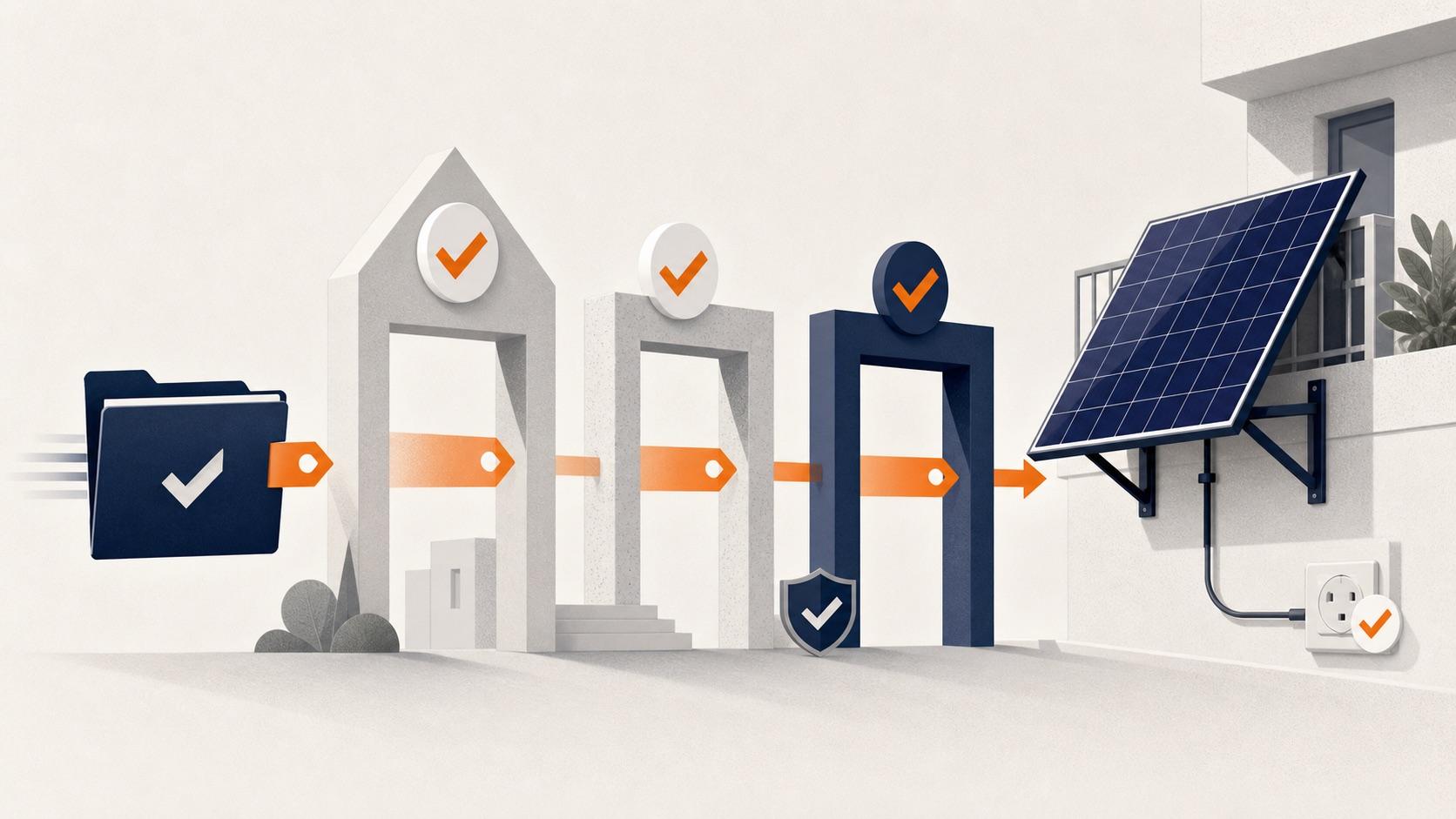
- Property consent, electrical eligibility, product evidence and planning or building approval are separate gates.
- Permission should identify one exact kit, mounting position and cable route; changing any of them can require a new decision.
- Germany's Civil Code section 554 gives tenants a right to request permission for plug-in solar modifications, subject to a landlord hardship test.
- Colorado's HB26-1007 became law on 7 May 2026 and allows property owners to impose reasonable restrictions on qualifying portable-scale solar devices.
- Australian government guidance says negotiated solar terms should be written into the tenancy agreement and cover ownership, maintenance and the end of the lease.
Do you need landlord permission for plug-in solar?
Treat written permission as a required pre-purchase gate whenever the panel, mount, cable or connection affects property you do not own. That includes a balcony railing, exterior wall, roof, garden, shared passage, external socket or any surface controlled by a landlord, freeholder, homeowners association, strata body or building manager. A system described as removable can still impose wind loads, alter the exterior appearance or depend on the building's electrical installation.
The answer can change where local law limits unreasonable restrictions or gives tenants a specific right to request an installation. Those rules are not interchangeable. Germany's Civil Code section 554 lets a tenant request permission for a modification that generates electricity with a plug-in solar device, but the claim does not apply where the modification would be unreasonable for the landlord after both interests are considered. Colorado's 2026 act makes unreasonable prohibitions on qualifying portable-scale solar unenforceable while preserving reasonable restrictions by a property owner. Neither example creates a worldwide permission rule.
| Gate | Question | Evidence |
|---|---|---|
| Property | Who controls the panel position, support, cable route and socket? | Tenancy or lease, building rules and written decision |
| Product | Is this exact complete kit documented for the market and proposed use? | Model numbers, manual, conformity or listing evidence and supplied components |
| Electrical | Does the current country, state, utility and circuit pathway cover it? | Official rule, utility process, circuit requirements and any registration record |
| Building | Do planning, fire, façade, heritage or structural rules apply? | Authority response, building policy and mount-specific structural evidence |
| Tenancy | Who owns, inspects, removes and restores the installation? | Dated written conditions signed or accepted by the relevant parties |
Run the five-minute precheck before writing
A request with no model number or a location described only as 'the balcony' gives a landlord too little to assess. Start by checking whether the proposed grid-tied system has a current connection pathway where you live. A plug-in solar law or simplified process may set output, product, circuit, notification or installer conditions. Where no explicit framework exists, the accurate result is research required with the utility and authority having jurisdiction, not a blanket claim that the equipment is illegal.
Next, confirm who can actually decide. A tenant's immediate landlord may not control an apartment façade, roof, guardrail or common area. A freeholder, homeowners association, housing provider, strata body, insurer or superior landlord may hold a separate approval. Australian government guidance illustrates this split: a rented apartment starts with the landlord, while rooftop or shared-property work can also require the body corporate. Ask the property manager to identify every decision-maker rather than assuming one signature clears the building.
- Read the alterations, exterior items, electrical equipment and common-area clauses in the tenancy or lease.
- Identify the exact surface and whether it is part of the rented unit, the building exterior or common property.
- Check the current grid-connection route before presenting retailer copy as evidence.
- Confirm that the complete product, not only one inverter component, has the required market evidence.
- Stop if the proposal depends on drilling, changing a socket, using an adapter or substituting the supplied mount without documented approval.
The landlord evidence pack: 12 items
Keep the cover request to one page and put the technical detail in labeled attachments. The decision-maker should be able to trace one product through one mounting plan, one electrical route and one removal agreement. Use the same model name throughout.
| Item | What to provide | Why it matters |
|---|---|---|
| 1. Requester and property | Tenant name, address, unit and contact details | Ties the decision to the correct tenancy |
| 2. Exact system | Manufacturer, full model, panel count, inverter AC rating and component list | Prevents approval from drifting to another bundle |
| 3. Product evidence | Regional manual and exact conformity, type-test or listing records | Separates complete-system evidence from badges on a component |
| 4. Location plan | Annotated photographs showing panel, inverter, cable and socket | Makes the affected property visible |
| 5. Mounting method | Bracket or stand model, fasteners, angle and support material | Defines how loads reach the building |
| 6. Structural basis | Manufacturer limits or a site-specific assessment for the support and exposure | Avoids treating every railing or wall as equivalent |
| 7. Cable route | Length, weather exposure, penetrations, trip protection and entry point | Shows whether the plan affects doors, drainage or escape routes |
| 8. Electrical pathway | Official location rule, utility process, circuit method and connection point | Keeps property approval separate from electrical compliance |
| 9. Installation plan | Who installs, under which instructions and with what access controls | Defines responsibility and work-at-height exposure |
| 10. Inspection plan | Routine checks, severe-weather checks and stop-use conditions | Shows how the installation will remain safe |
| 11. Insurance and liability | Requested policy evidence and responsibility for damage | Lets the owner set proportionate documented conditions |
| 12. Removal and restoration | Disconnection, removal, storage, make-good and end-of-tenancy steps | Resolves ownership and exit before installation |
Copy-ready landlord request template
Replace every bracketed field and delete any sentence that is not true. Do not call a mount no-drill, a product certified or a connection approved unless the attached evidence supports that statement.
Subject: Request for written permission to install a plug-in solar system at [address and unit]. I request permission for the exact [manufacturer and full model] system described in the attached evidence pack. It has [panel count] panels, a maximum inverter output of [AC watts or VA] and will connect through [documented connection method] under [current official pathway]. The panels will be placed at [exact location] using [exact mount] on [support description]. The cable will follow [route] to [socket or connection point]. The proposal involves [no drilling / the listed penetrations or alterations]. I will follow the manufacturer instructions, the written approval conditions and the attached inspection plan. [Responsible party] will own, insure, inspect and remove the system. At the end of the tenancy, [responsible party] will disconnect it and restore [affected surfaces]. Please confirm whether you, the freeholder, building manager, insurer or another party needs further evidence, and provide a dated written decision tied to this exact configuration.
Attach a short configuration schedule after the letter. Give each panel, mount, inverter and cable a model or part number. If the package contains optional batteries, adapters or third-party brackets that are not part of the request, mark them excluded. A landlord should not have to infer which product photo or retailer bundle you mean.
How to document mounting, wind and falling-object risk
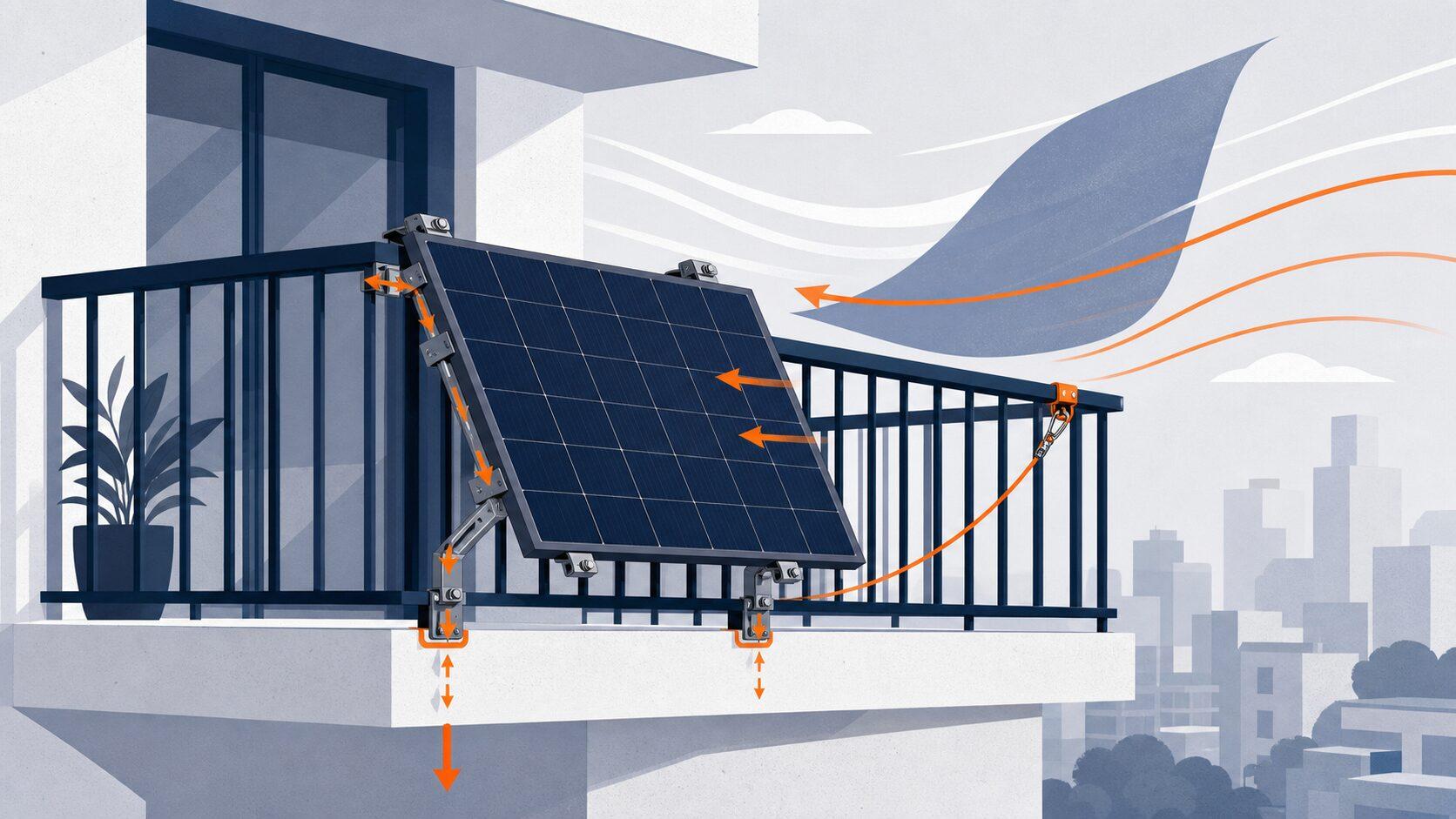
A panel at height can act like a sail. The permission pack should trace loads from the module frame through the exact brackets, fasteners and support into the building. A generic payload figure or clamp photograph does not establish wind capacity. State the panel dimensions, approved angle, railing or wall material, building height or exposure limits named by the manufacturer and any secondary restraint required by the documented design.
Show that the installation does not reduce the guardrail's safety function, obstruct an escape route, interfere with drainage or create an uncontrolled drop zone. Installation and inspection must not require leaning over an edge or working in unsafe wind. If the manufacturer documentation does not cover the support or position, obtain a qualified assessment or choose another location. The mount still needs documented safety evidence after the landlord gives consent.
| Mounting claim | Evidence that can support it | Evidence that is not enough |
|---|---|---|
| The clamp fits | Exact rail material, shape and dimensions within the mount instructions | A product photo on a different railing |
| The system resists wind | Applicable test, design limits or site-specific calculation for the full configuration | A panel weight or generic wind-speed badge |
| The installation is removable | Defined removal method and make-good plan | No-drill marketing language by itself |
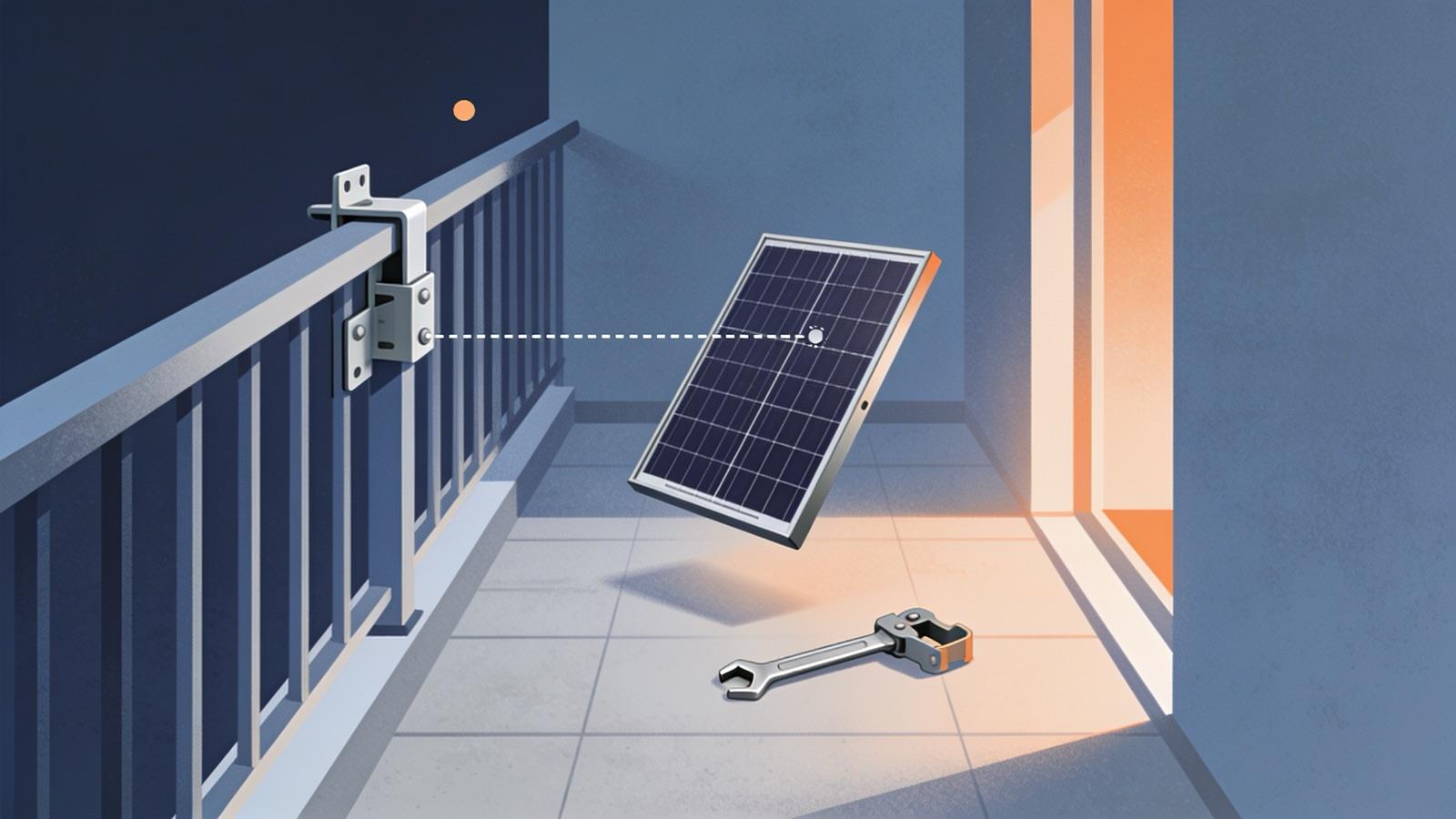
| The panel cannot fall | Verified primary load path plus any specified independent restraint | Cable ties, luggage straps or improvised wire |
How to present electrical and product evidence
State whether the system is grid-tied plug-in solar, an off-grid solar generator or a panel-only package. Only the first intentionally operates in parallel with household wiring. A portable power station that supplies its own outlets follows a different path and must never be improvised into a wall socket. A bare panel is not a household AC product.
For grid-tied equipment, list the inverter's rated AC output, plug and cable supplied for the market, anti-islanding or grid-interface evidence, circuit requirement and any registration or notification. UL Solutions describes several engineered circuit-protection approaches for US plug-in photovoltaic systems; one component listing or a generic smart plug does not prove that an improvised bundle satisfies the complete-system method. Use the exact product record and local rule.
Great Britain shows why dates and scope belong in the pack. SI 2026/848 comes into force on 27 August 2026 and creates a defined route for compliant plug-in solar. The final Interim Product Specification covers a complete solar-only device and excludes plug-in batteries from that first route. A landlord's approval cannot make an early connection, imported adapter or battery configuration eligible.
Reasonable conditions and the written decision
Ask the decision-maker to approve, refuse or request specific evidence in writing. An approval should identify the exact configuration and list its conditions. Common subjects include location, visibility, drilling, installation method, proof of insurance, inspection access, severe-weather actions, damage reporting, transfer to a new tenant and removal. Whether a particular condition is lawful or reasonable depends on the jurisdiction and agreement, so seek local housing or legal advice for a disputed decision.
Do not treat silence as approval unless the controlling law expressly gives it that effect. Keep the request, attachments, replies and final decision together. England and Wales guidance for qualifying tenant-funded energy-efficiency requests likewise emphasizes checking tenancy type, securing funding, compiling evidence and preparing a written request. That process may not cover every plug-in solar proposal, but it demonstrates why an evidence trail matters.
| Decision outcome | What to record | Next action |
|---|---|---|
| Approved | Exact model, site, mount, cable route, conditions and decision date | Complete the remaining product, electrical and building gates |
| More evidence needed | Each unanswered question and requested document | Respond with evidence or redesign, not sales claims |
| Approved with changes | Revised configuration and who accepted it | Recheck every affected technical document |
| Refused | Stated reason and governing clause or rule | Consider an off-grid alternative or obtain local tenancy advice |
| No response | Delivery record and follow-up dates | Do not install on the assumption that silence is consent |
Change control after permission
Treat permission as specific to the approved configuration. Reopen the decision if you change the panel count, inverter, battery, bracket, tilt, support, cable route, socket or installation method. Recheck it after moving home because the new property has a different owner, structure, circuit, network area and planning context.
Keep a commissioning record with photographs, model labels and the signed conditions. Follow the manufacturer's inspection schedule and check after severe weather, impact, nearby building work or any visible movement. Stop using and secure the area if a bracket shifts, a support deteriorates, a cable is damaged or a connection becomes loose, hot, wet, discolored or intermittent. Record repairs and any approval for material changes.
Country examples: rights differ, the evidence method survives
| Example | Official position | What the tenant should carry forward |
|---|---|---|
| Germany | BGB section 554 gives a tenant a right to request permission for a plug-in solar modification, subject to whether it is reasonable for the landlord | Submit the exact safe configuration; a right to request is not permission to ignore conditions |
| Colorado | HB26-1007 became law on 7 May 2026, voids unreasonable prohibitions for qualifying portable-scale solar and permits reasonable owner restrictions | Match the statutory device definition and document compliance with health and safety codes |
| Great Britain | The defined solar-only electrical route begins on 27 August 2026; tenancy, freeholder, planning and building gates remain separate | Use the UK renter guide for the current product, G98 and property sequence |
| Australia | Federal guidance starts renters with landlord permission and says negotiated solar terms should be written into the tenancy agreement | Record ownership, costs, maintenance, electricity benefits and end-of-lease treatment |
| Elsewhere | The lease, property law, building rules and grid pathway may assign different rights and decision-makers | Use primary local sources and describe missing evidence as research required |
Sources and next steps
The property-law examples come from the current German Civil Code and Colorado General Assembly. The written-agreement fields use Australian Government solar guidance. Great Britain's product boundary and commencement use SI 2026/848 and the July 2026 government outcome. Electrical evidence principles use UL Solutions safety guidance. These examples explain the method and do not replace local tenancy, building, insurance or utility advice.
- Germany Federal Ministry of Justice: Civil Code section 554
- Colorado General Assembly: HB26-1007 signed act and summary
- Australian Government: solar for rentals and multi-occupancy property
- GOV.UK: tenant energy-efficiency consent requests
- UK legislation: SI 2026/848
- GOV.UK: plug-in solar outcome and final product specification
- UL Solutions: plug-in photovoltaic safety considerations
Frequently asked questions
Do I need landlord permission for balcony solar?
Treat written permission as required when a panel, mount, cable or socket affects rented, exterior or shared property. Local law may limit unreasonable restrictions or create a right to request permission, but those rules differ. Electrical legality does not grant property consent. Identify the exact decision-maker and obtain a configuration-specific written answer before buying or installing.
What should I include in a landlord permission letter?
Identify the property, exact system and AC output, proposed panel location, mount, support, cable route and connection method. Attach product and structural evidence, the current electrical pathway, installation and inspection plans, insurance information, ownership, removal and restoration terms. Ask who else must approve and request a dated decision tied to that configuration.
Can a landlord refuse plug-in solar?
Sometimes, but the answer depends on local law, the tenancy and the proposed installation. Germany gives tenants a statutory right to request certain plug-in solar modifications, subject to a landlord hardship test. Colorado bars unreasonable prohibitions on qualifying devices while allowing reasonable restrictions. For a disputed refusal, use current local housing or legal advice.
Does a no-drill mount mean permission is unnecessary?
No. A clamp or floor stand can still load a railing or slab, alter the exterior, create a falling-object risk, affect drainage or occupy a shared area. No-drill describes one detail, not the whole property decision. Provide the exact mount, support, wind evidence, position, inspection plan and removal method.
Can I install if the landlord does not reply?
Do not treat silence as consent unless the controlling law expressly says otherwise. Keep proof of delivery and follow up in writing. A housing adviser can explain any statutory response process that applies to your tenancy. Installing without a documented decision can create lease, damage, insurance and removal disputes even where a grid-connection route exists.
Does landlord approval make a plug-in solar kit legal?
No. Property approval covers the owner's conditions, not product compliance, utility rules, circuit safety, planning or building requirements. Verify the exact complete system and current connection pathway separately. The reverse is also true: a state or national plug-in route does not automatically authorize mounting equipment on property you do not own.
Do I need new permission after changing the kit?
Recheck permission if you change the panel count, inverter, battery, mount, tilt, support, cable route, socket or installer. Any change can alter wind loads, electrical scope, appearance or responsibility. Permission also does not transfer to a new home. Save the approved configuration and compare every proposed change against it before proceeding.
Check your location
Framework status and exact product eligibility are separate checks.
The best plug-in solar kits of 2026, ranked
Now you know how it works — here are the kits we track, compared by configuration, AC output, verified price and certification evidence.
| Product | Exact configuration | Output | Panels / storage | Verified offer | Availability | UL 3700 evidence |
|---|---|---|---|---|---|---|
| EcoFlow STREAM Microinverter | STREAM Microinverter — bare unit | 1,200 W grid-tie | Not included | $299 · USD | UT · region only | not-verified |
| EcoFlow STREAM Ultra + Microinverter | STREAM Ultra + STREAM Microinverter | 1,200 W grid / 800 W hardware | 1,920 Wh | $1,459 · USD | UT · region only | not-verified |
| CraftStrom 400 Watt Plug&Play Solar | 400 W Eco-Line kit | 350 W grid / 400 W hardware | 2 panels | $499 · USD | US · in stock | not-verified |
| CraftStrom 800 Watt Plug&Play Solar | 800 W complete kit | 700 W grid / 800 W hardware | 4 panels | $2,031 · USD | US · in stock | not-verified |
| CraftStrom 1600 Watt Eco-Line Plug&Play Solar | 1600 W Eco-Line kit | 1,400 W grid / 1,600 W hardware | 8 panels | $3,187.5 · USD | US · in stock | not-verified |
| Bright Saver Flex180 single-panel kit | Flex180 single-panel kit | 180 W grid-tie | 1 panels | $399 · USD | US · in stock | not-verified |
| Plug In Solar Utah 3 Panel EcoFlow STREAM Kit | 3-panel EcoFlow STREAM kit | 1,200 W grid-tie | 3 panels | $1,299 · USD | UT · region only | not-verified |