
California Plug-In Solar Laws
 By Daniel Okafor · Last reviewed
 In short: California does not yet have an enacted statewide plug-in solar exemption. SB 868 passed both chambers and was presented to Governor Gavin Newsom on August 31, 2026, but enrollment is not enactment. Its proposed 1,200 W aggregated AC route is not current permission. Follow the existing utility and electrical process while tracking governor action.
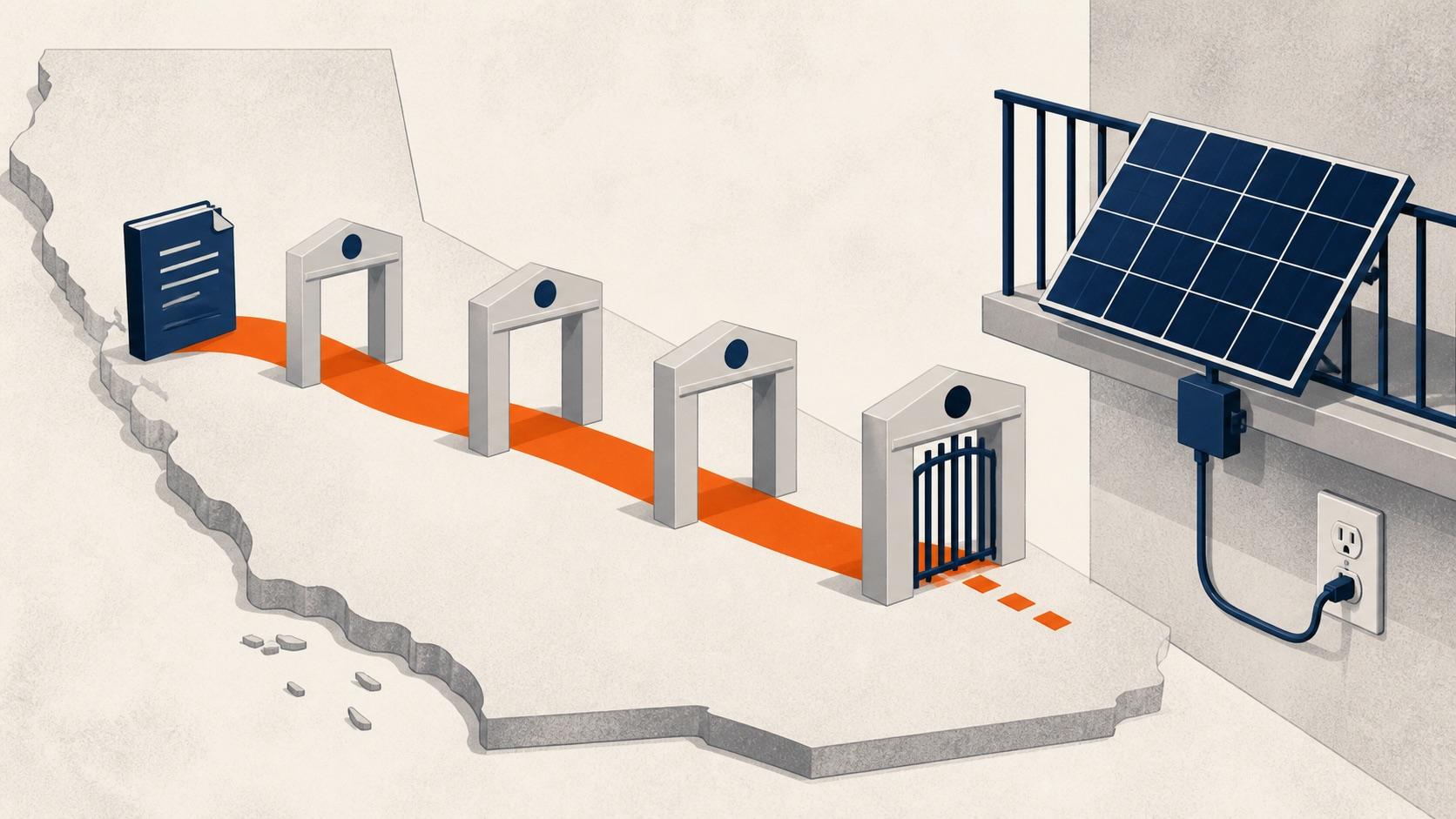
Current status
Passed both chambers—not signed
The Legislature has finished voting, but the proposal is not law. Track delivery and governor action, then wait for any stated effective date before relying on the new route.
Key facts
- Status: enrolled and presented to the governor on August 31, 2026
- Assembly floor vote: 73-0 on August 25, 2026
- Senate concurrence vote: 36-4 on August 26, 2026
- Proposed limit: no more than 1,200 W maximum aggregated AC output per dwelling
- Proposed evidence: certified plug-in PV system and certified outage isolation
- Current route: existing utility, electrical, local and property requirements
Check your location
Framework status and exact product eligibility are separate checks.
What this means today
SB 868 completed the Legislature but remains an active enrolled bill. The official history records a 73-0 Assembly vote on August 25, Senate concurrence by 36-4 on August 26, and presentation to the governor at 6 p.m. on August 31. No chapter number or signature appears in the reviewed status, so the proposed exemptions do not apply today.
For customers in CPUC-regulated investor-owned utility territories, Rule 21 describes interconnection, operating and metering requirements for generating facilities connected to the distribution system. Each utility administers its own version. Publicly owned utilities use their own processes. The absence of SB 868's proposed exemption is not proof of a universal prohibition, and legislative passage is not permission to connect without checking.
Current California process versus enrolled SB 868
| Question | What applies today | What enrolled SB 868 would do if enacted |
|---|---|---|
| Connection route | Use the current serving-utility and electrical pathway for the exact system. | A qualifying device would be exempt from state and utility interconnection requirements. |
| Output threshold | No statewide plug-in-specific 1,200 W exemption is in force. | No more than 1,200 W aggregated AC output per dwelling. |
| Utility step | Ask the utility what approval, application, metering or other process applies. | No prior utility approval, related fee or extra controls for a qualifying device; a simple online notice could still be required. |
| Equipment evidence | Current electrical, product and utility requirements still control. | The complete plug-in PV system and outage-isolation feature would need certification by UL or an equivalent NRTL, plus the stated code conditions. |
| Property permission | Lease, HOA, common-area, mounting and local rules remain separate checks. | The bill's operative provisions do not themselves grant permission to alter rented or common property. |
| Export value | Confirm meter behavior and tariff treatment with the serving utility. | The enrolled bill targets onsite consumption and creates no export-payment entitlement. |
What SB 868 says
The August 28 enrolled text defines a portable solar generation device as one photovoltaic device or a combination of devices with no more than 1,200 W maximum aggregated AC output per dwelling. It must connect and disconnect through a receptacle, be intended to offset onsite consumption, meet the most recent National Electrical Code and California Electrical Code, carry plug-in photovoltaic system certification from UL or an equivalent NRTL, and include certified outage isolation. A device missing any condition would not receive the proposed exemption.
Read the official bill record ↗
Legislative timeline
| Date | Official event | What it means |
|---|---|---|
| January 5, 2026 | SB 868 introduced | The proposal entered the Legislature; no legal exemption was created. |
| May 19, 2026 | Senate passed 35-1 | The bill advanced to the Assembly but did not become law. |
| June 10, 2026 | Assembly Utilities and Energy passed 18-0 | The committee sent an amended measure to Appropriations. |
| August 13, 2026 | Assembly Appropriations passed 11-0 | The committee sent the amended bill to the Assembly floor. |
| August 25, 2026 | Assembly passed 73-0 | The bill returned to the Senate for concurrence in Assembly amendments. |
| August 26, 2026 | Senate concurred 36-4 | Both chambers had agreed on the final text, but it was not yet enacted. |
| August 28, 2026 | SB 868 enrolled | The Legislature prepared the final bill for presentation to the governor. |
| August 31, 2026 | Presented to the governor at 6 p.m. | Governor action is the next official gate; the proposal is still not current law. |
Why legislative passage is not current permission
SB 868 would create a narrow exemption for devices that meet every condition in the enrolled bill. Until enactment and commencement, customers remain under the current utility, electrical and local framework. That route may not offer a practical socket connection for every configuration, but a missing dedicated statute is not proof of a universal ban.
California is also examining plug-in solar through CPUC proceeding R.25-08-004. The March 2026 scoping document expressly includes whether Rule 21 should address the interconnection process and requirements for plug-in solar. A regulatory proceeding can change the applicable path independently of SB 868, so both records matter.
What the enrolled product evidence would need to show
SB 868 does not name UL 3700. Its enrolled text requires certification of the plug-in photovoltaic system and its outage-isolation feature by UL or an equivalent nationally recognized testing laboratory. That wording concerns the complete system. A listing for one inverter or panel does not by itself prove that the assembled kit meets the bill's definition.
The 1,200 W limit is maximum aggregated AC output per dwelling, not the sum of panel DC nameplate ratings. The exact inverter configuration, any software limit and the certification record would need to agree. WattRank has not verified a current US product with complete-system evidence matching the enrolled clauses.
- Match the exact system model and every included component to the certification record.
- Verify aggregated AC output for the whole dwelling, not only one inverter or panel label.
- Confirm the certified outage-isolation feature and the permitted receptacle and circuit arrangement.
- Keep the official record showing which bill version and effective date apply.
What renters and HOA residents still need to solve
SB 868 regulates electrical corporations and local publicly owned electric utilities. Its operative provisions do not grant a renter permission to attach equipment to a balcony, change a receptacle or route a cable through shared property. They also do not turn a railing, roof or facade into an approved mounting surface.
California's existing solar-access rules can affect homeowner associations, including installations on shared multifamily roofs, but the exact property and installation determine which provisions apply. Renters should obtain a configuration-specific written decision from the landlord or other property decision-maker. HOA residents should identify separate-interest, exclusive-use and common-area boundaries before treating a solar-access rule as approval.
How to prepare without buying too early
The enrolled bill is useful for building an evidence file, but it does not show that a current product qualifies. Record the serving utility, dwelling and circuit, exact AC output, complete-system certification evidence, proposed mount, cable route, property approval and meter treatment. Recheck the official status for governor action, a chapter number and the operative date.
Do not assign value to export unless the serving utility confirms the applicable tariff. SB 868 describes devices intended to offset onsite consumption and creates no export-payment entitlement. A daytime-load estimate is the safer starting point for economics.
Your serving utility still matters
SB 868 passed both chambers and was presented to the governor on August 31, 2026, but it is not yet enacted. Existing serving-utility, electrical and local requirements apply unless and until the bill is enacted and its new route is in force.
Pre-purchase checklist
- 1Open the official SB 868 status and enrolled text; do not rely on an older bill summary.
- 2Wait for governor action and an operative route before relying on the proposed exemptions.
- 3Identify the serving utility and request its current process for the exact grid-parallel plug-in configuration.
- 4Record aggregated inverter AC output per dwelling separately from panel DC nameplate watts.
- 5Verify complete-system and outage-isolation certification evidence for the exact model and configuration.
- 6Confirm the receptacle, branch circuit, protection method and installation instructions with qualified help when needed.
- 7Obtain written landlord, HOA or other property approval for the exact mount and cable route.
- 8Check local electrical, building, fire and structural requirements; SB 868's proposed interconnection exemption is not a blanket property or construction approval.
- 9Confirm meter behavior and export treatment before assigning any value to surplus generation.
- 10Recheck the official record after governor or CPUC action before purchasing or connecting.
Next steps
Primary sources
Frequently asked questions
Is plug-in solar legal in California right now?
California has no enacted statewide plug-in-specific exemption in the reviewed sources. SB 868 passed both chambers and reached the governor, but it is not current law. That does not prove every configuration is prohibited. Customers must check the existing serving-utility, electrical, local and property requirements for the exact grid-parallel system.
Has California SB 868 passed?
Yes, both legislative chambers passed the final bill. The Assembly voted 73-0 on August 25, 2026, and the Senate concurred in the amendments 36-4 on August 26. The Legislature presented the enrolled bill to the governor on August 31. It still requires governor action and enactment before it can create an operative exemption.
Is the proposed 1,200 W limit panel wattage?
No. The enrolled text uses no more than 1,200 W maximum aggregated AC output per dwelling. Panel DC nameplate capacity is a different figure and may be higher than inverter AC output. Compare the entire dwelling's inverter configuration with the final text rather than adding only panel labels.
Would SB 868 require UL 3700 certification?
The enrolled bill does not name UL 3700. It requires the plug-in photovoltaic system and its outage-isolation feature to be certified by UL or an equivalent NRTL. Verify the exact complete-system record. A certification attached only to an inverter or panel would not prove every proposed condition is met.
Would a utility still need to approve the system?
If SB 868 is enacted and Section 8531 is in force, a qualifying device would be exempt from interconnection requirements and prior utility approval. A utility could still require a simple online notice with the address, make, model and size, but notification could not become approval. None of those exemptions applies yet.
Would SB 868 give California renters permission to install panels?
No property right appears in the bill's operative utility provisions. A renter would still need to resolve landlord consent, mounting, common-area access, cable routing and local requirements. HOA protections depend on the property and installation. Electrical eligibility and permission to alter a building are separate decisions.
Would California utilities pay for exported plug-in solar power?
Do not assume an export credit. The proposal defines the device around offsetting onsite consumption and does not create an export-payment entitlement in its operative text. Ask the serving utility how the meter records surplus and which tariff, if any, applies before including export value in a savings calculation.