
Hawaii Plug-In Solar Laws
 By Daniel Okafor · Last reviewed
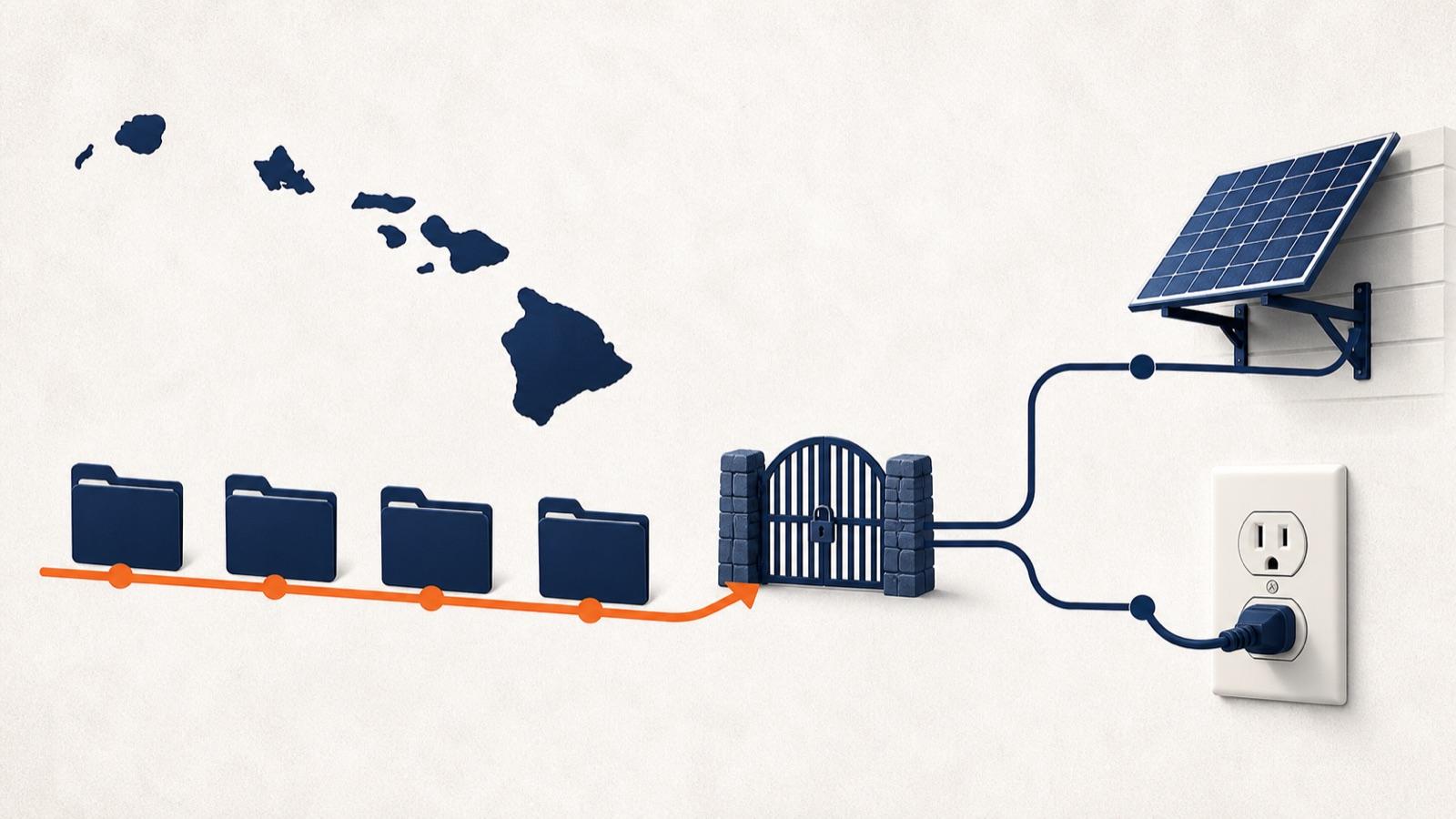
 In short: Hawaii has no enacted statewide plug-in solar exemption in the reviewed official records. The 2026 regular session ended after four proposals took different paths. Their 1.2 kW or 1,200 W thresholds are not current permission. Hawaiian Electric and KIUC still direct customers through their own interconnection processes before grid-parallel generation is installed or connected.
Current status
Session ended without passage
The tracked proposal did not become law and is no longer active. Follow the rules in force today and watch for a separately introduced future bill.
Key facts
- Status: the 2026 regular session ended without an enacted plug-in solar exemption
- Reviewed measures: SB 2902, HB 2609, HB 2486 and HB 2435
- Furthest Senate route: SB 2902 S.D. 2 H.D. 1 reached House Consumer Protection and Commerce
- Proposed limits only: 1.2 kW or 1,200 W, using different measurement language
- Current HECO route: application or agreement plus company approval under Rule 14H
- Current Kauai route: KIUC interconnection request and engineering review before installation
Check your location
Framework status and exact product eligibility are separate checks.
What this means today
Hawaii considered four portable-solar measures in 2026, but none created a route that applies today. SB 2902 S.D. 2 H.D. 1 was reported by House Energy and Environmental Protection and referred to Consumer Protection and Commerce. HB 2486 reached an H.D. 1 and a hearing before that committee, while HB 2435 was deferred on February 10. The regular session adjourned sine die on May 8 without an enacted plug-in-solar exemption.
These were not duplicate proposals. SB 2902 and its introduced companion HB 2609 focused on devices inside Chapter 514B condominium units. HB 2486 proposed a broader registration route. HB 2435 paired an electrical exemption with proposed property protections. Since none became law, the utility serving the address still controls the grid-parallel interconnection path.
Current Hawaii process versus the 2026 proposals
| Question | What applies today | SB 2902 / HB 2609 | HB 2486 | HB 2435 |
|---|---|---|---|---|
| Legal status | Existing utility, electrical, property and local requirements apply. | The session ended without enactment. | The session ended without enactment. | The session ended without enactment. |
| Who was covered | Eligibility depends on the current utility process and the property. | The introduced route was limited to devices within Chapter 514B condominium units. | The introduced text proposed statewide registration for qualifying devices. | The proposal covered residential dwellings owned by the installer and addressed landlords and associations separately. |
| Power wording | No statewide plug-in-specific cap was verified in current law. | No more than 1.2 kW maximum power output. | No more than 1,200 W maximum aggregate rated power output per meter. | No more than 1,200 W aggregate rated AC power output per electrical service. |
| Connection | Use the serving utility's current application, review, agreement and approval steps. | A standard 120 V AC outlet with proposed utility and interconnection exemptions. | A standard 120 V AC outlet with proposed registration and interconnection exemptions. | A standard 120 V AC outlet with a proposed exemption from individual interconnection approval and agreement. |
| Product evidence | Verify the exact equipment and current utility requirements. | The introduced text used UL or an equivalent NRTL; the later SB version delegated the standard to the PUC. | The introduced text used UL or an equivalent NRTL. | The text required NRTL certification for the intended application and did not name UL 3700. |
| Outage behavior | Confirm grid-loss behavior for the exact approved configuration. | A qualifying device needed a feature preventing energization of building wiring during an outage. | A qualifying device needed a mechanism preventing grid energization during an outage. | The proposal required anti-islanding functionality. |
| Export | Confirm meter treatment and compensation with the utility in writing. | The proposal created no automatic export-payment right. | The proposal created no automatic export-payment right. | The text expressly excluded net-energy or export compensation. |
What SB 2902 / HB 2609 / HB 2486 / HB 2435 says
SB 2902 and introduced companion HB 2609 proposed a condominium-only route for a movable photovoltaic device with no more than 1.2 kW maximum power output, a standard 120 V AC connection, outage isolation and registration. HB 2486 proposed a broader registration route capped at 1,200 W aggregate rated power per meter. HB 2435 used 1,200 W aggregate rated AC power per service and would have limited blanket property restrictions while allowing reasonable safety, structural, aesthetic and common-property conditions. The later SB 2902 S.D. 2 H.D. 1 delegated the certification standard to the Public Utilities Commission and carried a July 1, 3000 effective date to encourage further discussion. None of these provisions became current law.
Read the official bill record ↗
Hawaii's 2026 portable-solar timeline
| Date | Official event | What it means |
|---|---|---|
| January 2026 | Four measures introduced | SB 2902, HB 2609, HB 2486 and HB 2435 proposed different portable-solar pathways. |
| February 10, 2026 | HB 2435 deferred | House Energy and Environmental Protection did not advance the property-rights proposal. |
| February 24, 2026 | HB 2486 H.D. 1 heard by CPC | The official testimony archive confirms a later House draft and committee hearing, not enactment. |
| March 2026 | SB 2902 S.D. 2 H.D. 1 reported | House Energy and Environmental Protection recommended the amended bill and referral to CPC. |
| May 8, 2026 | Regular session adjourned sine die | No reviewed portable-solar proposal became an Act or created a current exemption. |
The proposed 1.2 kW figure is not a current Hawaii limit
The four measures do not add up to one simple 1,200 W rule. SB 2902 and HB 2609 used maximum power output. HB 2486 used maximum aggregate rated power output across devices connected to one meter. HB 2435 used aggregate rated AC power output per electrical service. Panel DC nameplate watts, inverter AC output and power exported at the meter are different measurements.
Each distinction belonged to a proposed definition that never took effect. A product page that says 1.2 kW therefore does not establish a current statewide route. Record panel DC capacity, continuous inverter AC output and expected export separately, then ask the serving utility which value its current process uses.
Hawaiian Electric and KIUC use separate current routes
Hawaiian Electric serves Oahu, Hawaii Island and Maui County. Rule 14H requires the relevant interconnection application or agreement and company approval before generating equipment is interconnected. The utility's Customer Interconnection Tool and Smart DER materials are the starting points for a grid-parallel system in its territory.
Kauai follows a separate route through KIUC. The cooperative tells customers to submit an interconnection request for engineering review before installing distributed generation, with details in Tariff No. 2. A Hawaiian Electric form cannot replace KIUC review. Identify the provider from the account or service address before choosing forms, equipment or a meter pathway.
The bills did not name UL 3700
The introduced texts of SB 2902, HB 2609 and HB 2486 referred to UL or an equivalent nationally recognized testing laboratory. HB 2435 required NRTL certification for the intended application. A later SB 2902 version directed the Public Utilities Commission to determine a certification standard. None of the reviewed texts names UL 3700.
UL 3700 remains an Outline of Investigation. A generic UL mark does not identify the product, configuration or test standard, and an inverter certification does not automatically cover the panel, cable, plug, controls and mounting as a complete system. Match the exact model and configuration to the laboratory record and the current utility requirement before treating a certification claim as evidence.
- Record the exact model, included components, laboratory, certification mark and named standard.
- Confirm whether the evidence covers a component or the complete connected system.
- Verify the receptacle, branch circuit, protection and grid-loss behavior for the approved configuration.
- Do not convert proposed bill language into a current product-compliance claim.
Property permission and export treatment remain separate
HB 2435 would have limited agreements that prevented an owner from installing a qualifying device, while preserving reasonable restrictions for safety, structure, appearance and common property. That protection did not take effect. Anyone using shared property still needs the applicable written decision for the panel, mount, railing, facade, cable route and equipment location.
The reviewed proposals promised no payment for surplus electricity. HB 2435 expressly excluded net-energy or export compensation, while the other proposals focused on exemptions and onsite consumption. Current meter behavior and any credit depend on the serving utility and approved tariff. Model savings from verified daytime self-consumption unless the utility confirms another treatment in writing.
Your serving utility still matters
The reviewed 2026 proposals did not become law. Hawaiian Electric Rule 14H requires the relevant application or agreement and company approval before grid-parallel interconnection. KIUC directs Kauai customers to submit an interconnection request for engineering review before installation. Confirm the current route with the utility serving the address.
Pre-purchase checklist
- 1Treat all four 2026 measures as ended and look for a new bill number before relying on similar language.
- 2Identify Hawaiian Electric or KIUC from the service address before selecting an interconnection process.
- 3Request the utility's current written route for the exact grid-parallel plug-in configuration.
- 4Record panel DC nameplate capacity, continuous inverter AC output and expected export separately.
- 5Do not use a proposed 1.2 kW or 1,200 W threshold as a current statewide limit.
- 6Verify the exact model, configuration, NRTL, certification mark and named test standard.
- 7Confirm the branch circuit, receptacle, protection, cable and manufacturer-approved connection method.
- 8Obtain written landlord, association or other property approval for the mount and cable route.
- 9Check county building, electrical, fire and structural requirements for the site.
- 10Model economics from onsite use unless the serving utility documents an export credit for the approved route.
Next steps
Primary sources
Frequently asked questions
Is plug-in solar legal in Hawaii right now?
Hawaii has no enacted statewide plug-in-specific exemption in the reviewed official records. The 2026 proposals ended without passage. That does not establish that every configuration is prohibited. Ask Hawaiian Electric or KIUC which current interconnection, electrical, equipment, meter and property requirements apply to the exact grid-parallel system and address.
Did Hawaii pass SB 2902 in 2026?
No. SB 2902 reached the House as S.D. 2 and was reported as H.D. 1 by House Energy and Environmental Protection for referral to Consumer Protection and Commerce. The regular session adjourned sine die on May 8, 2026 without an enacted plug-in-solar Act, so the bill's proposed exemptions are not available.
What happened to HB 2609, HB 2486 and HB 2435?
HB 2609 was the introduced House companion to SB 2902. HB 2486 advanced to an H.D. 1 and a Consumer Protection and Commerce hearing. HB 2435 was deferred by House Energy and Environmental Protection on February 10. None of the three became current law before the 2026 regular session ended.
Does Hawaii now allow 1,200 W plug-in solar systems?
No current statewide permission follows from those numbers. The measures used different terms: 1.2 kW maximum power output, 1,200 W aggregate rated output per meter, or 1,200 W aggregate rated AC output per service. None took effect. Confirm the current utility route and keep panel DC, inverter AC and export power separate.
Do Hawaii's bills require UL 3700?
No reviewed 2026 bill names UL 3700. The bills used generic UL or NRTL language, required certification for an intended application, or delegated the standard to the Public Utilities Commission. UL 3700 remains an Outline of Investigation. Verify the exact model, configuration, laboratory and named standard instead of treating a component mark as complete-system evidence.
Do I need utility approval for plug-in solar in Hawaii?
Use the serving utility's current process because no 2026 exemption took effect. Hawaiian Electric Rule 14H requires the relevant application or agreement and company approval before grid-parallel interconnection. KIUC directs Kauai customers to submit an interconnection request for engineering review before installation. Ask about the exact configuration rather than assuming one utility's form applies statewide.
Would a Hawaii landlord or condo association have to allow balcony solar?
HB 2435 proposed limits on blanket restrictions but did not become law. Current lease, condominium, common-property, structural and local requirements remain separate. Obtain a written decision for the exact panel, mount, railing or facade attachment, cable route, receptacle and removal plan. Utility eligibility would not itself grant property permission.
Will Hawaii utilities pay for exported plug-in solar power?
No export payment should be assumed. HB 2435 expressly excluded net-energy or export compensation, and the other proposals did not create an automatic payment right. Ask the serving utility how its approved meter and tariff treat surplus electricity. Base a savings estimate on verified daytime self-consumption unless another treatment is confirmed in writing.