Illinois Plug-In Solar Laws
 By Daniel Okafor · Last reviewed
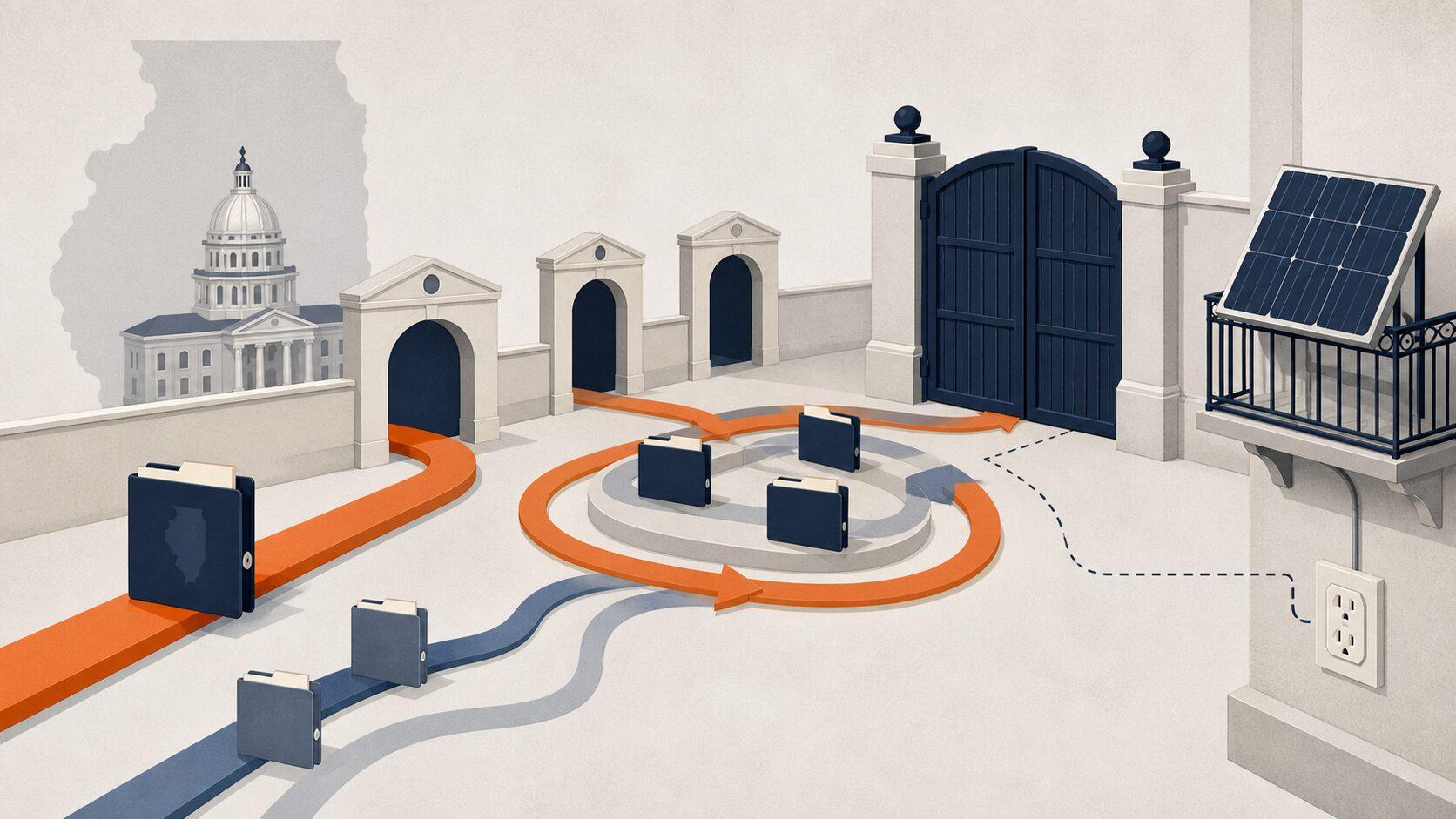
 In short: Illinois has not enacted a statewide plug-in solar exemption. SB 3104 was re-referred to Senate Assignments on May 22, 2026, so its proposed route is not available today. Its adopted committee text separates a 1,200 W definition from a 391 W installation threshold. Check the current utility, electrical, property and local requirements before connecting a grid-parallel system.
Current status
Bill introduced
A proposal is pending and may change or fail. Follow today’s utility and electrical rules while tracking the official bill record.
Key facts
- Status: SB 3104 is in Senate Assignments, not enacted law
- Bill action: re-referred to Assignments on May 22, 2026
- Adopted committee text: 1,200 W outlet-export definition with a 391 W installation threshold
- Committee vote: do pass as amended, 9-4-0 on March 12, 2026
- Floor Amendment 7: not adopted; referred to Assignments on July 2, 2026
- Current route: Part 466 or the serving provider's applicable process still controls
Check your location
Framework status and exact product eligibility are separate checks.
What this means today
SB 3104 has not passed the Senate or become law. The official action history shows the bill re-referred to Assignments under Rule 3-9(a) on May 22, 2026. Later action on July 2 sent pending Floor Amendment 7 to Assignments as well. None of the proposed utility exemptions, tenant provisions or watt thresholds can be used as present connection authority.
Illinois does have a general route for distributed energy resources that operate in parallel with an investor-owned utility distribution system. Part 466 defines the interconnection request and the conditions that must be completed before operation. Municipal and cooperative customers may have a different provider process. The absence of a plug-in-specific exemption does not prove that every configuration is prohibited, but it does require an address-specific answer before connection.
What applies today versus the adopted SB 3104 proposal
| Question | What applies today | What adopted Amendments 2 and 3 propose |
|---|---|---|
| Legal status | No enacted statewide plug-in-specific exemption appears in the reviewed official record. | A narrow route would apply only if a final bill is enacted and reaches its effective date. |
| Output figures | No statewide plug-in-specific 391 W or 1,200 W exemption is in force. | The definition allows no more than 1,200 W exported to a receiving outlet, but installation above 391 W would be prohibited until an applicable NEC standard exists. |
| Utility process | For an in-scope public utility, use Part 466; otherwise obtain the serving provider's applicable process. | A qualifying system would be exempt from Section 16-107.5 interconnection requirements and prior provider approval. |
| Utility notice | Ask what application, approval, meter, inspection and export steps apply before operation. | The owner would notify the provider within 30 days after installation using a limited form. |
| Export value | Do not assume that a bidirectional meter produces compensation. | The exempt system would not qualify for net metering or a Section 16-107.6 rebate. |
| Product evidence | Current Part 466 lab certification covers interconnection equipment under its stated standards and use conditions. | The adopted text requires UL or equivalent NRTL certification; pending Amendment 7 would explicitly require UL 3700 or equivalent system certification. |
| Property rights | Lease, association, mounting and local requirements remain separate decisions. | Future landlord and association protections would apply only to specified agreements or documents created, entered into, renewed or amended after the act's effective date. |
What SB 3104 says
As modified by adopted Senate Committee Amendments 2 and 3, SB 3104 would define a plug-in solar energy system around an existing outlet, an exclusive-use location, onsite consumption and no more than 1,200 W exported to a receiving outlet. A separate clause would exempt systems at 391 W or less from code or listing provisions that require premises, wiring or panel alterations. Installation above 391 W would remain prohibited until the National Fire Protection Association adopts an applicable National Electrical Code standard. The proposal also requires UL or equivalent NRTL certification.
Read the official bill record ↗
SB 3104 and parallel Illinois bill timeline
| Date | Official event | What it means |
|---|---|---|
| January 29, 2026 | SB 3104 introduced | The proposal entered the Senate; no exemption was created. |
| March 12, 2026 | Amendments 2 and 3 adopted; committee vote 9-4-0 | The bill advanced as amended to second reading, but did not pass the Senate. |
| April 24, 2026 | Floor Amendment 7 filed | The later text proposed explicit UL 3700 or equivalent system certification; filing did not make it controlling text. |
| May 22, 2026 | SB 3104 re-referred to Assignments | The bill left the third-reading path without Senate passage. |
| July 2, 2026 | Pending amendments referred to Assignments | The action history still does not show Floor Amendment 7 adopted. |
| Parallel House bills | HB 4371 and HB 4524 remain in Rules | Both were re-referred under House Rule 19(a) on March 27, 2026; neither is law. |
Why the bill version changes the answer
SB 3104 has several text layers. Committee Amendment 2 replaced the bill's operative language, and Amendments 2 and 3 were adopted on March 12. Floor Amendment 7 was filed later and would change the product definition by explicitly naming UL 3700 or equivalent plug-in solar certification. The official action list shows it referred to committee and later to Assignments, not adopted.
Those versions are easy to blur together. The adopted proposal does not offer a simple 1,200 W connection route because it also includes the 391 W installation threshold. The later UL 3700 wording remains informative, but it cannot be presented as enacted law or as the adopted Senate text.
The current Illinois route before SB 3104
Part 466 applies to distributed energy resource facilities operating in parallel with an Illinois electric public utility distribution company when the rule's scope conditions are met. It defines an interconnection request as a request to connect a new facility or change an existing one. The rule does not permit operation until the applicable agreement requirements, electrical approval, certificate of completion and any required witness test are satisfied.
Part 466 does not cover every provider in Illinois. The Illinois Commerce Commission identifies four regulated investor-owned distribution utilities: Ameren Illinois, ComEd, MidAmerican Energy and Mt. Carmel Public Utility. A municipal utility or cooperative customer should ask that provider for its current classification and process. Do not assume that a retailer, installer or bidirectional meter can answer for the distribution provider.
How to read the safety and certification language
Current Part 466 lab certification concerns interconnection equipment. Section 466.70 references IEEE 1547 and IEEE 1547.1, UL 1741 and NFPA 70, and requires the proposed use and connected components to be consistent with the NRTL evaluation. Those records matter, but they are not automatically a listing for the complete plug-in kit.
Floor Amendment 7 would make the proposed system-level condition more specific by naming UL 3700 or an equivalent certification for plug-in solar energy systems. UL Solutions describes UL 3700 as the Outline of Investigation for Interactive Plug-In PV Equipment and Systems and has launched an evaluation program based on it. An outline can support testing, but it must not be relabeled as a consensus ANSI/UL standard. Verify the exact model and configuration in the certifier's record.
- Record outlet-side output separately from panel DC nameplate watts.
- Match the inverter, panels, cable, plug, controls and any battery to the evaluated configuration.
- Verify anti-islanding, overcurrent protection, ground-fault behavior and installation instructions for the exact system.
- Do not treat a UL 1741 inverter mark as complete-system UL 3700 evidence.
What the proposals would not settle
The adopted proposal includes future protections against unreasonable landlord and association restrictions, but only for specified leases, contracts or governing documents created, entered into, renewed or amended after the act's effective date. It also keeps an exemption for certain associations. Until a final law takes effect, a renter or association resident should obtain a written decision for the exact mount, cable route, outlet and equipment location.
A warning-label date is not an effective date. Amendment 2 would require a circuit-overload and fire warning on systems manufactured on or after January 1, 2027. That provision would matter only if enacted. It does not make SB 3104 effective on that date, and it does not replace a circuit check, utility process or local building decision.
Your serving utility still matters
SB 3104 is not enacted. For a public utility within Part 466, use the current interconnection process; municipal and cooperative customers should obtain their serving provider's applicable route.
Pre-purchase checklist
- 1Open the official SB 3104 action history and confirm whether the bill or Floor Amendment 7 has moved since this review.
- 2Do not use the proposed 391 W or 1,200 W provisions before a final act becomes effective.
- 3Identify the distribution provider, not only the electricity supplier shown on the bill.
- 4Request the current interconnection, approval, inspection, metering and export route for the exact grid-parallel system.
- 5Record receptacle-side AC output separately from panel DC nameplate capacity and total every inverter in the configuration.
- 6Verify the exact NRTL record, approved use, outage protection, plug, cable, circuit method and manufacturer instructions.
- 7Check whether installer certification, local electrical approval or other qualified work applies to the proposed scope.
- 8Obtain written landlord, association or other property approval for the exact mounting and cable plan.
- 9Model savings from verified self-consumption unless the provider confirms an export-compensation agreement.
Next steps
Primary sources
Frequently asked questions
Is plug-in solar legal in Illinois right now?
Illinois has no enacted statewide plug-in-specific exemption in the reviewed official sources. SB 3104 is pending in Senate Assignments. That does not prove every configuration is prohibited. It means the proposal cannot be used as permission, and the current utility, electrical, property and local requirements must be checked for the exact system and address.
Did Illinois SB 3104 pass?
No. The Senate Energy and Public Utilities Committee reported the bill do pass as amended by a 9-4-0 vote on March 12, 2026. The bill later returned to Assignments on May 22 without Senate passage. Floor Amendment 7 was also referred to Assignments on July 2 and is not shown as adopted.
Is the Illinois proposal limited to 391 W or 1,200 W?
The adopted committee text uses both figures for different purposes. Its definition allows no more than 1,200 W exported to a receiving outlet, while installation above 391 W would be prohibited until NFPA adopts an applicable NEC standard. The 391 W figure concerns outlet output, not the sum of panel DC nameplate ratings.
Would an Illinois plug-in system need utility approval?
Today, use the applicable current provider route. For a public utility within Part 466, that includes an interconnection process and conditions before operation. Adopted SB 3104 language would remove prior approval for a qualifying system and require owner notice within 30 days after installation, but that proposed exemption is not in force.
Would Illinois pay for exported plug-in solar energy?
Do not assume export compensation. The adopted SB 3104 proposal says an exempt plug-in system would not qualify for net metering or a distributed-generation rebate. Current treatment depends on the applicable provider route and tariff. Model savings from daytime self-consumption unless the distribution provider confirms how the meter records and credits surplus.
Would SB 3104 give Illinois renters permission to install panels?
Not today. The adopted proposal would restrict unreasonable landlord and association rules only for specified agreements or governing documents created, entered into, renewed or amended after the act's effective date. It also preserves an association exemption. A current renter should obtain written, configuration-specific permission and still resolve electrical, mounting and local requirements.
Does Illinois SB 3104 require UL 3700 certification?
The adopted Amendment 2 requires UL or equivalent NRTL certification without naming UL 3700. Later Floor Amendment 7 would explicitly require UL 3700 or equivalent plug-in system certification, but it is not shown as adopted. UL 3700 is currently an Outline of Investigation. A UL 1741 inverter listing alone does not establish complete-system evidence.