
Oklahoma Plug-In Solar Laws
 By Daniel Okafor · Last reviewed
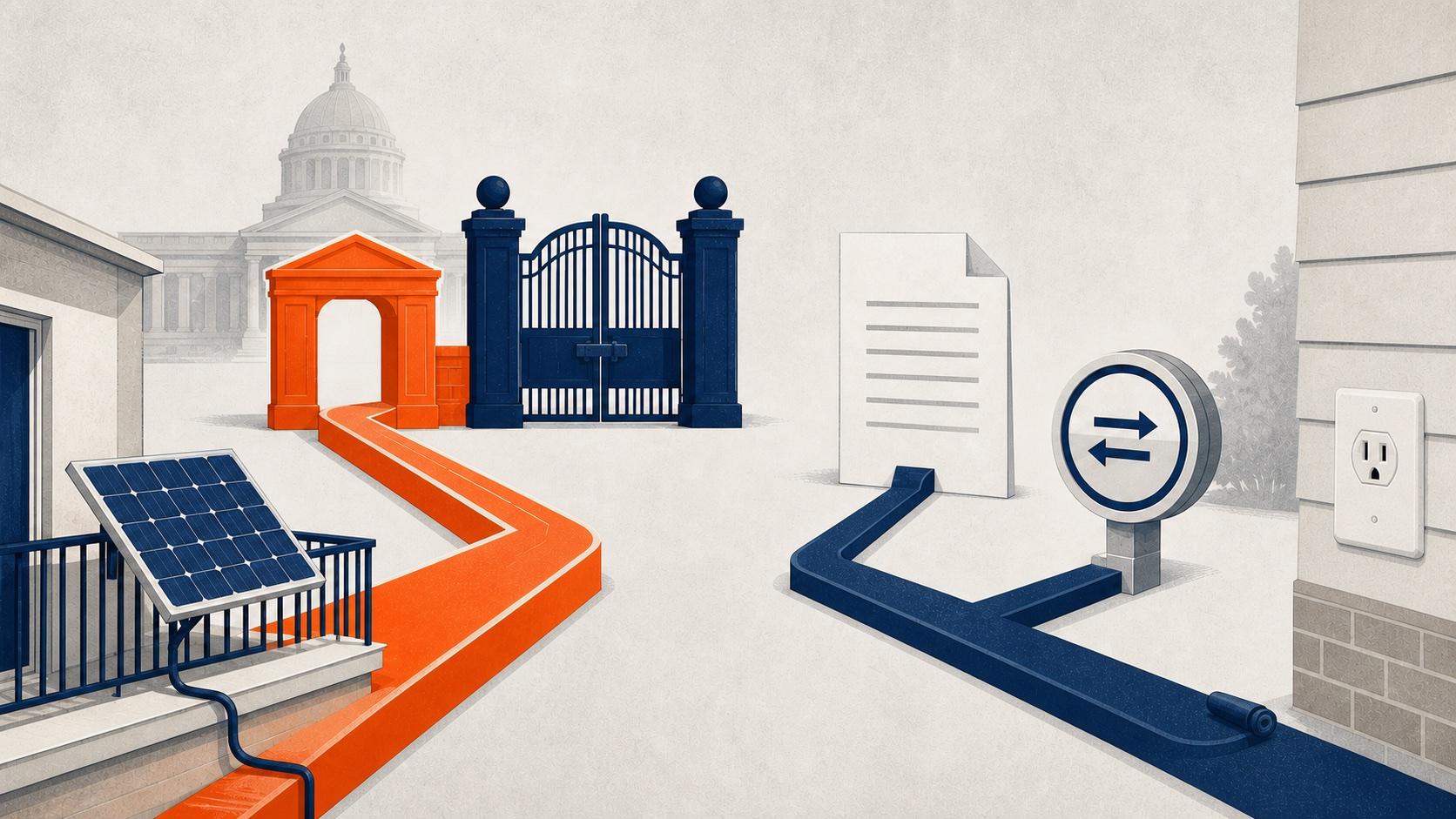
 In short: Oklahoma has no enacted plug-in solar exemption. HB 4060 passed the House 88-4 but ended in the Senate Energy Committee when the Legislature adjourned on May 15, 2026. Its proposed 1,200 W AC outlet route and November 1 start date never took effect. Use the serving provider's current interconnection, electrical, meter and approval process.
Current status
Session ended without passage
The tracked proposal did not become law and is no longer active. Follow the rules in force today and watch for a separately introduced future bill.
Key facts
- Status: HB 4060 ended without passage on May 15, 2026
- House vote: 88-4 on March 24, 2026
- Last procedural move: referred to Senate Energy on April 1, 2026
- Former limit: no more than 1,200 W aggregate rated AC output
- Former connection: a standard grounded 120 V outlet with anti-islanding
- Current route: OCC rules and serving-provider requirements, not the ended exemption
Check your location
Framework status and exact product eligibility are separate checks.
What this means today
The official HB 4060 history records an 88-4 House vote on March 24, 2026 and transmission to the Senate the next day. The Senate referred the bill to its Energy Committee on April 1. A coauthor was added on April 16, but the record shows no Senate committee report, floor vote or enrollment before the second session of the 60th Legislature ended sine die on May 15.
The engrossed text leaves the Senate passage line blank. November 1, 2026 was only the proposed effective date in a bill that did not become law, not a delayed launch date. Oklahoma customers must use the current route that applies to their provider, configuration, premises wiring and location.
Current Oklahoma process versus ended HB 4060
| Question | What applies today | What engrossed HB 4060 proposed |
|---|---|---|
| Legal status | Existing statutes, OCC rules, provider tariffs and electrical requirements remain in force. | The bill ended without Senate passage, enactment or an effective date. |
| Connection route | Ask the serving provider how it classifies and approves the exact grid-parallel system. | A qualifying device would not count as interconnection and would need no utility or OCC application, inspection or approval. |
| Output threshold | No statewide plug-in-specific watt exemption was enacted. | No more than 1,200 W aggregate rated AC output, not panel DC nameplate power. |
| Provider scope | OCC jurisdiction differs among investor-owned, governmental, municipal and cooperative providers. | The definition covered a retail public utility subject to OCC jurisdiction, not every Oklahoma provider. |
| Safety evidence | Use current code, provider requirements, equipment records and installation instructions. | Nationally recognized electrical safety standards and anti-islanding, with no numbered test standard or NRTL named. |
| Meter and export | Current net-metering and provider rules control meter treatment and compensation. | The proposal granted no export compensation and did not modify existing net-metering programs. |
| Property and local checks | Landlord, association, mounting, structural, fire, permit and inspection questions remain separate. | The bill preserved general electrical-code enforcement and granted no property permission. |
What HB 4060 says
The engrossed version of HB 4060 would have created sections 875 through 882 of Title 17. It defined a portable solar generation device as a photovoltaic device with no more than 1,200 W aggregate rated AC output, connection through a standard grounded 120 V outlet, integrated anti-islanding or equivalent outage protection, and primary use to offset onsite consumption. A qualifying device would sit outside ordinary interconnection and net-metering requirements. The proposal also restricted what an OCC-regulated electric utility could demand, required nationally recognized electrical safety standards, preserved general electrical-code enforcement and granted no compensation for exported electricity. Section 9 proposed November 1, 2026 as the effective date, but the bill did not pass the Senate or become law.
Read the official bill record ↗
HB 4060 legislative timeline
| Date | Official event | What it means |
|---|---|---|
| January 15, 2026 | Introduced version published | The proposal entered the legislative process. It created no exemption. |
| February 3, 2026 | House committee referrals | The bill was referred to Energy and Natural Resources Oversight and Utilities. |
| February 11, 2026 | Utilities recommendation | The committee recommended passage as amended by a committee substitute. |
| March 4, 2026 | Oversight committee report | The bill advanced to the House floor with the committee substitute. |
| March 24, 2026 | House passed HB 4060, 88-4 | One chamber approved the proposal. It was still not law. |
| March 25, 2026 | Engrossed bill sent to Senate | The Senate received the House-approved version. |
| April 1, 2026 | Referred to Senate Energy | This was the last procedural move listed before the session ended. |
| May 15, 2026 | Legislature adjourned sine die | HB 4060 had no Senate passage or enactment, so the proposed route ended. |
The former 1,200 W limit was explicitly AC
Unlike proposals that leave the measurement undefined, HB 4060 specified aggregate rated alternating-current output and capped it at 1,200 W. That is the inverter-side rating, not the combined DC nameplate rating printed on the panels. A package advertised with 1,200 W of panels could have a lower AC output. Several inverters would have to be counted together under the proposal.
The definition also required a standard grounded 120 V outlet and integrated anti-islanding or an equivalent function that prevents the building's electrical system from being energized during an outage. Those details describe a grid-parallel plug-in PV device. They do not describe a panel-only bundle or a solar generator supplying isolated loads through its own outlets.
Describe each of those points in the past tense. The Legislature did not enact the definition, threshold or outlet route. A retailer's claim that a system matches the former 1,200 W proposal does not establish permission to connect it today.
The proposed exemption would not have covered every provider
The engrossed bill defined an electric utility as a public utility providing retail service subject to Oklahoma Corporation Commission jurisdiction. The OCC says it regulates the rates and service reliability of Liberty Utilities, OG&E and Public Service Company of Oklahoma. It also says governmental utilities fall outside its regulation and many electric cooperatives have opted out of price regulation.
Even if HB 4060 had passed, its definition would have limited the proposed restrictions on approval, fees, extra equipment and agreements to the defined OCC-regulated utility. The text was not a universal instruction for every municipal, governmental or cooperative provider in Oklahoma.
Identify the provider named on the electric bill. Request its written classification of the exact system, including panel DC rating, continuous inverter AC output, connection method, anti-islanding evidence and expected export. Do not borrow PSO or OG&E instructions for a different provider unless that provider adopts them.
How the current interconnection and meter route works
The OCC's current net-metering page says grid-connected distributed generation is governed by 17 O.S. section 156 and OAC 165:40:9. Its guidance covers qualified rated capacity of 300 kW or less and uses a 125% peak-load limit. Those are general distributed-generation rules, not a plug-in socket exemption.
Provider implementation still controls the project sequence. PSO tells customers to submit an interconnection application before connecting a distributed energy resource. Its current process includes technical review, approval, installation, inspection and an interconnection agreement. The technical page also calls for IEEE 1547-2018-certified equipment and a visible lockable disconnect. These are PSO instructions, not a statewide checklist for every provider.
Ask for the current application, tariff, equipment list, one-line diagram requirements, inspection steps, meter work and permission-to-operate condition before ordering. If the provider says an ordinary application does not fit a small plug-in device, request that answer in writing rather than assuming the ended bill supplies an exemption.
HB 4060 did not name UL 3700 or an NRTL
The safety clause required compliance with nationally recognized electrical safety standards and anti-islanding protection. It did not name UL 3700, UL 1741, IEEE 1547 or the National Electrical Code. Nor did it require certification by a nationally recognized testing laboratory. Do not read those requirements into the former bill.
UL 3700 is the December 11, 2025 Outline of Investigation for Interactive Plug-In PV Equipment and Systems. It is relevant evidence for this product category, but HB 4060 did not make it a statutory condition. A component listing under another standard also would not prove that the complete panel, inverter, cable, plug and protection package met every proposed definition and safety condition.
Verify the exact model and configuration in the certifier's public directory, including the named standard and any installation conditions. OSHA recognition applies only within each NRTL's approved scope. The scope record helps evaluate product evidence, but it does not revive or rewrite HB 4060.
- Record the exact panel, inverter, cable, plug and protection model numbers.
- Match certification records to the supplied configuration, not a related component or product family.
- Confirm the named test standard and the laboratory's approved scope.
- Keep product evidence separate from utility approval and property permission.
Export value, electrical work and property permission remain separate
HB 4060 expressly denied any new right to compensation for exported electricity and left existing distributed-generation and net-metering programs unchanged. The OCC currently describes retail netting up to onsite consumption and utility purchase or credit of excess generation at avoided energy cost for covered net-metering customers. That does not establish how an unapproved plug-in configuration would be measured or credited.
Model savings from direct daytime use until the provider confirms the applicable tariff and meter in writing. A meter capable of recording reverse flow does not by itself create a credit. The proposed bill's primary-use language focused on offsetting consumption, not earning export revenue.
Oklahoma adopted the 2023 National Electrical Code effective September 14, 2024. The Construction Industries Board says notice can be required for electrical work in places without an adopted code, permit requirement or appointed inspector. Local enforcement and provider requirements can add address-specific steps, so confirm the circuit, receptacle, protection, permit and inspection path for the actual site.
The ended bill created no landlord, association or structural right. Obtain a written property decision for the exact panel position, mount, support, cable route, outlet and removal plan. Electrical eligibility, if established through today's route, would still not prove that a balcony or facade may be used.
Your serving utility still matters
HB 4060 ended without passage. Ask the serving provider how its current interconnection, electrical, metering, inspection and permission-to-operate rules classify the exact grid-parallel configuration.
Pre-purchase checklist
- 1Treat HB 4060 as ended and look for a new bill number before relying on a similar future proposal.
- 2Identify the serving provider and whether the account is under OCC, municipal, governmental or cooperative rules.
- 3Request the provider's current written classification and approval route for the exact grid-parallel plug-in configuration.
- 4Record panel DC nameplate watts and aggregate rated inverter AC output separately.
- 5Verify the exact model, complete configuration, certifier, named standard and listing conditions in a public record.
- 6Confirm anti-islanding, outage behavior, circuit, receptacle, protection and disconnect requirements.
- 7Check the current permit, inspection and code-enforcement route for the installation address.
- 8Confirm the meter and tariff before assigning value to any exported electricity.
- 9Obtain written landlord, association or owner approval for the mount, cable route and removal plan.
- 10Keep provider approval, inspection records, product evidence and property permission with the final configuration.
Next steps
Primary sources
Frequently asked questions
Is plug-in solar legal in Oklahoma right now?
Oklahoma has no enacted statewide plug-in-specific exemption in the reviewed official record. HB 4060 ended without passage. That does not prove every configuration is prohibited. It means the former bill is not permission, so the current serving-provider, electrical, meter, inspection, property and local requirements must be checked before connecting grid-parallel generation.
Did Oklahoma HB 4060 pass?
No. HB 4060 passed the House 88-4 on March 24, 2026 and reached the Senate Energy Committee. The official history shows no Senate committee report or Senate vote before the Legislature adjourned sine die on May 15. The engrossed bill did not become law, and its proposed November 1 date never took effect.
What was the Oklahoma plug-in solar watt limit?
Engrossed HB 4060 proposed no more than 1,200 W aggregate rated AC output. That was an inverter-side limit, not panel DC nameplate capacity. Because the bill ended, Oklahoma has no current plug-in-specific 1,200 W exemption. Record both DC and AC ratings when asking the serving provider about today's route.
Would HB 4060 have applied to every Oklahoma utility?
No. The bill defined an electric utility as a retail public utility subject to Oklahoma Corporation Commission jurisdiction. The OCC says governmental utilities are outside its regulation and many cooperatives have opted out of price regulation. Identify the provider before applying any utility-specific process or interpreting the former proposal's scope.
Did HB 4060 require UL 3700 certification?
No. The safety clause referred to nationally recognized electrical safety standards and anti-islanding but named no numbered standard, certification laboratory or NRTL. UL 3700 is relevant evidence for interactive plug-in PV systems, yet it was not written into HB 4060. Verify the exact model, configuration, laboratory, standard and listing conditions separately.
Do I need utility approval for solar in Oklahoma today?
Use the serving provider's current written process because HB 4060 created no exemption. PSO currently requires an interconnection application, technical review, approval, inspection and agreement for grid-parallel DER. Other investor-owned, municipal, governmental and cooperative providers may use different rules, so PSO's process should not be treated as statewide.
Will Oklahoma credit exported plug-in solar power?
The ended bill granted no export-compensation right. Current OCC guidance describes netting and avoided-cost treatment for covered net-metering customers, but the applicable provider tariff, approval and meter determine the result. Model direct daytime self-consumption unless the serving provider documents export treatment for the exact approved configuration.