
Pennsylvania Plug-In Solar Laws
 By Daniel Okafor · Last reviewed
 In short: Pennsylvania has not enacted a statewide plug-in solar exemption. HB 1971 has remained in the House Energy Committee since October 28, 2025, so its proposed 1,200 W grid-output route is not available today. Use the serving utility's current interconnection process and check electrical, local-code and property requirements before connecting a grid-parallel system.
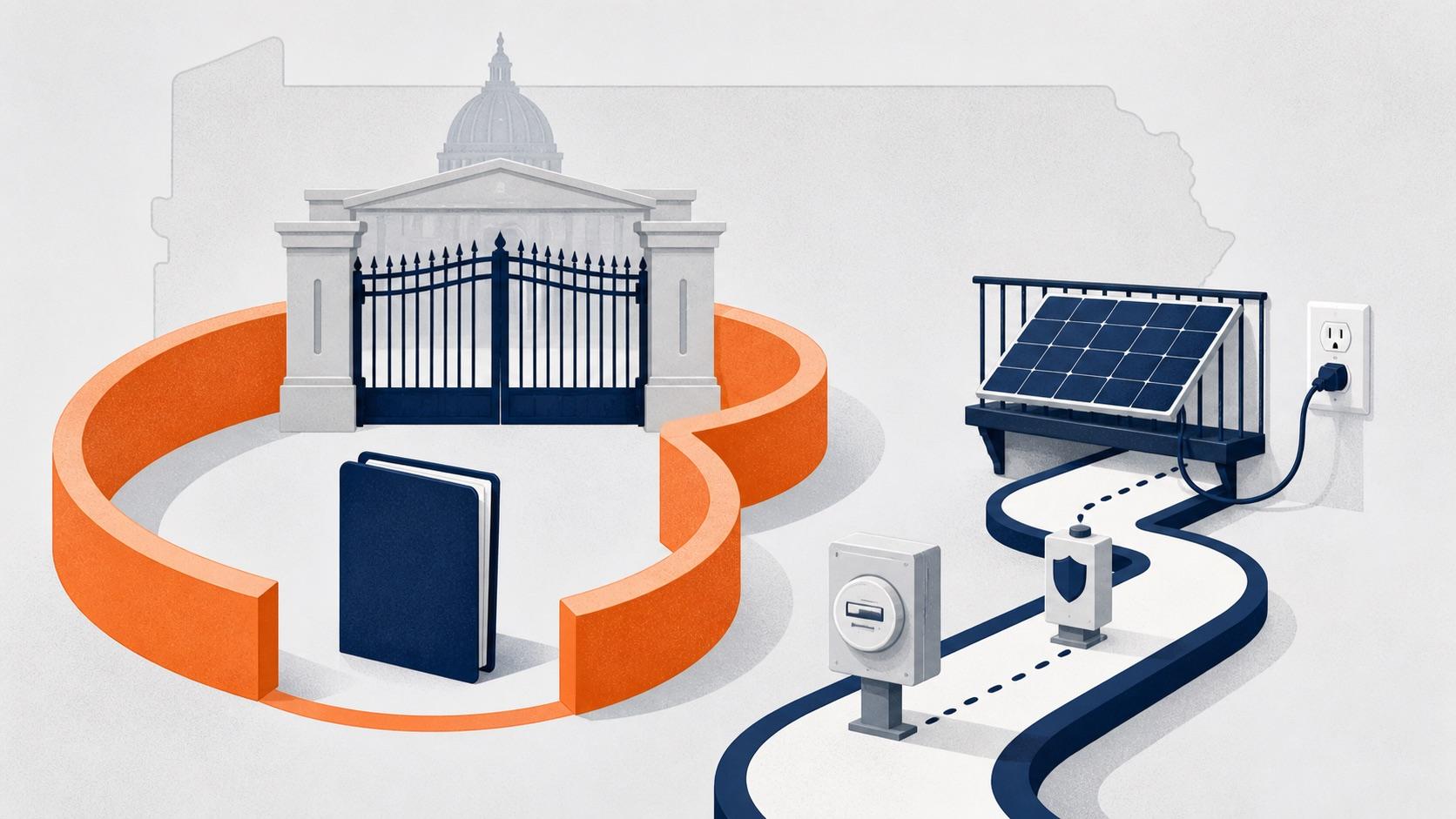
Current status
Bill introduced
A proposal is pending and may change or fail. Follow today’s utility and electrical rules while tracking the official bill record.
Key facts
- Status: HB 1971 is in House Energy, not enacted law
- Last official action: referred to House Energy on October 28, 2025
- Proposed limit: no more than 1,200 W supplied back to the utility grid
- Proposed connection: directly through a standard electrical outlet
- Proposed export treatment: no utility credit or compensation
- Proposed start: 60 days after enactment
Check your location
Framework status and exact product eligibility are separate checks.
What this means today
HB 1971 is a proposal, not a connection authorization. The Pennsylvania General Assembly lists its last action as referral to the House Energy Committee on October 28, 2025. The official record shows no committee vote, House passage, Senate passage or enactment. Its exemptions and 60-day effective clock therefore do not apply.
Pennsylvania's current net-metering and interconnection rules govern qualifying customer-generators, but they do not create a socket-specific exemption. PECO tells solar customers to submit an interconnection application and wait for permission to operate. FirstEnergy Pennsylvania also requires an application and approval before installation and operation. The serving utility must classify the exact grid-parallel plug-in configuration under today's rules.
What applies today versus what HB 1971 proposes
| Question | What applies today | What HB 1971 proposes |
|---|---|---|
| Legal status | No enacted statewide plug-in-specific exemption appears in the reviewed official record. | A qualifying portable solar generation system would receive a narrow statutory exemption 60 days after enactment. |
| Connection route | Ask the serving utility how its current interconnection process classifies the exact grid-parallel outlet system. | The system would connect directly to a building or facility through a standard electrical outlet. |
| Output threshold | No plug-in-specific 1,200 W statewide exemption is in force. | Maximum power supplied back to the electric utility grid would be no more than 1,200 W. |
| Utility process | Current application, review, inspection, metering and permission-to-operate requirements may apply. | A qualifying system would avoid an interconnection application or agreement, utility inspection or technical review, prior approval, registration, notification and related fees. |
| Product evidence | Current interconnection standards name IEEE 1547 and UL 1741; verify the exact equipment package and utility requirements. | The defined system would need certification by UL or an equivalent nationally recognized testing laboratory, but the bill names no certification standard. |
| Export value | Only an approved net-metering or other applicable utility arrangement establishes how export is measured and credited. | The system could only offset onsite consumption and would receive no utility credit or compensation for exported energy. |
| Local and property rules | Electrical, building, fire, mounting, landlord, association and other property requirements remain separate checks. | The bill preserves applicable safety laws, local building and fire codes, and local enforcement of general electrical safety provisions. |
What HB 1971 says
HB 1971 defines a portable solar generation system as a photovoltaic system, or a hybrid photovoltaic system integrated with battery storage, that meets four conditions. It would supply no more than 1,200 W back to the utility grid, connect through a standard electrical outlet, primarily offset the customer's consumption and carry certification by UL or an equivalent nationally recognized testing laboratory. The bill would exempt a qualifying system from specified utility interconnection steps and fees, but would deny credit or compensation for export and preserve safety and local-code obligations.
Read the official bill record ↗
HB 1971 timeline
| Date | Official event | What it means |
|---|---|---|
| October 27, 2025 | HB 1971 introduced | Introduction created a proposal, not an operating exemption. |
| October 28, 2025 | Referred to House Energy | This remains the last action on the official bill record. |
| August 10, 2026 | Status reviewed | The official record still showed no committee vote or passage. |
| If enacted | 60-day commencement period | The proposed route would not start until 60 days after enactment. |
The current route starts with the serving utility
Chapter 75 of the Pennsylvania Code covers net metering and interconnection for customer-generators. Its rules require an interconnection request and define technical review levels. Section 75.35 names IEEE 1547 and UL 1741 as the standards used to evaluate those requests. These rules do not automatically exempt equipment because it plugs into a receptacle.
Utility instructions show how that framework operates in practice. PECO directs customers to apply for interconnection and issues permission to operate after approval. FirstEnergy Pennsylvania asks for an application, equipment details and drawings before construction and final approval. A small wattage does not by itself remove those steps under current law. Ask the electric distribution company, not only the retail electricity supplier, for a written answer tied to the exact system and address.
The proposed 1,200 W limit is a grid-output test
HB 1971 says the system must be limited to supplying no more than 1,200 W back to the electric utility grid. It does not label that figure as panel DC nameplate capacity, inverter AC nameplate capacity or an annual energy total. Keep the bill's wording and document every relevant rating until a final act or implementing guidance defines the test more precisely.
Adding the panel labels alone does not answer the bill's test. Record total panel DC capacity, every inverter's continuous AC rating, any battery-coupled output and the maximum power the complete configuration can supply toward the grid. If the text changes during committee review, the latest enacted definition would control.
HB 1971 does not name UL 3700
The bill requires the defined portable solar generation system to be certified by Underwriters Laboratories or an equivalent nationally recognized testing laboratory. It does not identify UL 3700, UL 1741 or another certification standard. A listing for one inverter component would not by itself establish that the whole proposed configuration satisfies the bill.
Pennsylvania's current interconnection rules separately name IEEE 1547 and UL 1741 for equipment evaluated through that process. Those current requirements and HB 1971's proposed system condition are not interchangeable. Verify the exact model and configuration in the testing laboratory's directory, the approved use, installation instructions, outage behavior, plug, cable and circuit conditions.
- Match the exact model and complete configuration to a public certification record.
- Separate UL 1741 inverter evidence from any claim about the whole plug-in system.
- Confirm anti-islanding and outage behavior under the current utility route even though HB 1971 does not name anti-islanding in its text.
- Keep the bill version, certification record and manufacturer instructions in the same evidence file.
Export under the proposal would have no bill credit
HB 1971 says a qualifying system may not be eligible for Pennsylvania net metering, shall not receive utility credit or compensation for exported energy and may only offset onsite consumption. That differs from an approved net-metered installation under current Chapter 75 rules, where eligible export can be measured and credited under the applicable arrangement.
Size the proposal around verified daytime load rather than treating all generation as retail-rate savings. Check how the existing meter records reverse flow before operation. FirstEnergy Pennsylvania warns that some meters may fail to subtract export or may record customer generation as delivered energy. A bill cannot resolve that current meter risk before it becomes law and the utility path is confirmed.
Local approval and property permission would remain
The bill preserves applicable safety laws and regulations, local building and fire codes, and local enforcement of general electrical safety provisions. Pennsylvania's Uniform Construction Code is administered locally in more than 90% of municipalities, so the responsible code office and permit answer depend on the address and proposed work. A utility exemption would not be a statewide permit waiver.
HB 1971 does not grant a renter permission to use a balcony rail, alter a receptacle or route a cable through common property. It also does not approve a condominium or association mount. Obtain a written decision for the exact panel, bracket, support, cable route and electrical method. Reopen that decision if the configuration changes.
Your serving utility still matters
HB 1971 is not enacted. Ask the serving electric distribution company how its current interconnection, approval, metering and export rules classify the exact grid-parallel plug-in system.
Pre-purchase checklist
- 1Open the official HB 1971 status page and current bill text; confirm that no later action or amendment has changed the proposal.
- 2Identify the serving electric distribution company, not only the retail electricity supplier on the bill.
- 3Request the current application, approval, inspection, meter and export process for the exact grid-parallel outlet system.
- 4Record panel DC capacity, every inverter's continuous AC rating and the configuration's maximum power toward the grid.
- 5Verify the exact NRTL record, approved use, outage behavior, plug, cable, circuit method and manufacturer instructions.
- 6Ask the local code office which electrical, building, fire or structural approvals apply to the proposed work.
- 7Obtain written landlord, condominium or association approval for the exact mount and cable route.
- 8Inspect meter behavior and model savings from self-consumption unless an approved arrangement confirms export credit.
- 9Do not rely on the proposed exemption or 60-day clock unless a final act is enacted and reaches its effective date.
Next steps
Primary sources
Frequently asked questions
Is plug-in solar legal in Pennsylvania right now?
Pennsylvania has no enacted statewide plug-in-specific exemption in the reviewed official sources. HB 1971 is pending in the House Energy Committee. That does not prove every configuration is prohibited. It means the proposal cannot be used as permission, and the current utility, electrical, property and local requirements must be checked for the exact system and address.
Did Pennsylvania HB 1971 pass?
No. The official General Assembly record lists introduction on October 27, 2025 and referral to House Energy on October 28 as the last action. It shows no committee vote, House passage, Senate passage or enactment. The bill's proposed exemptions and 60-day effective period are therefore not active.
Is the proposed 1,200 W limit based on panel wattage?
HB 1971 does not call the limit panel DC nameplate wattage. It says a system must supply no more than 1,200 W back to the electric utility grid. Record panel DC, inverter AC and maximum grid-directed output separately. Use the wording of any final enacted text or implementation guidance rather than assuming those measurements are identical.
Would a Pennsylvania plug-in system need utility approval?
Today, ask the serving electric distribution company for its applicable process. PECO and FirstEnergy Pennsylvania publish application and approval routes for customer generation. HB 1971 would remove specified application, agreement, inspection, prior-approval, registration and notification requirements for a qualifying system, but those proposed exemptions are not in force.
Does Pennsylvania HB 1971 require UL 3700 certification?
No standard is named. HB 1971 says the defined portable solar generation system must be certified by UL or an equivalent nationally recognized testing laboratory. It does not mention UL 3700 or UL 1741. Verify the exact system record and final bill wording. A UL 1741 inverter listing alone does not prove the whole configuration meets the proposed definition.
Would Pennsylvania pay for exported plug-in solar energy?
Not under the proposed exemption. HB 1971 says a qualifying system shall not receive utility credit or compensation for exported energy and may only offset onsite consumption. Current net-metering credit belongs to a separate approved route. Confirm the meter and applicable tariff before assigning any value to surplus generation.
Would HB 1971 give Pennsylvania renters permission to install panels?
No property permission appears in the bill. A renter would still need to resolve landlord consent, mounting, balcony or facade use, cable routing and local requirements. Condominium and association rules may create another decision. Treat electrical eligibility and permission to alter or use property as separate approvals.