Balcony Solar in Winter: Output, Snow & Safety
A climate-aware method for winter yield, low sun, cold modules, snow cover, mounting loads and useful household energy.

WattRank is reader-supported: we may earn a commission if you buy through links in this guide. This never affects our rankings.
Key facts
- Cold can improve a module's conversion performance relative to hot operation, but it cannot compensate for missing sunlight or a snow-covered surface.
- PVGIS monthly output is location- and plane-specific; a universal “winter percentage” is not a defensible forecast.
- In controlled 0.8 kWp vertical-panel PVGIS cases, modeled winter-month output ranged from 25.69 kWh in Berlin to 109.62 kWh in Denver.
- Snow loss depends on coverage, tilt, frame, weather and shedding; current research does not support one universal annual loss factor.
- Ordinary grid-tied plug-in solar normally stops supplying household circuits during a grid outage, including in winter.
Do balcony solar panels work in winter?
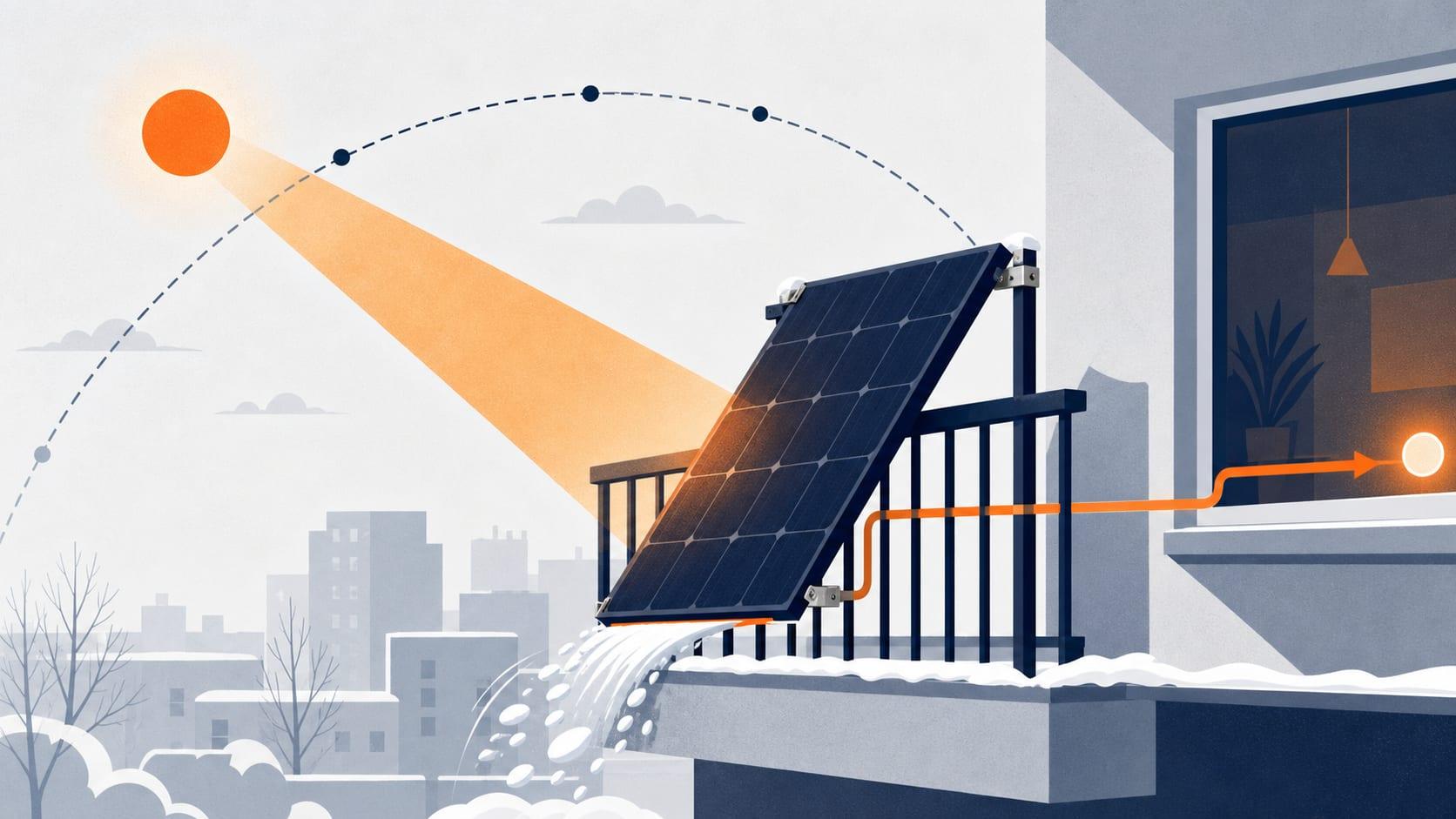
Yes. Photovoltaic cells convert light, not outdoor heat, so a cold clear day can produce useful power. The mistaken shortcut is to move from that fact to “winter does not matter.” At many locations, winter brings fewer daylight hours, a lower solar path, more cloud and longer shadows. Snow or ice can cover the active surface, while higher household heating or lighting demand may occur before sunrise or after sunset. Each effect needs its own line in the forecast.
This guide covers grid-tied balcony or plug-in solar: modules feed a compatible inverter that operates in parallel with the utility through a permitted connection. It is not a portable solar generator or an off-grid battery forecast. A normal grid-tied microinverter follows anti-islanding rules and stops household output when the grid disappears, so a winter storm outage does not turn the balcony array into backup power.
| Winter factor | What it changes | How to represent it |
|---|---|---|
| Available light | Energy reaching the module plane | Local monthly and hourly weather model |
| Low sun and nearby shade | Which hours receive direct light | Exact direction, tilt and near-object shade survey |
| Cold module temperature | Voltage and conversion behavior | Manufacturer coefficients and compatible equipment limits |
| Snow or ice cover | Light transmission and mechanical load | Separate loss scenario plus mount/load evidence |
| Household timing | How much generated energy is used directly | Interval load data matched to winter output |
Use a five-part winter output ledger
A credible winter estimate begins with plane-of-array sunlight: the radiation that reaches the actual module face, not a horizontal weather-station surface or an optimally tilted roof. Convert that sunlight through the exact module and inverter model, then subtract near shade, downtime and snow-cover scenarios. Only after obtaining AC output should you compare it with eligible household demand, export value or battery charging.
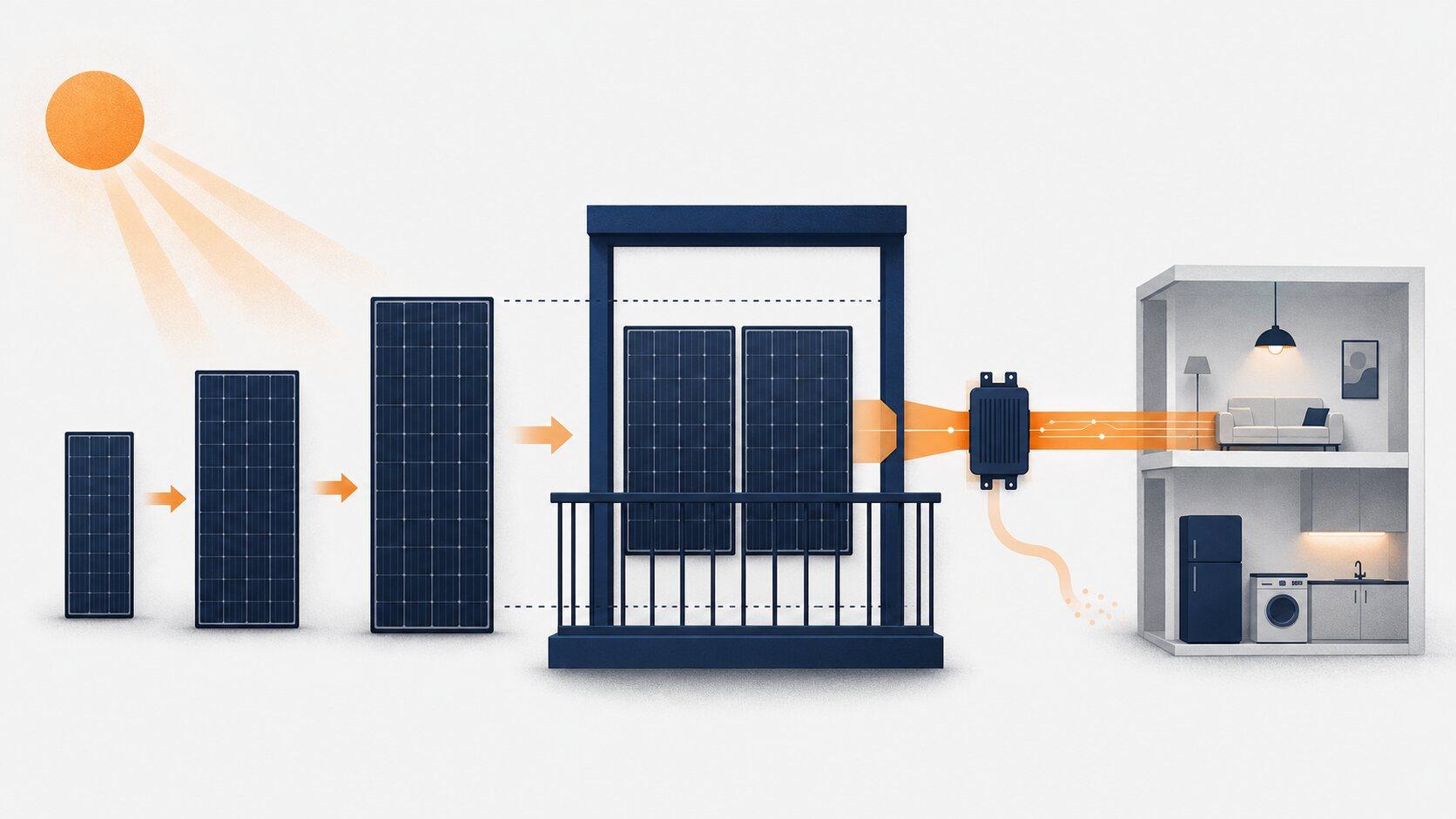
Keep the lines separate because they answer different interventions. A safer approved tilt may improve access to low winter sun, but it cannot remove a neighboring building's shadow. Clearing snow cannot lengthen the day. Adding panels can raise gross output, yet it may not increase direct self-use if winter production arrives while the home is empty. A battery can shift energy within its operating limits but cannot create winter generation.
| Ledger line | Question | Do not substitute |
|---|---|---|
| Solar resource | How much light reaches this location by month and hour? | A national annual average |
| Panel plane | What direction and tilt are safely available? | The calculator's automatic optimum |
| System conversion | What do the exact module and inverter deliver in cold conditions? | Retailer watt labels |
| Availability | When do snow, shade, faults or shutdown remove output? | One generic loss percentage |
| Useful energy | Which AC kilowatt-hours overlap load or have verified value? | Gross generation multiplied by the retail tariff |
What four controlled PVGIS scenarios show
WattRank ran four traceable PVGIS 5.3 cases to show why winter output cannot be summarized by latitude or temperature alone. Each uses 0.8 kWp of crystalline-silicon modules, 14% system losses, a fixed 90° vertical panel facing the equator, free-standing thermal behavior and the tool's terrain horizon. Climate data spans 2005–2023: SARAH3 for London and Berlin, ERA5 for Denver and Sydney.
| Location and vertical face | Winter month | Summer month | Modeled annual energy |
|---|---|---|---|
| London, south-facing | December: 34.65 kWh | June: 50.43 kWh | 594.29 kWh |
| Berlin, south-facing | December: 25.69 kWh | June: 54.61 kWh | 606.42 kWh |
| Denver, south-facing | December: 109.62 kWh | June: 41.06 kWh | 1,002.30 kWh |
| Sydney, north-facing | June: 77.93 kWh | December: 32.14 kWh | 779.78 kWh |
The same vertical geometry behaves very differently. Berlin's December result is 47% of its June result, while Denver's December result is more than twice its June value in this model because a clear high-altitude climate and a vertical equator-facing plane favor lower winter sun. Sydney reverses the calendar seasons. These figures demonstrate geometry and climate interaction; they are not forecasts for a generic “800W kit.”
PVGIS does not see a balcony slab, railing or neighboring tower, and it does not simulate site-specific snow cover; the 14% entered here is a general system-loss assumption rather than a snow time series. The cases also do not reproduce an exact inverter input layout, 800 W AC cap, module temperature coefficient, outage, export rule or household load. Re-run the model for the real coordinates and approved panel plane, then add the missing site constraints rather than copying any number from the table.
Cold can help conversion; winter light sets the energy budget
Module power ratings are established at reference conditions, including a 25°C cell temperature. As cells become hotter, voltage and power typically fall; colder operation can therefore improve instantaneous conversion relative to hot operation. The exact response belongs to the module data sheet, where temperature coefficients describe changes in maximum power, open-circuit voltage and current.
That efficiency effect applies to the light that arrives. It does not overcome a short day, dense cloud, a façade shadow or an opaque snow layer. Use kilowatt-hours for the seasonal question, not a single peak-watt reading at noon. A cold sunny interval may produce an impressive power peak while the month's total remains modest because productive hours are few.
Cold weather also changes the electrical envelope
Lower module temperature can raise open-circuit voltage. Check the exact module's cold-temperature calculation against every inverter input's maximum voltage and operating range, using the manufacturer's regional design method and the site's design minimum temperature. Do not add panels or series connections to “make up” for winter without rechecking voltage, current, connectors, tracker layout and the local AC-output pathway.
The inverter, plug, cable, connector, monitoring equipment and any battery also have operating and storage temperature limits. Keep ventilation paths clear and follow the specified weather exposure rating. Never insulate an inverter to warm it, place it in an unapproved enclosure or bring a connected cable through a pinched door or window.
How much output does snow remove?
There is no responsible universal percentage. Snow shading varies with depth, density, wetness, freeze-thaw cycles, module frame, surface, tilt, orientation, temperature, wind and clearance for material to slide. Partial coverage can also interact with cell layout, bypass diodes and inverter inputs. IEA PVPS reviews conclude that available models still require site evidence and do not capture every design variable.
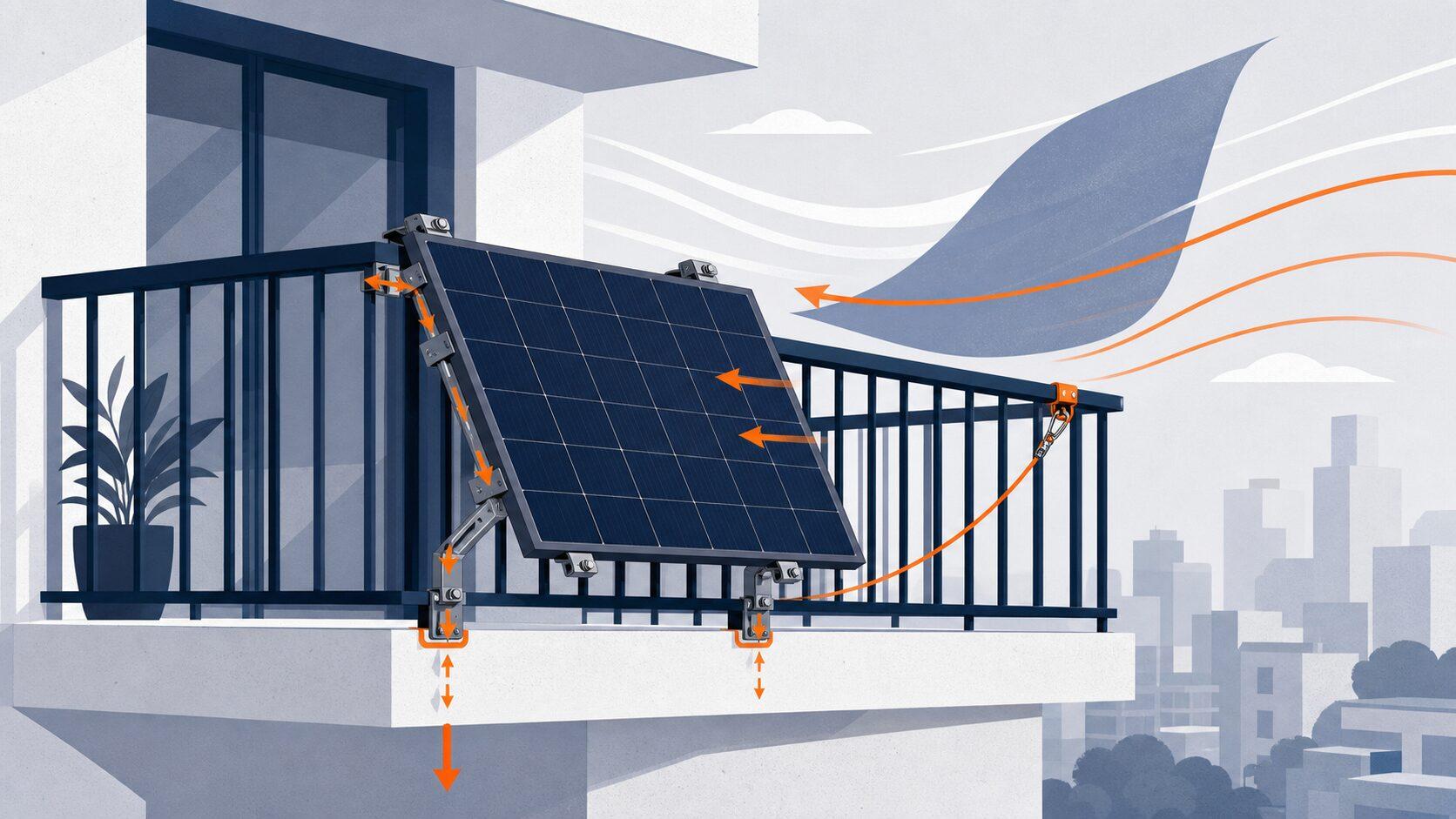
Treat snow as three separate questions. First, production: how long is the active surface covered? Second, mechanics: can the exact module, mount, railing or wall and building connection carry accumulated and drifting snow or ice together with wind? Third, consequence: where will shed snow and ice fall? A balcony array sits above people and property, so faster shedding can create a hazard even when it restores generation.
| Observed condition | Energy response | Safety response |
|---|---|---|
| Thin frost or light snow | Monitor output and natural clearing | Do not scrape glass or disturb the mount |
| Opaque cover over active cells | Model near-zero output for the covered period | Keep the area below clear; follow manufacturer guidance |
| Uneven or drifting accumulation | Do not infer loss from covered area alone | Check frame, supports, restraints and deformation from a safe position |
| Ice, cracked glass or shifted hardware | Stop relying on monitoring as proof of health | Isolate as instructed and obtain qualified inspection |
| Repeated winter coverage | Add a measured snow-loss scenario to future forecasts | Review the documented configuration, clearance and load basis |
Should you remove snow from balcony solar panels?
Usually, waiting for safe natural clearing is the better default. The US Department of Energy warns that manual snow or ice removal can damage modules and says removal is not recommended; if excessive accumulation creates a reason to intervene, it emphasizes extreme care and soft tools rather than shovels. A balcony adds fall, falling-object and access risks that can outweigh the value of a few winter kilowatt-hours.
Do not lean over a railing, climb on furniture, pour hot water, use salt or chemicals, chip ice, push snow onto people below or apply a tool the module maker has not approved. Do not change the panel angle under load unless the exact mount is designed for that procedure and access is safe. If accumulated snow threatens the documented load limit, the answer is a qualified safety response—not an improvised cleaning trick.
Choose winter orientation without creating a wind problem
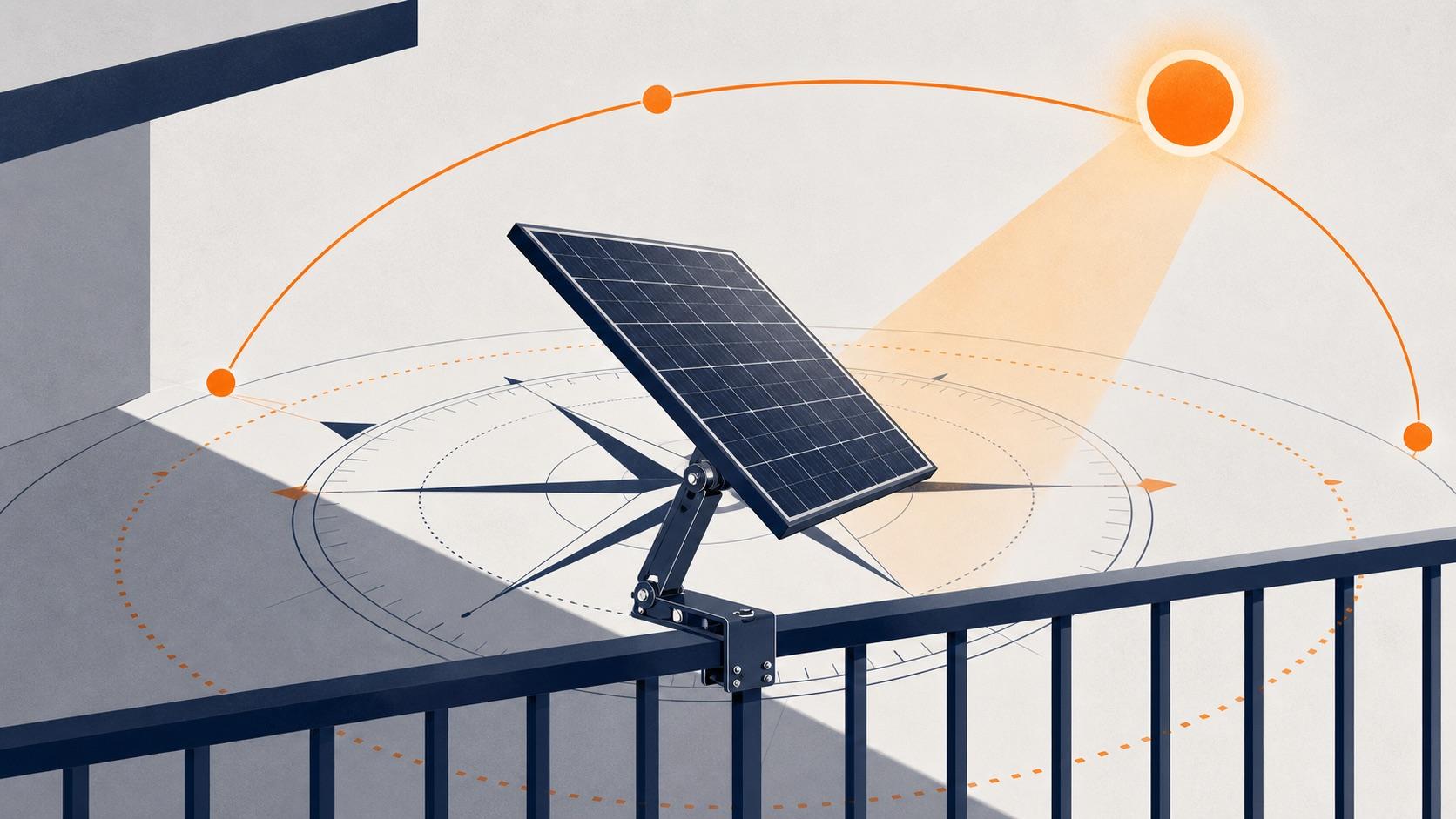
In the Northern Hemisphere, test a south-facing plane; in the Southern Hemisphere, test north. A steep or vertical equator-facing balcony panel can align well with the lower winter sun and may retain less snow than a shallow plane. It may also produce less annual energy, catch different wind actions or send shedding snow below. Only compare directions and tilts that the exact mount and supporting structure permit.
Survey shade in the winter season itself. The low sun may pass behind a neighboring building, balcony wall, opaque railing or tree that was irrelevant in summer. PVGIS terrain horizons are too coarse to represent these near objects. Record clear-day photos or a sun-path study at several times, then model separate planes if panels face different directions. Do not average east and west modules into one fictional south-facing surface.
| Possible winter adjustment | Potential benefit | Gate before using it |
|---|---|---|
| Steeper approved tilt | Better alignment with low sun; possible shedding | Mount, wind, snow-load and falling-object evidence |
| Vertical façade or railing plane | Low-sun access and reduced horizontal accumulation | Exact documented vertical configuration and support |
| Move away from an overhang shadow | More productive winter hours | Safe panel area, cable route and property permission |
| Split east and west planes | Wider daily production window | Separate model and compatible inverter inputs |
| Seasonal angle change | Different monthly profile | Designed adjustment points and safe ground-level access |
Match winter generation to winter household demand
Winter demand often rises when solar is unavailable: lighting before sunrise, cooking after sunset and electric heating through long nights. A higher monthly bill does not prove that more balcony capacity will be self-consumed. Align modeled AC output with smart-meter data at 15- or 30-minute intervals and calculate direct self-use as the smaller of solar output and eligible household load in each interval.
Shift flexible loads only within safe product instructions and a routine the household will maintain. Laundry, dishwashing or water heating may absorb midday energy; a short high-power appliance does not consume a whole day's production. Value export at the verified export rate, not automatically at the import price. If grid export is restricted, use the actual control behavior rather than assuming every unconsumed watt becomes savings.
Does a battery solve winter output?
A battery shifts available energy; it does not repair a seasonal shortage. Size storage from recurring measured surplus and later demand, and include round-trip losses, reserve settings, charge-rate limits and the battery's permitted cold-weather operation. A plug-in battery that exports into household wiring may also follow a different legal and electrical pathway from a solar-only microinverter. Do not treat it as an automatic winter add-on.
Build your own winter forecast
| Step | Record | Pass condition |
|---|---|---|
| 1. Fix the safe plane | Exact location, direction, tilt, module and approved mount | No energy option depends on undocumented hardware |
| 2. Model monthly and hourly output | PVGIS or another traceable model with saved assumptions | Winter months and annual result use the same configuration |
| 3. Add near shade | Balcony edges, buildings, trees and seasonal sun path | Objects the weather model cannot see are represented |
| 4. Add availability cases | No-snow, typical observed cover and severe-event downtime | Snow is not hidden inside a generic loss factor |
| 5. Match interval load | Direct self-use, export, storage and curtailment by interval | Gross generation is not mistaken for bill savings |
| 6. Stress-test equipment | Cold voltage, temperature limits, snow/wind loads and inspection route | All exact product limits remain satisfied |
Save the model inputs, a screenshot or export of monthly results, winter shade evidence and monitoring totals. After the first winter, compare modeled clear availability with measured output by month and note covered or faulted periods. Revise one assumption at a time. The goal is not to make the model match perfectly; it is to discover whether the gap came from weather, shade, snow, downtime or load overlap.
Winter inspection checklist
- Before winter, confirm the exact mount configuration, torque or locking marks, secondary restraint, cable support and drainage path.
- Check module, inverter, connector and battery temperature limits plus the cold-voltage calculation for the installed pairing.
- Map winter-specific shade and keep monitoring expectations separate from summer performance.
- After snow or strong wind, inspect from a safe position for shifted hardware, bowed frames, cracked glass, trapped ice, damaged cables or falling-object risk.
- Stop operation and follow the manufacturer isolation procedure when there is damage, water entry, a loose connection, abnormal heat, repeated faults or movement.
- Keep people and property away from the shedding zone; never clear snow by leaning outside or standing below the panel.
Sources and next steps
The climate scenarios use the European Commission Joint Research Centre's PVGIS 5.3 API and documented monthly outputs. Cold-weather performance, snow and ice risks, manual-clearing cautions and design tradeoffs use US Department of Energy guidance. IEA PVPS reports supply the broader evidence on snow shading, model limits and high-latitude system behavior. None of these sources certifies a particular balcony installation.
- European Commission JRC — PVGIS non-interactive API
- European Commission JRC — Data sources and calculation limits
- European Commission JRC — Grid-connected PV calculations
- US Department of Energy — PV resilience in winter weather
- US Department of Energy — PV performance and reference conditions
- IEA PVPS — Soiling and snow losses in PV systems
- IEA PVPS — Photovoltaics in the Greater Arctic
Frequently asked questions
Do balcony solar panels generate electricity in winter?
Yes. They generate whenever sufficient light reaches the cells, even below freezing. Cold cells can operate efficiently, but winter energy may still fall because days are shorter, the sun is lower, clouds and near shade differ, and snow can cover the surface. Use local monthly and hourly modeling for the exact panel direction and tilt.
How much less power does balcony solar produce in winter?
There is no universal percentage. WattRank's controlled vertical-panel PVGIS cases ranged from a large winter reduction in Berlin to higher December than June output in Denver. Location, climate and plane geometry drove that contrast before site shade or snow was added. Model your coordinates and approved panel plane, then add observed snow and availability scenarios.
Does cold weather damage solar panels or inverters?
Qualified outdoor equipment is designed for stated environmental limits, but “outdoor” is not unlimited. Check module snow-load and temperature ratings, cold open-circuit voltage, inverter input range, enclosure rating, connector instructions and mounting loads. Ice, water entry, cracked glass, shifted frames or damaged cables require isolation as instructed and qualified assessment.
Should I brush snow off balcony solar panels?
Usually, let snow clear naturally rather than creating fall, falling-object or glass-damage risk. The US Department of Energy advises against manual snow or ice removal as a general practice. Never lean over a railing, use a shovel, chip ice or pour hot water. If accumulation threatens a documented load limit, use the manufacturer procedure and qualified help.
Is a vertical balcony solar panel better in winter?
It can align well with low equator-facing winter sun and may retain less snow than a shallow panel, but it is not automatically the best or safest choice. Direction, clouds, nearby shade, wind action, module support and the shedding zone matter. Compare only exact planes approved for the mount and building, using monthly and hourly local results.
Will a balcony solar battery provide winter backup?
Not automatically. A battery can shift solar energy that was actually generated, but winter surplus may be limited and cold-weather charging restrictions can apply. Ordinary grid-tied equipment also shuts down during a utility outage unless the complete system has a designed isolated backup output. Verify operating modes, temperature limits, legal pathway and electrical separation.
Check your location
Framework status and exact product eligibility are separate checks.
The best plug-in solar kits of 2026, ranked
Now you know how it works — here are the kits we track, compared by configuration, AC output, verified price and certification evidence.
| Product | Exact configuration | Output | Panels / storage | Verified offer | Availability | UL 3700 evidence |
|---|---|---|---|---|---|---|
| EcoFlow STREAM Microinverter | STREAM Microinverter — bare unit | 1,200 W grid-tie | Not included | $299 · USD | UT · region only | not-verified |
| EcoFlow STREAM Ultra + Microinverter | STREAM Ultra + STREAM Microinverter | 1,200 W grid / 800 W hardware | 1,920 Wh | $1,459 · USD | UT · region only | not-verified |
| CraftStrom 400 Watt Plug&Play Solar | 400 W Eco-Line kit | 350 W grid / 400 W hardware | 2 panels | $499 · USD | US · in stock | not-verified |
| CraftStrom 800 Watt Plug&Play Solar | 800 W complete kit | 700 W grid / 800 W hardware | 4 panels | $2,031 · USD | US · in stock | not-verified |
| CraftStrom 1600 Watt Eco-Line Plug&Play Solar | 1600 W Eco-Line kit | 1,400 W grid / 1,600 W hardware | 8 panels | $3,187.5 · USD | US · in stock | not-verified |
| Bright Saver Flex180 single-panel kit | Flex180 single-panel kit | 180 W grid-tie | 1 panels | $399 · USD | US · in stock | not-verified |
| Plug In Solar Utah 3 Panel EcoFlow STREAM Kit | 3-panel EcoFlow STREAM kit | 1,200 W grid-tie | 3 panels | $1,299 · USD | UT · region only | not-verified |