Balcony Solar Orientation & Tilt Guide (2026)
Compare vertical, tilted, east, west and equator-facing panels with an auditable method for shade, safety and household load timing.

WattRank is reader-supported: we may earn a commission if you buy through links in this guide. This never affects our rankings.
Key facts
- Tilt is measured from horizontal: 0° is flat and 90° is vertical.
- PVGIS and PVWatts use different azimuth conventions; entering the same number in both can point the modeled array in different directions.
- PVGIS terrain-horizon data does not include nearby balconies, buildings or trees, so local shade needs a separate survey.
- In WattRank's controlled PVGIS scenarios, an equator-facing vertical panel produced 62–73% of the local tilted reference across London, Berlin, Denver and Sydney.
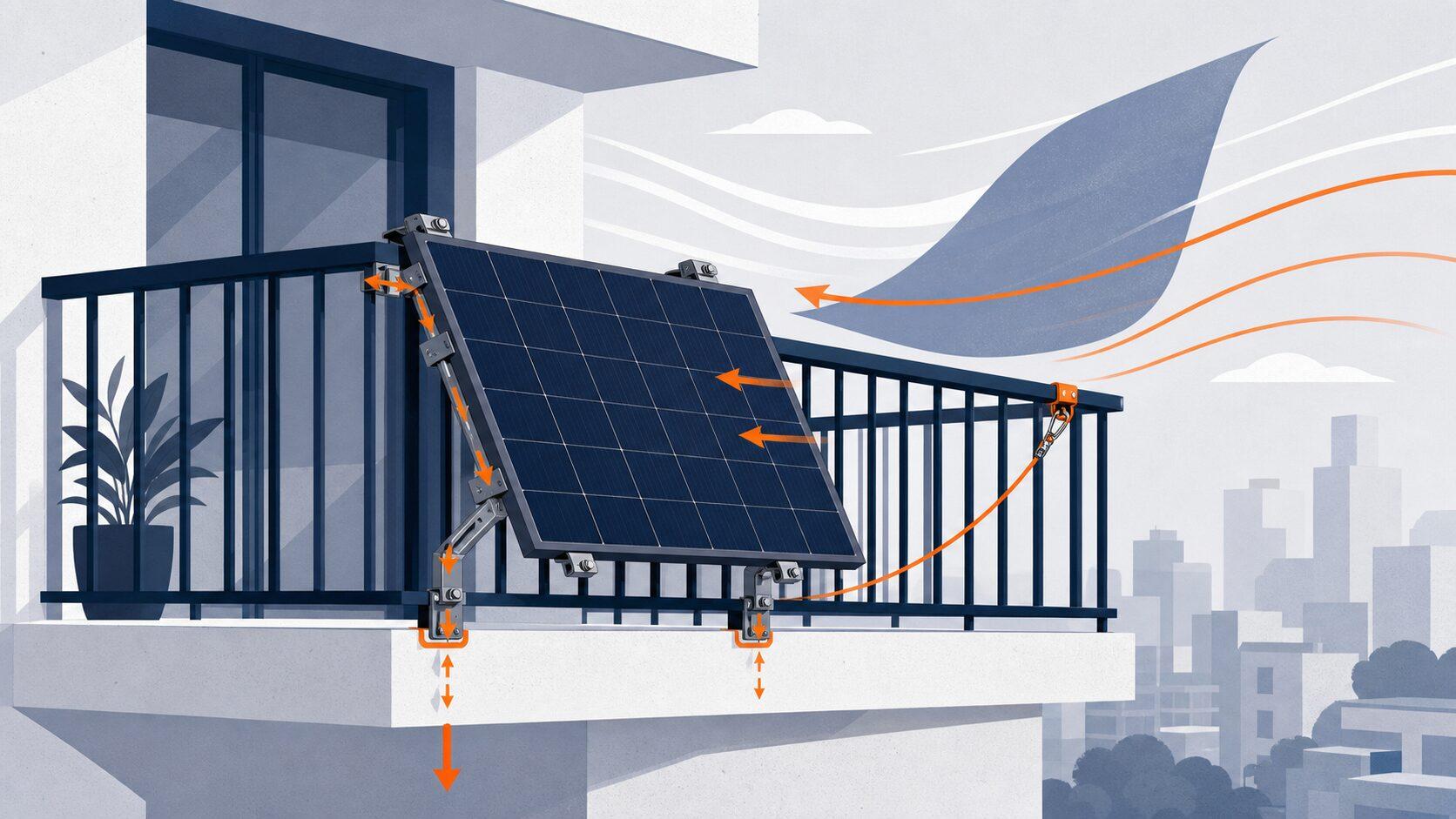
- Changing tilt can change wind actions and bracket forces, so energy optimization cannot override the mount's approved configuration.
What is the best direction and tilt for balcony solar?
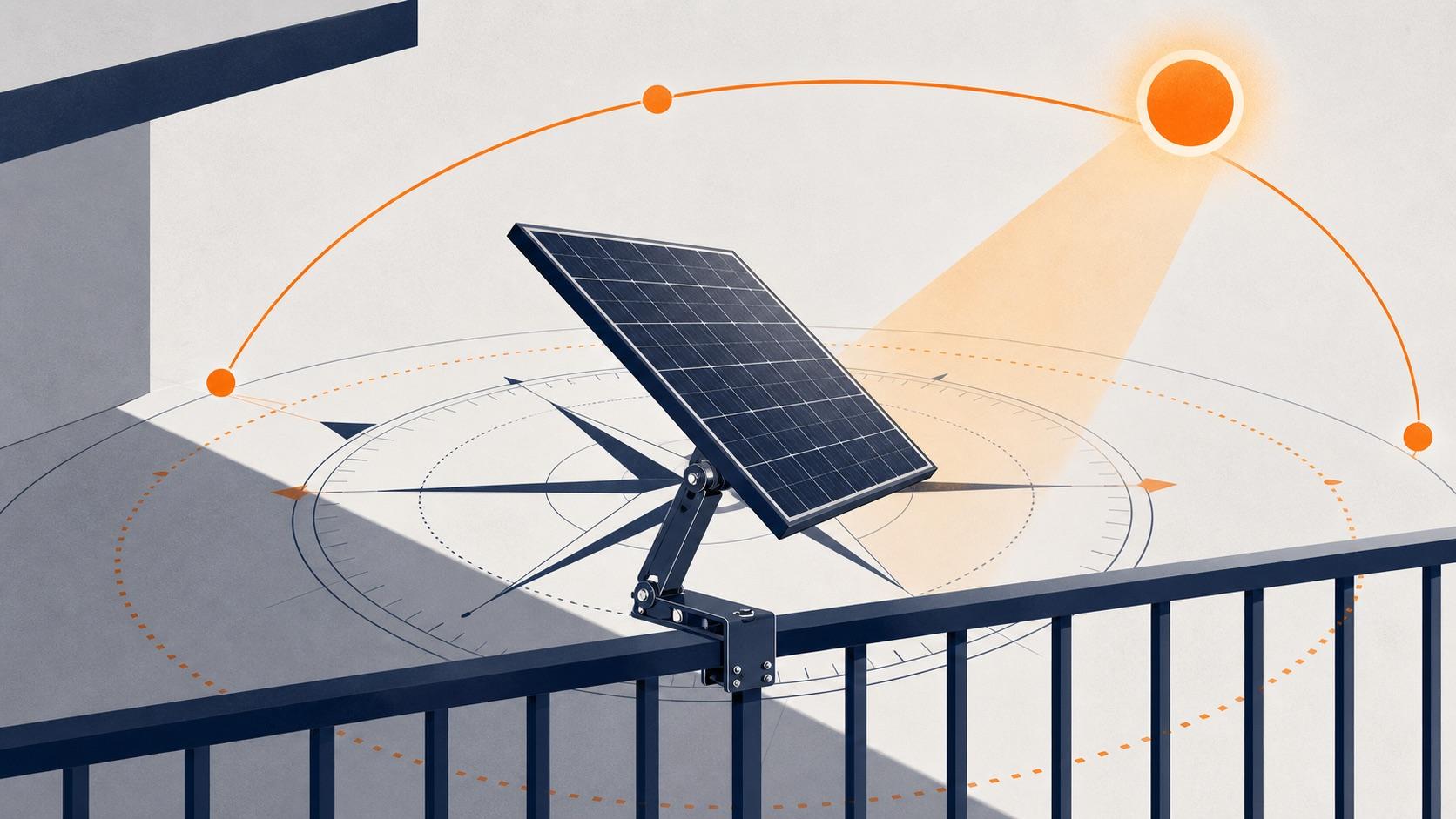
The energy-only answer is a starting point: a fixed panel normally gains the highest annual irradiation when it faces the equator—south in the Northern Hemisphere and north in the Southern Hemisphere—and uses a location-specific tilt. The US Department of Energy describes latitude as a useful annual-output reference for a fixed array, while its homebuilder guidance says unshaded south-facing US roofs between 15° and 40° commonly perform well. Neither statement creates one best angle for every balcony.
A balcony is a constrained façade site, not an open solar field. The railing may force a vertical panel. The balcony above can cut off high summer sun, an adjacent tower can remove the best afternoon hours, and a steeper bracket can increase wind load. The useful answer therefore combines four ledgers: safe mount configuration, sunlight reaching the panel plane, inverter output by time, and household demand or another verified value for that energy.
| Decision | Energy tendency | Balcony constraint | Evidence to collect |
|---|---|---|---|
| Direction | Equator-facing often maximizes annual irradiation | Façade direction is usually fixed | True building bearing and unobstructed sky |
| Tilt | Local optimum balances seasonal sun angles | Rail or wall mount may allow only one approved angle | PV model plus exact bracket configuration |
| East or west | Shifts output toward morning or afternoon | One side may have less shade | Hourly model matched with interval demand |
| Vertical | Usually sacrifices some annual energy | Can be the only documented railing layout | Location-specific annual and monthly result |
| Shade | Removes direct irradiance during affected periods | Overhangs and nearby buildings are common | Seasonal observation or a near-object shade model |
Orientation, azimuth and tilt: the terms that prevent bad inputs
Orientation is the direction the panel face points. Azimuth expresses that direction as an angle, but software conventions differ. PVGIS defines 0° as south, −90° as east and +90° as west. PVWatts uses the compass convention: 0° north, 90° east, 180° south and 270° west. Always read the tool's definition instead of copying an azimuth number from another calculator.
Tilt is the angle between the module and a horizontal plane. A panel lying flat is 0°; a panel hanging straight down a façade is 90°. This is not the angle from the wall. If a product describes “10° from vertical,” the equivalent model tilt is 80° from horizontal. Record the panel face, not the bracket arm, because hinge and frame geometry can differ.
| Panel faces | PVGIS aspect | PVWatts azimuth | Typical timing |
|---|---|---|---|
| North | ±180° | 0° | Equator-facing in the Southern Hemisphere |
| East | −90° | 90° | More morning-weighted output |
| South | 0° | 180° | Equator-facing in the Northern Hemisphere |
| West | +90° | 270° | More afternoon-weighted output |
What controlled PVGIS scenarios show
WattRank ran a transparent set of PVGIS 5.3 scenarios to show why a universal percentage is unreliable. Every case used 0.8 kWp of crystalline-silicon modules, 14% system losses, the free-standing thermal setting, a fixed array, the tool's terrain horizon and the same calculation method. PVGIS used 2005–2023 climate data: SARAH3 for London and Berlin, and ERA5 for Denver and Sydney. The free-standing setting approximates an air-cooled panel but does not reproduce a particular balcony. These are model outputs, not measured yields or promises for an 800 W AC inverter.
| Location and panel plane | Modeled annual energy | Share of local tilted reference | What it demonstrates |
|---|---|---|---|
| London: south, 35° | 815 kWh | 100% | Tilted annual reference for this model |
| London: south, vertical | 594 kWh | 73% | Vertical can remain productive when the face is favorable |
| London: east, vertical | 416 kWh | 51% | Morning-facing vertical case |
| London: west, vertical | 399 kWh | 49% | Afternoon-facing vertical case |
| London: north, vertical | 161 kWh | 20% | Unfavorable face still receives diffuse and seasonal light |
| Berlin: south, 35° / vertical | 840 / 606 kWh | 100% / 72% | A similar ratio is not a universal constant |
| Denver: south, 40° / vertical | 1,457 / 1,002 kWh | 100% / 69% | Climate changes absolute energy substantially |
| Sydney: north, 30° / vertical | 1,249 / 780 kWh | 100% / 62% | The equator-facing direction reverses south of the equator |
Do not transplant these values to your home. PVGIS says its terrain horizon uses elevation data at roughly 90 m resolution and does not capture shadows from nearby houses or trees. A balcony overhang, recess, opaque side wall or neighboring tower can therefore make the real result materially lower. The model also does not know your exact module temperature, microinverter input layout, AC cap, downtime, dirt, cable losses or export rules.
The information gain is the method and the ratio check, not the London number. Run the same capacity and loss assumptions for every candidate plane, save the inputs, compare monthly and hourly profiles, and then add local shade. If one option looks surprisingly good, verify that direction and tilt conventions were entered correctly before believing it.
Are vertical balcony solar panels worth using?
A vertical panel can be a rational choice when it is the safe, documented configuration and has a reasonably favorable direction. It often receives less high-angle summer sun than a tilted array but can align better with lower sun angles in other seasons. The annual penalty varies with latitude, climate, orientation, horizon and nearby shade; it should be modeled rather than assigned a generic 20% or 30% loss.
Vertical does not automatically mean safer. The mount, module, railing or wall, fasteners and building connection still need a documented load path. Nor does a more aggressive outward tilt automatically mean better: steeper projection can expose more surface to wind and create larger leverage at the attachments. The US Department of Energy specifically notes that steeper tilt can increase wind load and that design must balance weather risks.
What about snow, rain and dirt?
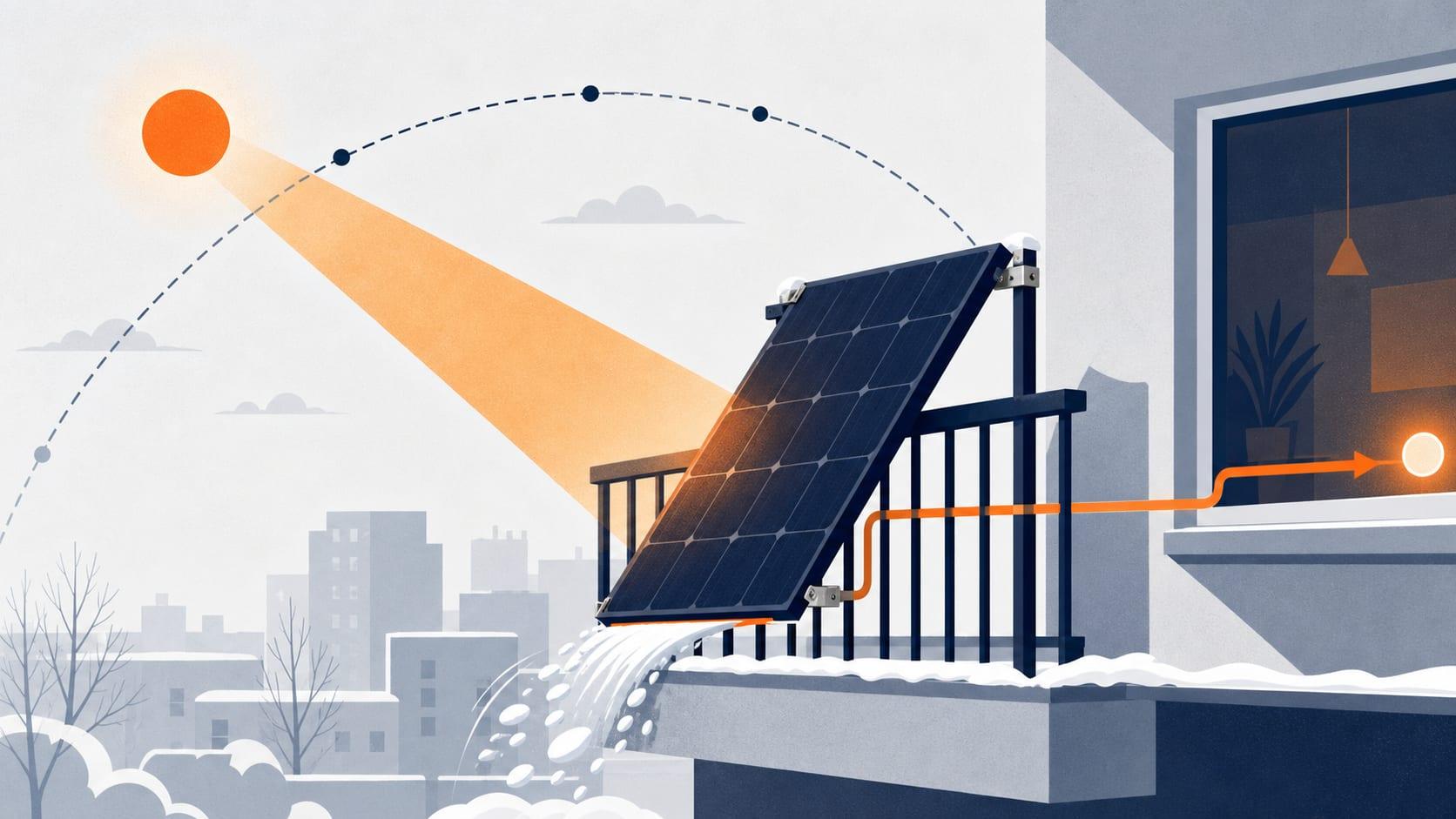
A steep panel may shed some snow and debris more readily, but the actual behavior depends on frame edges, surface friction, temperature, wind and what lies below. Never increase tilt merely to “self-clean” if the bracket or support is not approved for that angle. Follow the module and mount maintenance instructions, and prevent falling snow, ice, tools or cleaning water from creating a hazard below the balcony.
East, west or equator-facing: optimize for useful hours
Maximum annual kilowatt-hours and maximum bill value are different objectives. An east-facing panel can concentrate more output into breakfast and morning home-office loads; west-facing output may overlap late-afternoon cooling or cooking. An equator-facing panel often wins the annual-energy comparison, but some of its midday surplus may export without credit or trigger curtailment. Match hourly solar to hourly eligible demand before deciding that the annual winner is the economic winner.
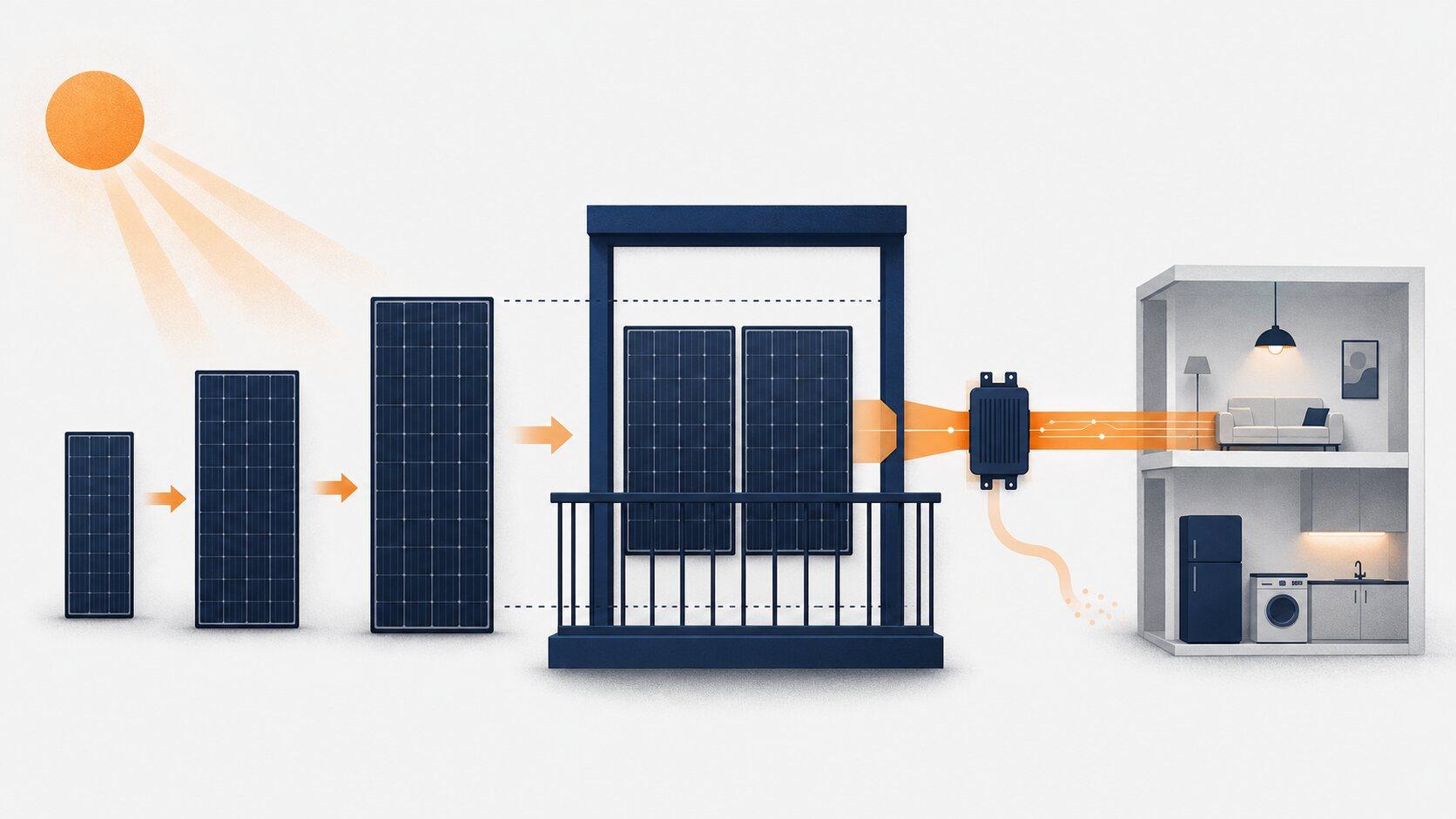
For two panels facing different directions, model two planes rather than averaging them into southeast or southwest. Add the two hourly series only after checking that the exact microinverter has suitable independent inputs or trackers and accepts both module electrical ranges. A blended direction can hide the fact that one panel is shaded while the other is productive, and can conceal input-level clipping or mismatch.
| Household pattern | Candidate to test | Why test it | Do not assume |
|---|---|---|---|
| Steady daytime base load | Equator-facing and least-shaded plane | Annual energy may have broad direct-use value | All produced energy is self-consumed |
| Morning-heavy demand | East or southeast | Output may arrive earlier | East always beats a less-shaded south face |
| Late-afternoon demand | West or southwest | Output may overlap later loads | West solves evening demand after sunset |
| Different panel positions | Separate hourly planes | Shows timing, shade and input differences | Average azimuth represents both panels |
| Battery charging goal | Plane that creates recurring chargeable surplus | Storage can shift time within its limits | Battery value follows from panel watts alone |
Shade can dominate a perfect compass direction
Map shade before refining tilt. Observe the proposed panel plane across representative clear days and seasons: the sun is much higher in summer and lower in winter, so one July visit cannot establish December access. Record when the balcony above, façade edges, rail infill, trees and neighboring buildings cross the module. A phone photo series is useful evidence, but a near-object sun-path or shade model is better for future seasons.
Inspect electrical layout as well as shaded area. A shadow across one module or cell region can affect output differently depending on bypass-diode behavior, module layout and whether panels have separate microinverter inputs. Marketing claims about independent MPPT do not make shade disappear; they may reduce interaction between compatible inputs. Use the exact module and inverter documentation, and keep cables, the inverter and ventilation clear of the shadow-casting geometry where their manuals require it.
| Shade source | Survey question | Model limitation | Decision response |
|---|---|---|---|
| Balcony above | When does its edge cross the full panel plane? | Terrain horizon will not see it | Compare vertical and approved tilted positions by month |
| Side wall or recess | Are morning or afternoon hours removed? | One annual percentage hides timing | Test east/west profiles against household demand |
| Railing or bars | Does a narrow shadow repeatedly cross cells? | Coarse tools may miss thin near shadows | Use exact geometry and equipment evidence |
| Trees | Are leaves seasonal and likely to grow? | Historical climate data is not a vegetation forecast | Use conservative present and future cases |
| Neighboring building | Which floors and seasons lose direct sun? | Elevation horizon may be too coarse | Add a local obstruction profile or shade study |
How to measure your balcony direction and tilt
Start with a map or satellite image aligned to true north and identify the outward normal of the panel face. A phone compass can be a cross-check, but metal railings, reinforced concrete and nearby electronics can disturb it. Stand away from those objects, calibrate the device and note whether the app reports true or magnetic north. You need a defensible direction range, not a false one-degree precision.
Measure tilt on the actual module plane after confirming the bracket is in an approved position. A digital level or inclinometer can report the angle from horizontal; verify its reference on a level surface first. Photograph the reading and bracket hole or stop used. If the model unexpectedly improves when the panel turns away from the visible sun, recheck the convention, hemisphere and whether you measured the panel face or its back.
- Record latitude, longitude, hemisphere and the tool/database version.
- Record every panel plane's true direction, tilt from horizontal, capacity and mounting type.
- Use the same technology and loss assumptions across alternatives.
- Save annual, monthly and hourly outputs; annual energy alone cannot show load overlap.
- Add near-object shade separately and document which obstructions the model includes.
- Match the result to the exact inverter input layout, AC cap and interval household demand.
The safe orientation-and-tilt workflow
| Step | Action | Pass condition |
|---|---|---|
| 1. Fix the boundaries | Confirm property permission, safe panel area and current connection pathway | The location and complete grid-tied system remain eligible candidates |
| 2. List approved planes | Use only module, bracket and support configurations documented for the site | Each direction and tilt has a valid structural load path |
| 3. Survey obstruction | Map overhangs, walls, buildings, trees and seasonal sun paths | Near-object shade is represented beyond the terrain model |
| 4. Model consistently | Run every plane with identical capacity, technology, loss and weather assumptions | Inputs and outputs are saved and comparable |
| 5. Match time | Compare hourly AC output with interval demand, export and storage rules | Useful energy is separated from gross generation |
| 6. Choose and verify | Select the safest high-value plane and check exact hardware instructions | Energy, electrical and mounting evidence all describe the same configuration |
Reject any answer that depends on changing an undocumented bracket angle, loading a decorative railing, leaning outside to adjust the panel seasonally, or ignoring shade the model cannot see. If two safe configurations are close in useful annual value, prefer the simpler documented installation and keep the assumptions. Precision in the decision is more valuable than chasing the last modeled kilowatt-hour.
Common orientation and tilt mistakes
- Using a universal “latitude equals tilt” rule as the final answer instead of a local model and safe mount configuration.
- Entering PVGIS azimuth numbers into PVWatts, or vice versa, without converting conventions.
- Calling a panel 10° tilted when it is actually 10° from vertical and therefore 80° from horizontal.
- Optimizing annual generation while ignoring that exported or curtailed midday energy may have lower value than directly used morning or afternoon energy.
- Averaging east and west panels into one direction instead of modeling separate hourly planes and checking inverter inputs.
- Trusting a terrain horizon to include a balcony overhang, adjacent tower, railing bar or tree.
- Increasing tilt for yield, snow or cleaning without rechecking wind actions, fasteners, permissions and fall risk.
Sources and next steps
The modeling method and WattRank scenarios use the European Commission Joint Research Centre's PVGIS 5.3 API and documentation. Direction, tilt and load-aware design principles use US Department of Energy guidance; PVWatts documentation supplies the contrasting azimuth convention and current model inputs. These sources estimate energy and explain design variables. They do not approve a balcony, bracket, electrical connection or product.
- European Commission JRC — PVGIS non-interactive API and angle definitions
- European Commission JRC — Grid-connected PV outputs
- European Commission JRC — Horizon profile limits
- NREL — PVWatts Version 8 API inputs
- US Department of Energy — Solar photovoltaic system design basics
- US Department of Energy — Solar guide for homebuilders
- US Department of Energy — Tilt and severe-weather tradeoffs
Frequently asked questions
What is the best direction for balcony solar panels?
For annual energy, start by testing an equator-facing panel: south in the Northern Hemisphere and north in the Southern Hemisphere. Then compare the directions your balcony actually permits. East or west can be more valuable when it avoids shade or better overlaps household demand. Use local hourly modeling rather than rejecting a non-south-facing balcony by rule.
What is the best tilt angle for balcony solar panels?
There is no worldwide best angle. A tilt near local latitude is a useful annual-output starting point for an unobstructed fixed array, but balconies add overhang shade, façade limits and wind-safe bracket positions. Model the exact approved angles at your location. Remember that tools define tilt from horizontal: 0° is flat and 90° is vertical.
How much output do vertical balcony solar panels lose?
The loss depends on location, direction, season, climate and shade. In WattRank's controlled PVGIS examples, equator-facing vertical panels produced 62–73% of the corresponding tilted annual reference across London, Berlin, Denver and Sydney. Those ratios are illustrations, not universal guarantees; nearby balcony obstructions were not included and can materially change a real site.
Are east- or west-facing balcony solar panels worthwhile?
They can be. East-facing panels shift more production toward morning, while west-facing panels shift it later. Their annual total may be lower than an unshaded equator-facing option, yet more of the output can overlap household demand. Compare hourly profiles, local shade, export value and the exact inverter inputs before deciding from annual kilowatt-hours alone.
Should I change balcony solar tilt for winter and summer?
Only if the exact mount is designed for adjustment, the permitted positions have valid wind and structural evidence, and adjustment can be performed without fall or falling-object risk. Seasonal changes may alter production, but repeated handling can introduce loose hardware or unsafe access. Compare the modeled gain with the safer option of one documented fixed position.
Can PVGIS or PVWatts model shade from the balcony above?
Not automatically. PVGIS can include a terrain horizon derived from elevation data, but its documentation says nearby houses and trees are not captured; balcony overhangs are smaller and closer still. PVWatts also needs appropriate shade inputs or external analysis. Survey near objects separately and combine that evidence with the tool's weather and solar-geometry model.
Check your location
Framework status and exact product eligibility are separate checks.