How to Size a Balcony Solar System (2026)
A constraint-by-constraint method for choosing panel area, DC capacity and AC output from your balcony, load curve and local pathway.

WattRank is reader-supported: we may earn a commission if you buy through links in this guide. This never affects our rankings.
Key facts
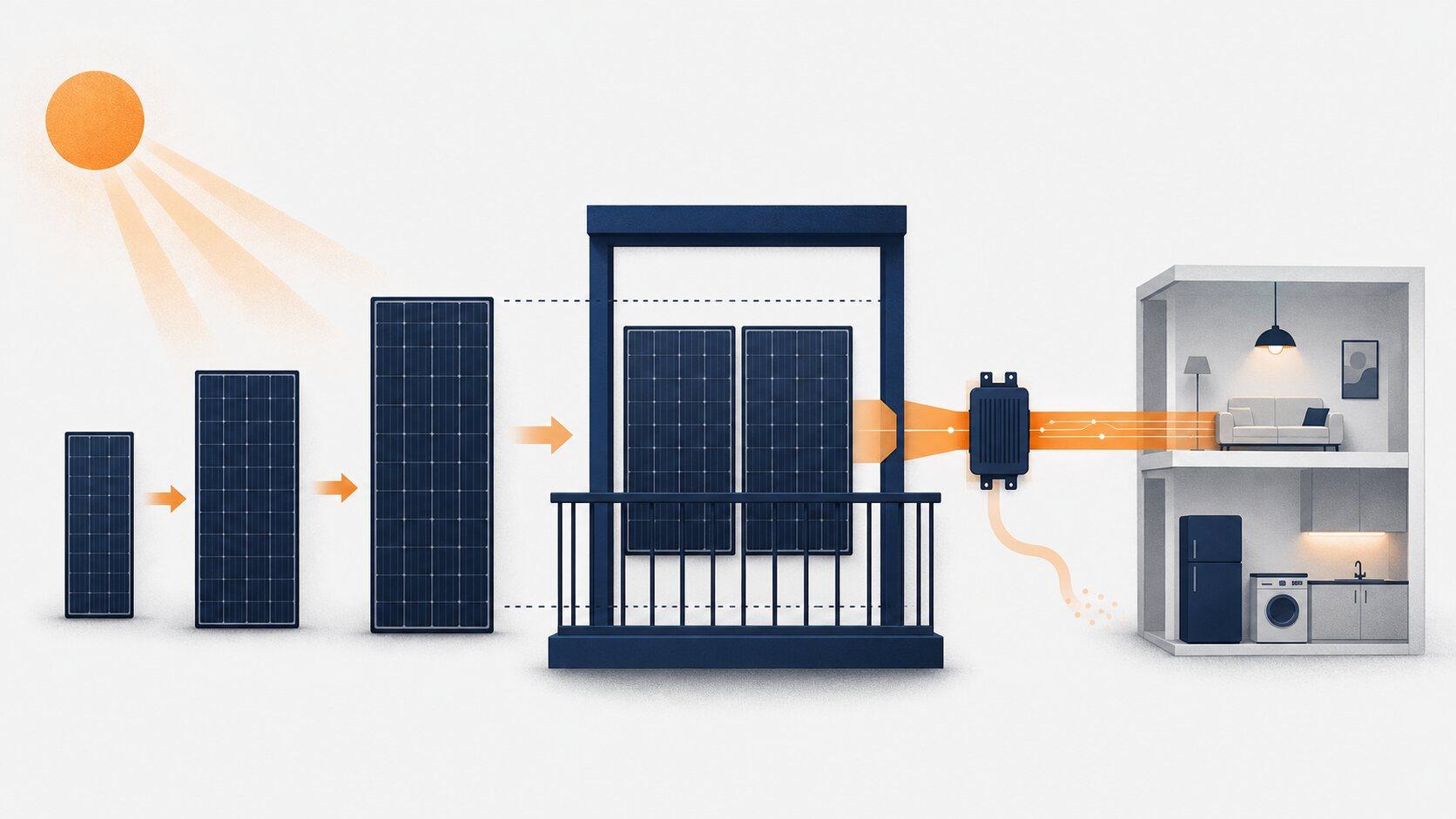
- Panel Wp is a laboratory DC nameplate; inverter W or VA is a separate AC output limit.
- Directly self-consumed solar in any interval is no greater than both solar AC production and eligible household demand.
- Smart-meter data at 15- or 30-minute intervals reveals when electricity is used; an annual bill does not.
- Different panel directions or shade patterns should be modeled as separate planes and matched to the inverter's real input layout.
- Battery capacity is sized from recurring surplus and later demand, not from the panel or inverter watt label.
What size balcony solar system do you actually need?
The right size is not the largest package that fits a retailer's menu. It is the smallest complete configuration that survives five constraints: it can be mounted safely, it fits the current legal and electrical pathway, its panels match the inverter inputs, its AC output is permitted, and enough of its production arrives while the home can use or legitimately value it. One failed constraint can make every larger option irrelevant.
This method is for grid-tied plug-in solar: panels and a compatible inverter intentionally operate in parallel with the utility through a permitted household connection. It is not a sizing method for a portable solar generator, where panels charge a battery that serves its own outlets, or for a panel-only package. Those systems have different power, energy and connection boundaries.
| Constraint | Question | Evidence | Output of the step |
|---|---|---|---|
| Job | What must the system accomplish? | Daytime loads, portability, export or storage goal | A measurable use case |
| Place | How many panel positions are genuinely safe and productive? | Dimensions, shade path, mount limits, consent | One or more candidate panel planes |
| Pathway | What complete system and AC output may connect here? | Current authority, utility and property requirements | A location-specific AC ceiling and equipment gate |
| Hardware | Do the modules match every inverter input? | Module and inverter data sheets; regional manual | Electrically compatible configurations |
| Energy | How much production overlaps load or has another verified value? | Hourly model plus interval consumption data | Useful kWh, surplus and clipping by candidate |
Step 1: define the job before choosing watts
Write one sentence that describes the intended outcome. Examples are “reduce recurring daytime imports without a battery,” “use two safe panel positions and limit low-value export,” or “measure summer surplus before deciding on storage.” Avoid goals such as “power the apartment” or “buy an 800W system”: the first has no boundary and the second is only a label.
List the loads that are eligible to be served while the grid is present. Refrigeration, networking, ventilation and genuine work-from-home equipment may recur; a kettle or oven can have high instantaneous power but run briefly. Ordinary grid-tied plug-in solar also shuts down its household output during a grid outage, so backup must be a separate requirement with an isolated, designed power path.
| Goal | Sizing metric | Common wrong shortcut |
|---|---|---|
| Reduce daytime imports | Interval solar output that overlaps eligible load | Annual household consumption divided by panel yield |
| Limit uncompensated export | Surplus energy by interval and season | Assuming every generated kWh saves the retail rate |
| Use constrained balcony space | Safe productive area for exact module dimensions | Panel count based on a generic module size |
| Prepare for a later battery | Measured recurring surplus and later demand | Choosing battery kWh from inverter watts |
| Obtain outage power | Isolated output power, energy and transfer behavior | Assuming more grid-tied panels remain on in a blackout |
Step 2: map safe, usable panel positions
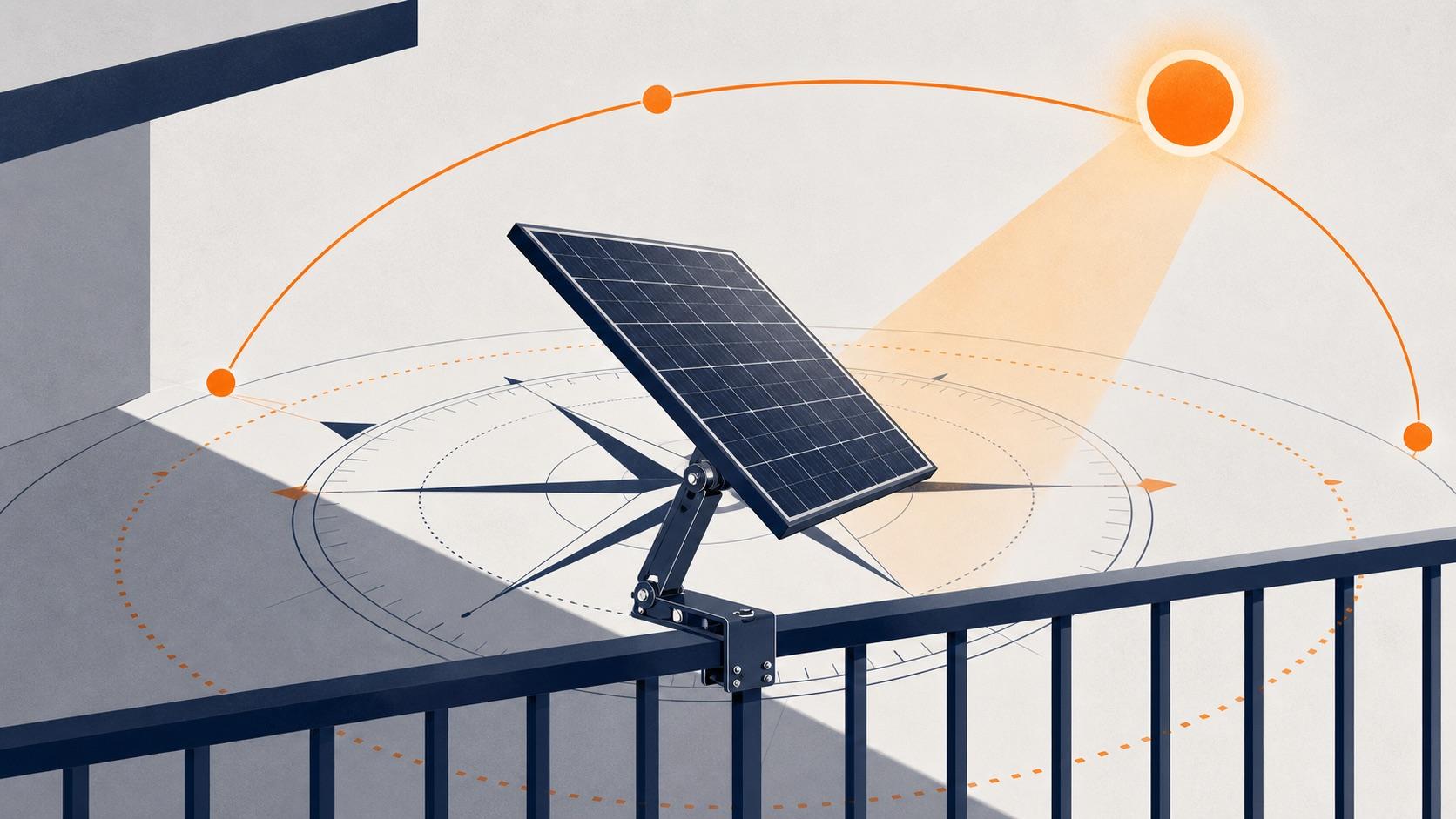
Measure the real envelope, not just railing length. Record width, height, clearance from doors and escape routes, cable path, allowable projection, railing material, attachment points and the mount manufacturer's permitted orientation. Confirm landlord, condominium or shared-property consent before a layout depends on common structure. Wind exposure and falling-object risk can eliminate an apparently sunny position.
For each remaining position, record azimuth, slope and shade as its own panel plane. Watch nearby buildings, railings and trees across the solar window and across seasons. The European Commission's PVGIS accepts location, slope and orientation and can provide hourly PV output. Its methods also explain that building-applied bifacial modules do not receive the same rear irradiance assumed for an open rack, so a generic bifacial uplift should not be pasted onto a balcony.
| Panel-plane record | Why it matters | Minimum evidence |
|---|---|---|
| Exact usable dimensions | Decides which module and mount physically fit | Measured clear width and height plus data-sheet dimensions |
| Direction and slope | Changes annual yield and the hours of production | Azimuth, inclination and one saved model per plane |
| Near shade | Can remove output during otherwise valuable hours | Season-aware observation or site survey |
| Wind and structure | Sets mount, tilt, ballast and placement limits | Manufacturer limits and building approval where required |
| Cable route | Can rule out a position that needs an unsafe lead or crossing | System instructions and a protected permanent route |
Step 3: separate panel DC, inverter AC and connection limits
Create a specification sheet for each exact candidate. Panel nameplate capacity is measured in watts peak on the DC side under standard test conditions. Real output changes with irradiance, cell temperature, angle and loss mechanisms. The inverter then converts that variable DC input to AC and cannot deliver more than its configured or nameplate AC limit.
Do not stop at aggregate watts. Check each inverter input's permitted voltage and current, maximum short-circuit current, operating or MPPT range, tracker arrangement, connector and allowed module combinations. Cold conditions can raise module open-circuit voltage; strong irradiance can raise available current. Use the exact manufacturer method and regional manual rather than calculating a custom pairing from marketing cards.
| Specification | Symbol or unit | What it controls | Where to verify |
|---|---|---|---|
| Module peak power | Wp or W DC | Array nameplate at reference conditions | Module data sheet |
| Open-circuit / operating voltage | Voc / Vmp | Whether each input remains within voltage limits | Module and inverter data sheets |
| Short-circuit / operating current | Isc / Imp | Whether the input and connectors can carry the module current | Module and inverter data sheets |
| Maximum inverter input and MPPT range | V and A by input | Compatible module combinations and operating window | Regional inverter manual |
| Continuous AC output | W AC or VA | Instantaneous grid-connected output ceiling | Nameplate, approved profile and commissioning settings |
| Local connection cap | W, VA or another defined limit | Eligibility for a simplified plug-in pathway | Current primary rules and utility instructions |
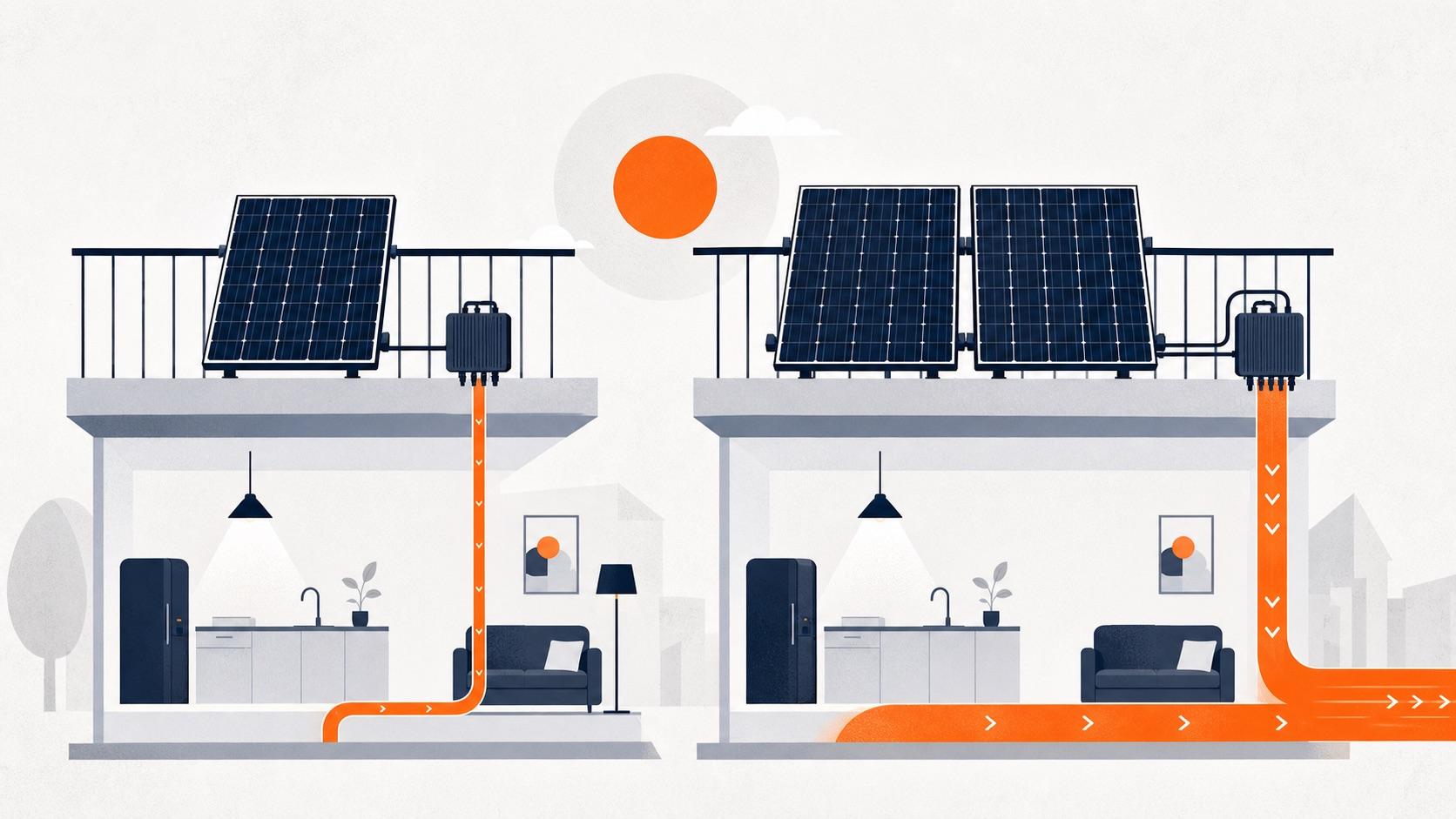
Location rules can keep DC and AC limits deliberately different. Germany's Federal Network Agency, for example, describes its simplified special rules as applying up to 2,000 W of installed module capacity while total inverter output behind the same withdrawal point remains limited to 800 VA. That is a Germany-specific legal example, not a worldwide design ratio. Another country or US state may define a different product, cap or connection method.
Step 4: model every panel plane by hour
Run one traceable model for each candidate size using the same weather source and loss assumptions. Enter the actual location, module capacity, fixed slope and azimuth; do not substitute a rooftop's optimal angle for a vertical railing. If two panels face different directions, model them separately and combine their time series only after checking whether the inverter provides suitable independent inputs.
Annual kWh is useful for cost and carbon screening, but sizing needs the production shape. PVGIS can return hourly data, while PVWatts models hourly DC and AC power, system losses and inverter clipping. Save both inputs and results. Treat shade from nearby structures as site-specific: the PVWatts manual says its default shading assumption represents distant horizon blocking and should be increased or modeled externally for nearby trees or structures.
| Model output | Use it for | Do not infer |
|---|---|---|
| Hourly or sub-hourly AC power | Matching production with household demand | That the same hour repeats every day |
| Monthly energy | Seasonality and conservative cash-flow cases | That winter and summer have equal value |
| Annual energy | Whole-year savings and candidate comparison | That every kWh is self-consumed |
| Clipped energy | Testing a larger DC array behind an AC ceiling | That all clipping is automatically wasteful or excessive |
| Plane-specific output | Comparing east, west, vertical and shaded positions | That one average direction represents all panels |
Step 5: measure when the home uses electricity
Request smart-meter interval data where available or use a trustworthy monitor that distinguishes import from export. The Australian Government's solar-sizing guidance notes that smart meters commonly record use every 15 or 30 minutes and recommends interval data for the most accurate estimate. Cover weekdays, weekends and more than one season; a short sunny-day snapshot can miss heating, cooling, occupancy and holiday patterns.
Align the load data and modeled AC output to the same timestamps. Remove loads the balcony system cannot legitimately serve and do not count a future schedule change unless the household will maintain it. Annual consumption alone is especially misleading for plug-in solar because it merges night imports with the smaller daytime window this system is meant to offset.
| Data quality | What it supports | Decision confidence |
|---|---|---|
| 12 months of interval data | Seasonal load distribution and candidate comparison | Highest |
| Representative weeks in different seasons | Recurring daytime baseline and sensitivity range | Useful with uncertainty bands |
| Several measured days | A conservative pilot size | Limited; avoid precise annual self-use claims |
| Monthly bills only | Total energy and tariff context | Insufficient for direct self-consumption |
| Generic household profile | A rough scenario, not a personal forecast | Lowest |
Step 6: calculate useful energy, surplus and clipping
For each interval without storage, direct self-use equals the smaller of eligible household load and solar AC output. Surplus equals solar AC output minus direct self-use. Grid import equals eligible load minus direct self-use. Keep export, curtailment and clipping separate: export is AC energy crossing the service point, curtailment is control intentionally reducing production, and clipping is the inverter limiting output at its AC ceiling.
Sum each ledger over a day, month and year. Then apply the correct value: direct self-use can avoid the applicable import rate, export receives only a verified export value, and curtailed or clipped potential does not become delivered AC energy. This makes the decision auditable and exposes exactly where a larger configuration stops adding useful value.
| Interval ledger | Calculation | Economic treatment |
|---|---|---|
| Direct self-use | min(solar AC output, eligible load) | Avoided import at the applicable time and tariff |
| Surplus at the home | solar AC output − direct self-use | Follow the actual export, storage or curtailment path |
| Grid import | eligible load − direct self-use | Electricity still purchased |
| Export | Measured flow beyond the service point | Verified export tariff only |
| Clipping / curtailment | Available potential not converted or delivered | No delivered-energy credit |
Worked example: where a larger array stops helping
The table below is a deliberately small arithmetic example, not a production forecast. It compares four representative daylight hours on one illustrative day. Candidate S has one 420 Wp panel with a 400 W AC inverter; M has two matched panels with 800 W AC; L hypothetically has three compatible panels and inputs behind the same 800 W AC ceiling. The home-load and solar values are invented solely to demonstrate the ledger.
| Interval | Eligible load | S output / self-use | M output / self-use | L output / self-use |
|---|---|---|---|---|
| 09:00–10:00 | 0.30 kWh | 0.18 / 0.18 kWh | 0.34 / 0.30 kWh | 0.41 / 0.30 kWh |
| 11:00–12:00 | 0.22 kWh | 0.36 / 0.22 kWh | 0.69 / 0.22 kWh | 0.80 / 0.22 kWh |
| 13:00–14:00 | 0.50 kWh | 0.28 / 0.28 kWh | 0.54 / 0.50 kWh | 0.69 / 0.50 kWh |
| 15:00–16:00 | 0.34 kWh | 0.12 / 0.12 kWh | 0.25 / 0.25 kWh | 0.38 / 0.34 kWh |
| Four-hour sample | 1.36 kWh | 0.94 / 0.80 kWh | 1.82 / 1.27 kWh | 2.28 / 1.36 kWh |
Moving from S to M adds 0.88 kWh of production and 0.47 kWh of direct self-use in this example. Moving from M to L adds 0.46 kWh of production but only 0.09 kWh of direct self-use; the rest needs a verified export or storage value. L also touches the shared 800 W AC ceiling at midday. A different load curve, panel plane or tariff could reverse the choice, which is why the method matters more than these numbers.
Choose at the knee of the useful-energy curve
Compare each upgrade increment, not just total generation. Additional annual value equals added self-consumed energy at the avoided rate, plus compensated export, plus any separately modeled storage value after losses. Divide the additional complete-system cost by that additional annual value. The practical stopping point is where another panel's useful value no longer justifies its cost, risk, space and pathway.
How should DC oversizing and clipping affect the choice?
More panel DC capacity than inverter AC capacity can raise production whenever the available DC would otherwise leave the inverter below its AC rating, even though stronger peaks clip. PVWatts documents this trade: a higher DC-to-AC ratio can increase annual output while the inverter limits AC power at its rating. But its generic default is not permission to exceed an actual microinverter's voltage, current, connector, module-count or warranty limits.
Test at least two model runs with the exact candidate inputs and compare added shoulder-hour energy against clipped energy and incremental cost. A larger array is attractive when its extra energy arrives during useful intervals; it is weak when it mainly deepens uncompensated surplus. Save the clipping assumption so a retailer's “up to” claim cannot silently replace it later.
When should a battery enter the sizing process?
After the no-battery ledgers exist. The usable capacity worth considering is bounded by the smaller of recurring surplus available to charge and later load available to discharge, then adjusted for conversion losses, standby use, charge/discharge power, reserve and seasonal variation. A 2 kWh battery is not implied by an 800 W inverter, and a large panel array does not prove that storage will cycle economically.
Model the battery as an incremental purchase. Compare direct load shifting first, then verified export, then compatible storage under the actual tariff. Keep blackout power separate: a battery needs a documented isolated output or approved transfer arrangement to serve loads during an outage; grid-tied storage alone does not prove backup.
Final legal, electrical and safety gate
Sizing does not authorize connection. Before purchase, verify the current effective law or standard, utility implementation, complete-system eligibility, AC limit, plug and voltage, circuit requirements, meter behavior, registration, mounting, insurance and property consent. No explicit framework means research is required; it does not justify a blanket “illegal” label.
Use only the system-specified connection, cable and mounting arrangement. Do not use extension leads, power strips, improvised adapters or double-ended cables, and do not infer generation permission from an outlet's ordinary load rating. If a candidate requires a different circuit or professional electrical work, include that requirement and cost before comparing it with the smaller option.
| Gate | Pass condition | If unknown or failed |
|---|---|---|
| Location | Current pathway applies to this complete system and output | Pause and verify with the authority or utility |
| Electrical | Exact modules, inverter inputs, AC settings and connection match instructions | Choose a documented configuration or qualified design |
| Mounting | Rated hardware fits the structure, exposure and property rules | Change the layout or do not mount there |
| Meter/export | Import, export and compensation behavior are known | Value surplus at zero until verified |
| Evidence | Models, data sheets, interval data and assumptions are saved | Use a smaller pilot or collect better data |
Your 15-minute sizing worksheet
- Define one measurable job and confirm that the system is grid-tied plug-in solar, not a portable generator or panel-only package.
- Draw every safe panel position with exact dimensions, direction, slope, shade, mount and cable constraints.
- Write module Wp, Voc, Vmp, Isc and Imp beside every inverter input limit, tracker and continuous AC rating.
- Record the location-specific system and connection cap from current primary sources; never borrow another market's threshold.
- Export hourly production for each plane and align it with representative interval household demand.
- Sum direct self-use, surplus, export, clipping, curtailment and grid import separately for every candidate.
- Compare each size increment by added useful annual value and complete installed cost, then run the legal and safety gate.
The deliverable is one sentence with evidence: “This configuration fits these panel positions, stays within these verified DC and AC limits, is modeled to produce this hourly and annual profile, directly serves this much load, sends this much to a documented surplus path, and costs this much more or less than the next size.” If any blank is material, the system is not fully sized yet.
Sources and next steps
The method combines Australian Government guidance on interval data and solar sizing, European Commission JRC guidance on PVGIS inputs and hourly output, US Department of Energy PV design fundamentals, NLR PVWatts documentation for DC/AC sizing and clipping, and Germany's Federal Network Agency rules as one current example of separate module and inverter limits. These sources support the method; they do not approve a specific product or location.
- Australian Government — Size your solar system
- European Commission JRC — PVGIS 5 user manual
- European Commission JRC — PVGIS data sources and calculation methods
- US Department of Energy — Solar photovoltaic system design basics
- US Department of Energy — Inverters and grid services basics
- NLR — PVWatts system design and DC-to-AC ratio
- Enphase — Microinverter module compatibility calculator
- Bundesnetzagentur — Balcony solar maximum ratings and aggregation
Frequently asked questions
How many watts of balcony solar do I need?
There is no universal watt target. Start with safe panel positions and the local AC pathway, then model compatible panel DC capacity by hour and match it with interval household demand. Choose the smallest configuration whose additional useful energy justifies its additional complete cost. Keep panel Wp and inverter AC output as separate numbers.
Should balcony solar be sized to annual electricity use?
Not by itself. Annual use combines daytime and nighttime demand, while an unbuffered balcony system produces during solar hours. Interval data shows the overlap that can avoid imports. Annual consumption remains useful for context, but a household with large evening use can have less direct solar value than a lower-use home with steady daytime loads.
Is 800W the ideal balcony solar size?
It is a common marketed and regulatory class, not a universal optimum. An 800 W AC system can suit two productive panel positions and substantial daytime demand, while one panel may be better at a shaded or low-load site. Some frameworks also allow more panel DC capacity behind an 800 VA inverter, but only within exact local and equipment limits.
Can I connect more panel watts than inverter watts?
Sometimes, when the exact manufacturer documents the module combination and every voltage, current, input and warranty limit is met. Extra DC capacity may increase shoulder-hour production while the inverter clips peaks. Do not apply a generic DC-to-AC ratio to a microinverter or exceed a module-count rule; model the trade and follow the regional manual.
How do I size balcony solar for east- and west-facing panels?
Treat east and west as separate panel planes. Model each direction and slope hourly, then combine the outputs at matching timestamps after confirming the inverter has compatible independent inputs or trackers. The split can broaden production into morning and afternoon, but one average direction hides shade, clipping and input-layout constraints.
What battery size matches an 800W balcony solar system?
No battery capacity follows automatically from 800 W. Measure or model recurring surplus and compare it with later demand; usable capacity should stay near the smaller quantity after accounting for losses, power limits, reserve and seasonality. Also verify full-system compatibility and whether any promised outage outlet is electrically isolated and documented.
Check your location
Framework status and exact product eligibility are separate checks.