Does Plug-In Solar Work During a Power Outage?
Follow the outage sequence, separate anti-islanding from backup, and verify exactly which loads a solar or battery system can power.

WattRank is reader-supported: we may earn a commission if you buy through links in this guide. This never affects our rankings.
Key facts
- Sunlight can remain available while usable household AC falls to zero because the grid-following inverter has shut down.
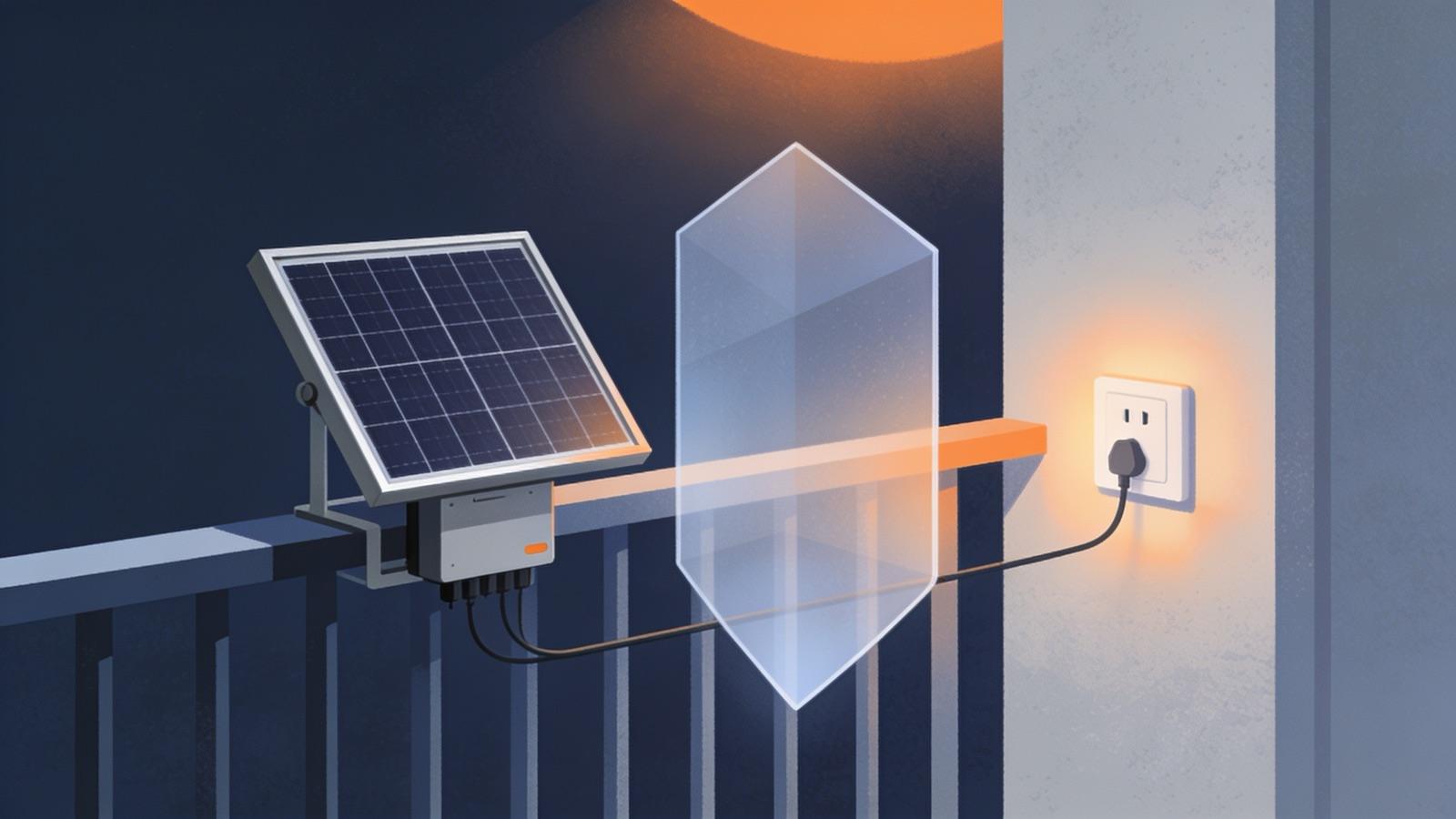
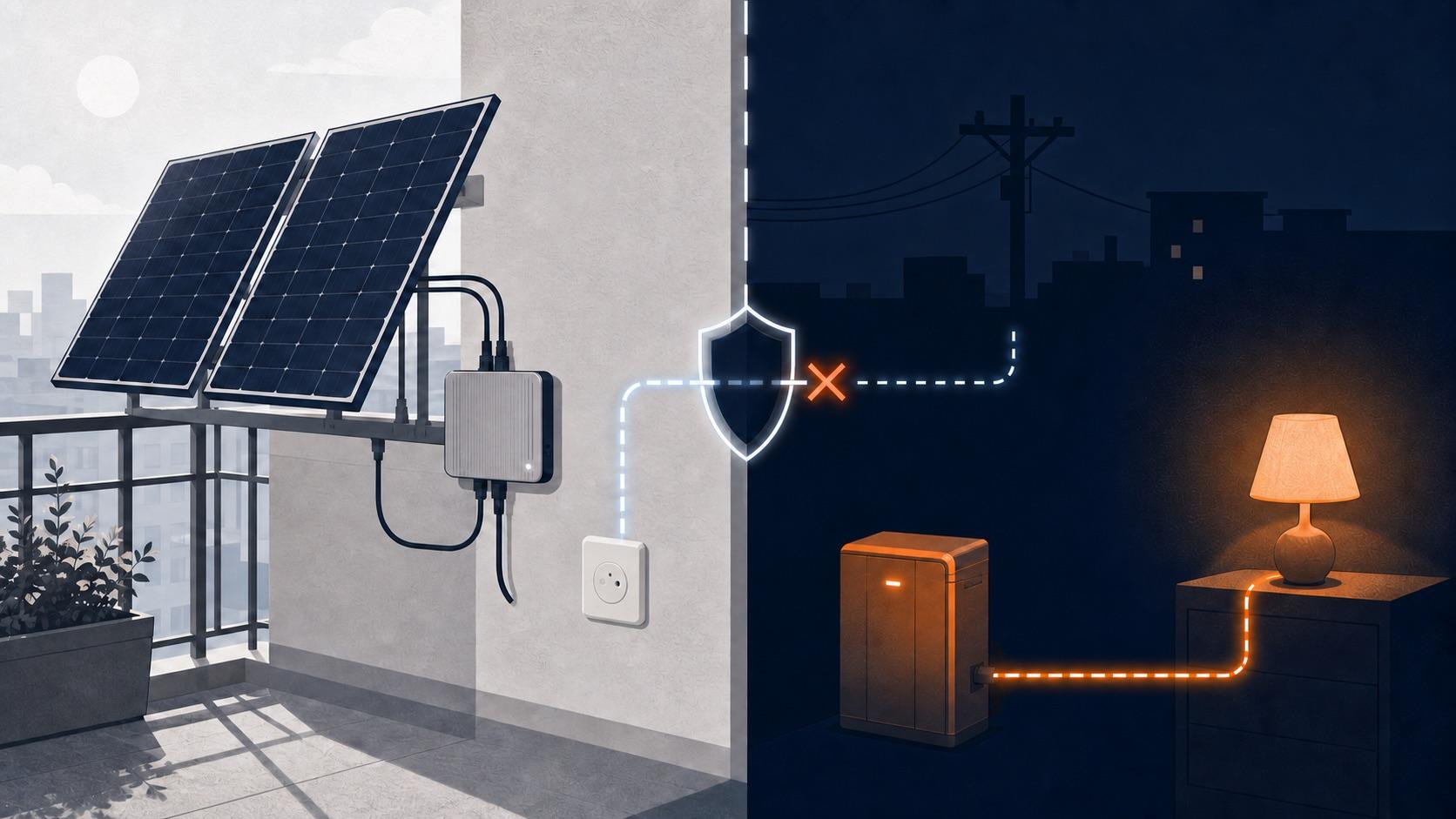
- Grid-loss protection separates generation from a de-energized utility network; it protects workers, equipment and the restoration process.
- A battery stores energy, but outage service also needs an inverter that can form an island and a device that isolates eligible loads from the grid.
- A dedicated backup outlet, protected-load panel and whole-home backup are three different capabilities with different power and installation limits.
- Portable solar generators normally power only their own outlets; they must never be connected to a home receptacle to energize fixed wiring.
What happens the moment the grid goes down?
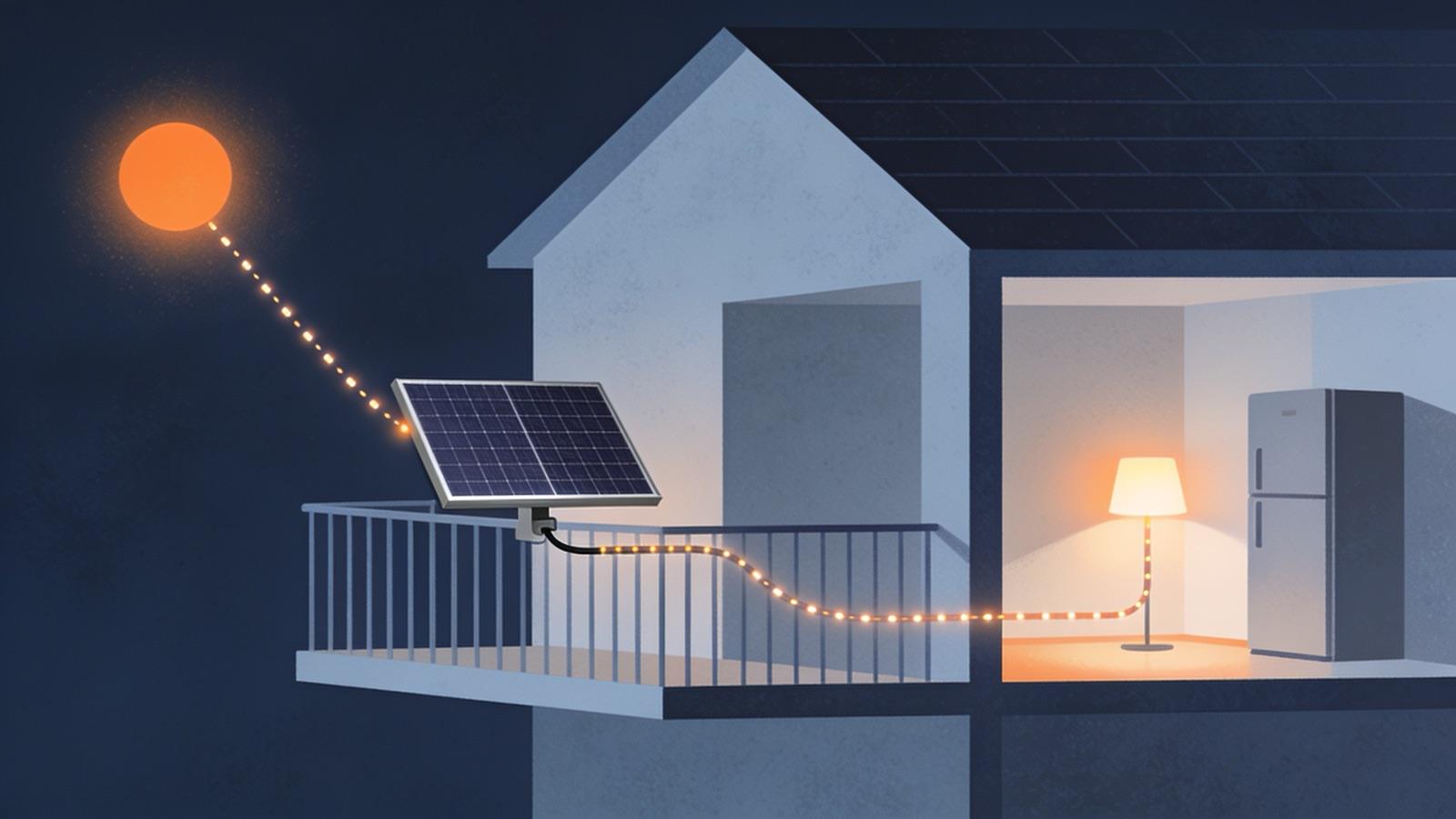
A plug-in microinverter is normally grid-following. It observes the utility voltage and frequency, synchronizes its AC output to that reference and supplies the household branch circuit while the grid is healthy. When the reference moves outside the permitted range or disappears, the inverter detects the condition and stops energizing its grid-connected output. The panels may still have sunlight on them, but the ordinary AC path into the home is no longer active.
That distinction explains the apparently strange result: the solar modules have not failed and the sun has not stopped producing photovoltaic DC potential. The conversion and connection stage has deliberately shut down. An app may report a grid fault, zero production or an offline inverter. None of those readings authorizes a workaround; follow the manufacturer’s fault and restart instructions.
| Outage stage | Grid-tied plug-in system | Designed backup system |
|---|---|---|
| Grid voltage or frequency leaves limits | Inverter detects an abnormal grid condition | Controller detects the event and prepares isolation |
| Utility supply is lost | Grid-connected AC output stops | Transfer or microgrid interconnect device separates backup loads from the utility |
| Home is safely isolated | Ordinary household circuits remain off | Grid-forming inverter can establish local voltage and frequency for eligible loads |
| Outage continues | Panels do not restart the grid-tied output | Battery and compatible solar may serve loads within power, energy and control limits |
| Grid returns | Inverter waits for acceptable grid conditions before reconnecting | Controller synchronizes and transfers the protected system back according to its design |
Why does plug-in solar shut down in a blackout?
The safety function is called anti-islanding. An unintentional island would be a section of wiring that remains energized by local generation after the utility has disconnected it. That can expose utility workers and the public to a circuit expected to be dead, interfere with protection and restoration, and leave voltage or frequency without the larger grid that normally stabilizes them.
US interconnection requirements address unintentional islanding through IEEE 1547 and equipment testing such as UL 1741. In Great Britain, Energy Networks Association guidance for G98-connected generation says the generating unit must disconnect from the distribution network if mains power is interrupted. The exact equipment, clearing behavior and reconnection settings depend on the applicable grid code and approved configuration, but the principle is consistent: ordinary parallel generation does not continue feeding a dead network.
Anti-islanding is not the same as zero export
Zero-export control manages normal operation while the grid is present, usually by measuring site flow and reducing inverter output near an export limit. Anti-islanding responds to loss of the grid reference and stops the connected output. A system can have one feature without the other, and a zero-export claim does not establish backup capability.
Which solar systems can provide outage power?
| System configuration | Works in a grid outage? | What can remain powered | Decisive evidence |
|---|---|---|---|
| Plain grid-tied plug-in solar | No | Nothing through its normal household connection | Grid-loss behavior in the exact inverter manual |
| Grid-tied solar plus battery, no backup interface | Usually no | Battery may retain charge but cannot energize household wiring | An identified islanding or backup output—not the word “battery” |
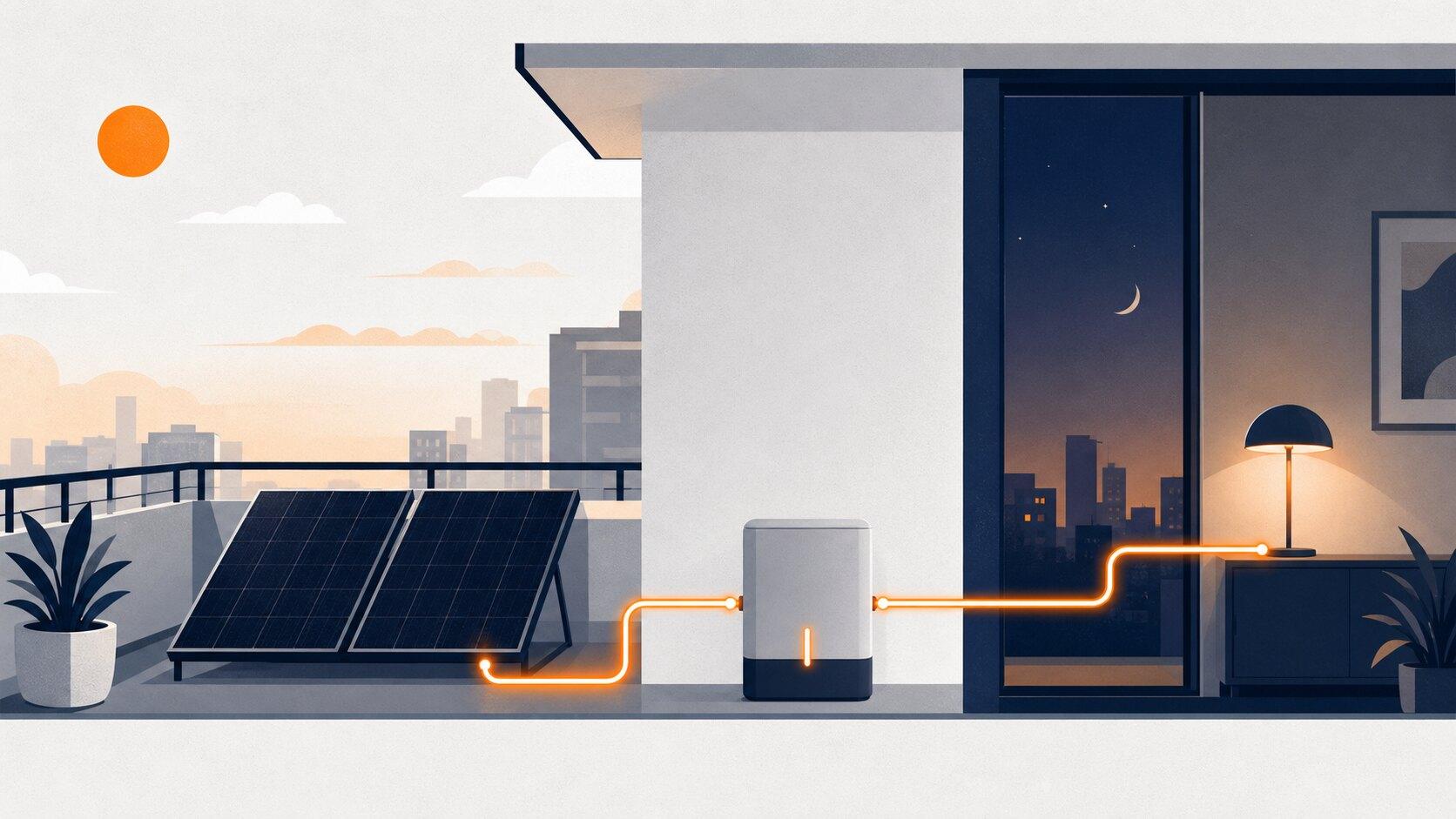
| Battery system with isolated backup outlet | Yes, within limits | Only appliances connected to that designated outlet | Outlet power, surge limit, transfer behavior and solar-recharge mode |
| Critical-load or whole-home backup | Yes, as designed | Circuits selected behind an approved transfer or microgrid interconnect device | Single-line diagram, protected loads, installer commissioning and approvals |
| Portable solar generator / power station | Yes, off-grid | Devices plugged into the unit’s own outlets | Output, usable capacity and compatible panel inputs |
The second row is the common buying trap. Storage and backup are different functions. A battery can shift midday solar into the evening during normal grid operation while its grid-tied output still shuts down in an outage. Look for a named emergency-power-supply, off-grid or backup output and read what it actually supplies. Marketing phrases such as “energy security,” “backup ready” or “UPS” are not a circuit diagram.
Does adding a battery make balcony solar work during an outage?
Only when the complete configuration is designed to operate safely as an intentional island. That requires more than stored energy. The system needs a grid-forming inverter or other source that establishes stable local voltage and frequency, a reliable means of separating the backup side from the utility, controls that balance generation with changing loads, and an approved connection to the loads it is allowed to serve.
A compact balcony battery may solve this with one or more isolated AC receptacles. Appliances plug directly into the device, so the battery does not energize fixed household wiring. A larger home system may use a transfer device and a protected-load panel. Enphase’s system-controller documentation illustrates the latter architecture: when the grid is lost, the controller opens its microgrid interconnect device before compatible inverters remain in island mode. Without the controller, the documented battery inverters cease energizing premises wiring.
Can the panels recharge the battery during the blackout?
Sometimes, but not by assumption. In a DC-coupled system, compatible panels may continue charging a battery while an isolated output powers loads. In a coordinated AC-coupled microgrid, solar inverters may operate after the controller has safely formed the island. In a plain grid-tied arrangement, the microinverter is off and cannot send AC to an unrelated battery charger. Check the outage-mode energy diagram, compatible panel range, minimum state of charge and black-start behavior in the exact manual.
Black start matters after the battery reaches its shutdown reserve. Some systems need stored energy to establish the local grid before solar inverters can start. A bright morning does not guarantee automatic recovery from an empty battery. The manual should state whether solar can restart the system, how much reserve it protects and whether user action is required.
Can solar provide daytime backup without a battery?
A specially engineered system can, but it is not ordinary plug-in solar. Battery-free “sunlight backup” architectures use an isolation controller, compatible inverters and managed loads so instantaneous solar power can serve selected circuits without the utility. Output can fall quickly when a cloud passes, and starting loads may exceed what the panels can deliver at that moment. This capability must be explicitly designed, installed and approved; it cannot be created by defeating anti-islanding on a grid-tied microinverter.
For small balcony systems, an isolated power station charged directly from compatible panels is the clearer battery-backed alternative. It remains off-grid and serves its own outlets. That is a different category from a grid-tied plug-in system, even when both products are sold beside the same solar modules.
How much backup can a small system provide?
Separate power from energy. Output power in watts determines which appliances can run together and whether a motor’s start-up surge is supported. Usable energy in kilowatt-hours determines approximately how long those loads can run. A 1 kWh label does not prove that the inverter can start a refrigerator, and a high-watt outlet does not prove that the battery will last all night.
For a transparent planning example, suppose selected loads average 50 W. Eight hours requires 0.4 kWh before conversion losses and reserve settings: 50 W × 8 h = 400 Wh. That arithmetic is not a product promise. Measure the actual devices, include surge power, use the manufacturer’s usable-capacity figure and keep a margin for standby consumption, temperature and battery aging.
| Backup question | Unit | What to verify |
|---|---|---|
| Can it start the appliance? | Surge watts | Motor or compressor start requirement versus outlet surge rating and duration |
| Can it keep the appliance running? | Continuous watts | Combined load versus continuous output |
| How long will it run? | Usable watt-hours or kilowatt-hours | Load energy plus conversion, standby and reserve losses |
| Will solar extend runtime? | Solar input watts and watt-hours | Outage-mode charging support, weather and panel compatibility |
| Which sockets or circuits are live? | Connection path | Dedicated outlet, protected-load panel or whole-home transfer |
What about a brief outage, brownout or planned shutdown?
Not every disturbance produces the same visible response. Grid codes define voltage and frequency ranges, ride-through behavior, trip conditions and reconnection delays. A brief dip may leave some approved inverters connected, while a deeper or longer event can trip them. A true loss of utility supply should not be used as a DIY test; use documented monitoring or a qualified installer’s commissioning procedure.
When the grid returns, a compliant inverter does not simply force itself online the instant voltage appears. It checks that the grid satisfies its entry conditions and follows the configured reconnect process. A backup controller must also synchronize its local island before reconnecting. Delayed solar recovery after the lights return can therefore be normal, but persistent faults belong with the manufacturer or installer.
Six checks before buying for backup
- Identify the exact outage output: ordinary grid port, isolated AC outlet, EPS output, protected-load panel or whole-home transfer.
- Record continuous watts, surge watts, usable energy, transfer time and the loads the warranty permits.
- Confirm whether compatible solar can charge during island mode and whether the system can restart after reaching its low-battery cutoff.
- Check which accessories are mandatory. A battery, controller, meter, transfer device and load panel may be separate purchases.
- Verify the complete regional configuration, grid code and certification scope; evidence for one inverter or battery cell is not proof for the whole installed system.
- Confirm installation, utility, fire, building, landlord and insurance requirements before connecting anything to fixed wiring.
Build the backup plan around critical loads, not the system’s headline capacity. List the devices that genuinely matter, measure or document their power, decide how long each must run, and choose the permitted connection path. Medical equipment, life-safety systems and other critical loads need a professionally reviewed continuity plan rather than a consumer battery assumption.
Unsafe workarounds to avoid
- Do not disable anti-islanding, substitute an unapproved grid profile or modify the inverter to keep its grid output active.
- Do not connect a power station, inverter or generator to a household outlet to backfeed fixed wiring.
- Do not assume opening one breaker creates a compliant island; safe transfer equipment must prevent unintended reconnection and meet local rules.
- Do not treat an extension lead as permanent wiring or route it through wet, pinched, hot or inaccessible locations.
- Do not exceed a backup outlet’s continuous or surge rating, and do not energize loads the manufacturer excludes.
A five-minute outage-readiness audit
| Audit step | Question | Pass condition |
|---|---|---|
| 1. Map | Which output remains live after grid loss? | The exact outlet or protected circuits are named in the manual and installation documents |
| 2. Isolate | What physically separates those loads from the utility? | A documented isolation or transfer device exists, or loads use only the power station’s own outlets |
| 3. Size | Do power and usable energy cover the critical-load plan? | Continuous, surge and runtime calculations all fit with margin |
| 4. Recharge | Can solar operate in island mode? | The exact configuration documents panel charging and restart behavior |
| 5. Approve | Does the complete setup match local and property rules? | Utility, electrical, fire, building and permission checks are resolved as applicable |
Sources
The outage and resilience explanation follows US Department of Energy guidance on solar, storage and intentional islands. Interconnection context comes from IEEE 1547 and Energy Networks Association G98 guidance. The controller example uses Enphase’s primary technical brief to show why a battery and an isolation device perform separate jobs. These sources establish system behavior, not approval for a particular product or location.
- US Department of Energy — Solar and Resilience Basics
- US Department of Energy — Distributed Energy Resources and Microgrids
- IEEE — Standard 1547 for DER interconnection
- UL Standards & Engagement — UL 1741 scope
- Energy Networks Association — G98 connection guide
- Enphase — IQ System Controller concept of operations
Frequently asked questions
Will plug-in solar power my home during a blackout?
No for an ordinary grid-tied system. Its microinverter depends on the utility waveform and stops energizing the household connection when that reference disappears. Power can continue only through a separately designed isolated outlet, protected-load system or off-grid power station. Bright sun alone does not keep normal sockets live.
Why do solar panels shut off when the grid fails?
The panels may still produce DC potential, but the grid-connected inverter stops AC output to prevent an unintentional island. That protects workers and equipment and allows orderly grid restoration. A backup system first isolates eligible loads from the utility, then uses a grid-forming inverter to create a controlled local supply.
Does a balcony solar battery work in a power cut?
Not automatically. Some batteries provide isolated backup receptacles, while others only shift energy during normal grid operation. Check the exact manual for the live outage output, continuous and surge ratings, transfer behavior, required accessories, solar charging in island mode and which loads are permitted.
Can solar panels charge a battery while the grid is down?
They can when the panels, charge controller, battery and outage controls are designed for that path. A DC-coupled power station often supports direct solar charging. A plain grid-tied microinverter normally shuts down and cannot automatically charge an unrelated AC battery. The exact outage-mode diagram is decisive.
Can I use a solar generator during a power outage?
Yes, for devices connected to the generator’s own outlets and within its power and energy limits. Keep it electrically separate from household receptacles unless a manufacturer-approved, professionally installed transfer system explicitly provides a fixed-wiring connection. Never use a double-ended cable or other backfeed method.
Will plug-in solar restart automatically after an outage?
Usually the grid-tied inverter monitors the restored utility and reconnects after the required conditions and delay are satisfied. Backup systems also synchronize before transferring back. Exact timing and user actions vary by equipment and grid profile, so follow the manual if a fault remains after utility service is stable.
Check your location
Framework status and exact product eligibility are separate checks.