Balcony Solar With Battery (2026 Guide)
A source-led guide to battery architecture, usable capacity, output power, blackout behavior, compatibility and honest savings math.

WattRank is reader-supported: we may earn a commission if you buy through links in this guide. This never affects our rankings.
Key facts
- Battery capacity (kWh) is how much energy can be stored; output power (W) is how quickly it can serve loads. One does not prove the other.
- The useful battery is usually the smallest one that can be filled by normal surplus and emptied by later demand—not the largest module a vendor sells.
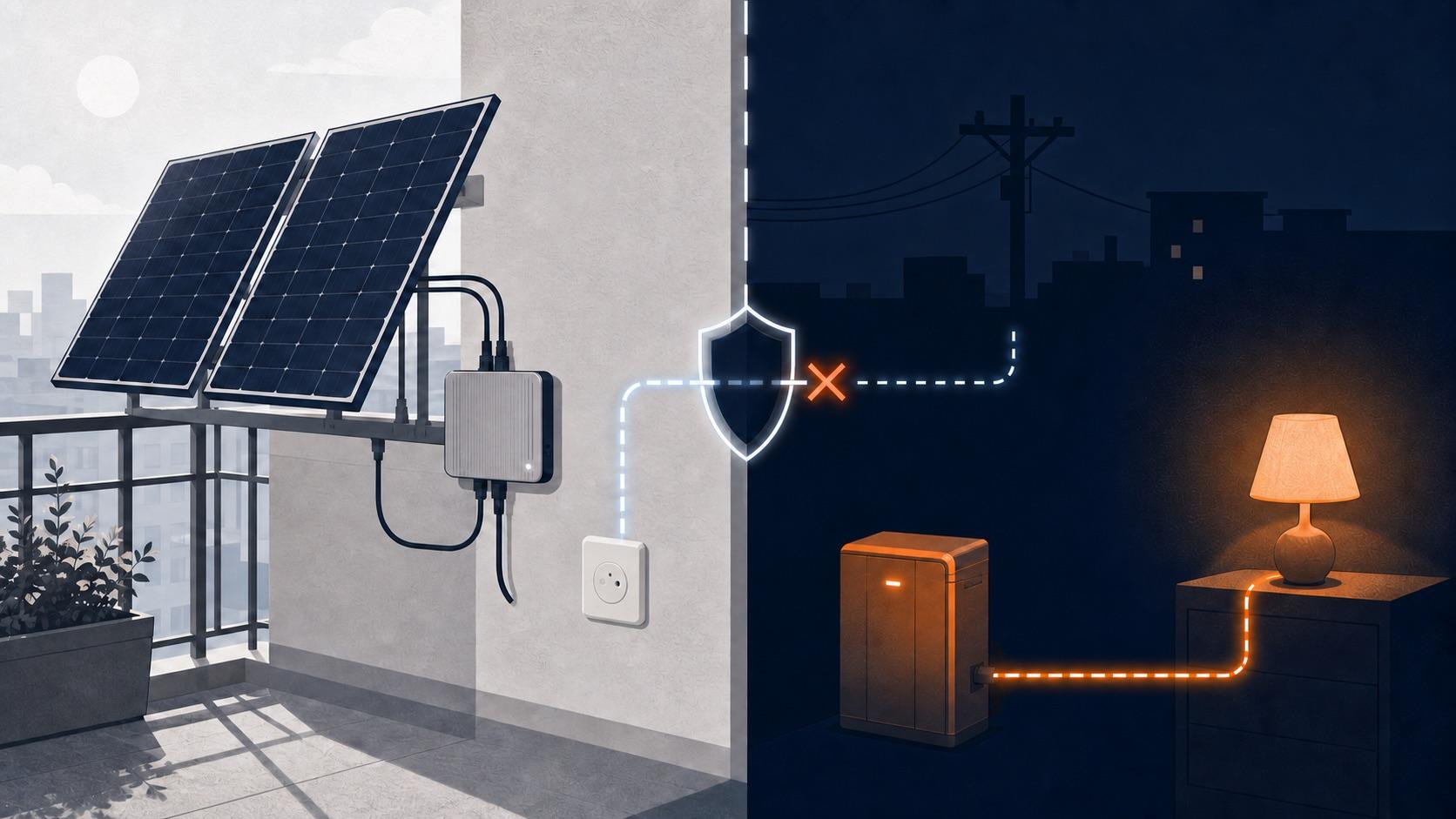
- A grid-tied battery still needs a designed island or dedicated backup output to work during an outage; ordinary grid-following export must stop.
- AC-coupled retrofits and DC-coupled systems move energy through different conversion paths, so product compatibility and losses cannot be inferred from capacity alone.
- The UK plug-in solar policy published in July 2026 covers battery-free products; it does not establish a plug-in route for battery systems.
Should you add a battery to balcony solar?
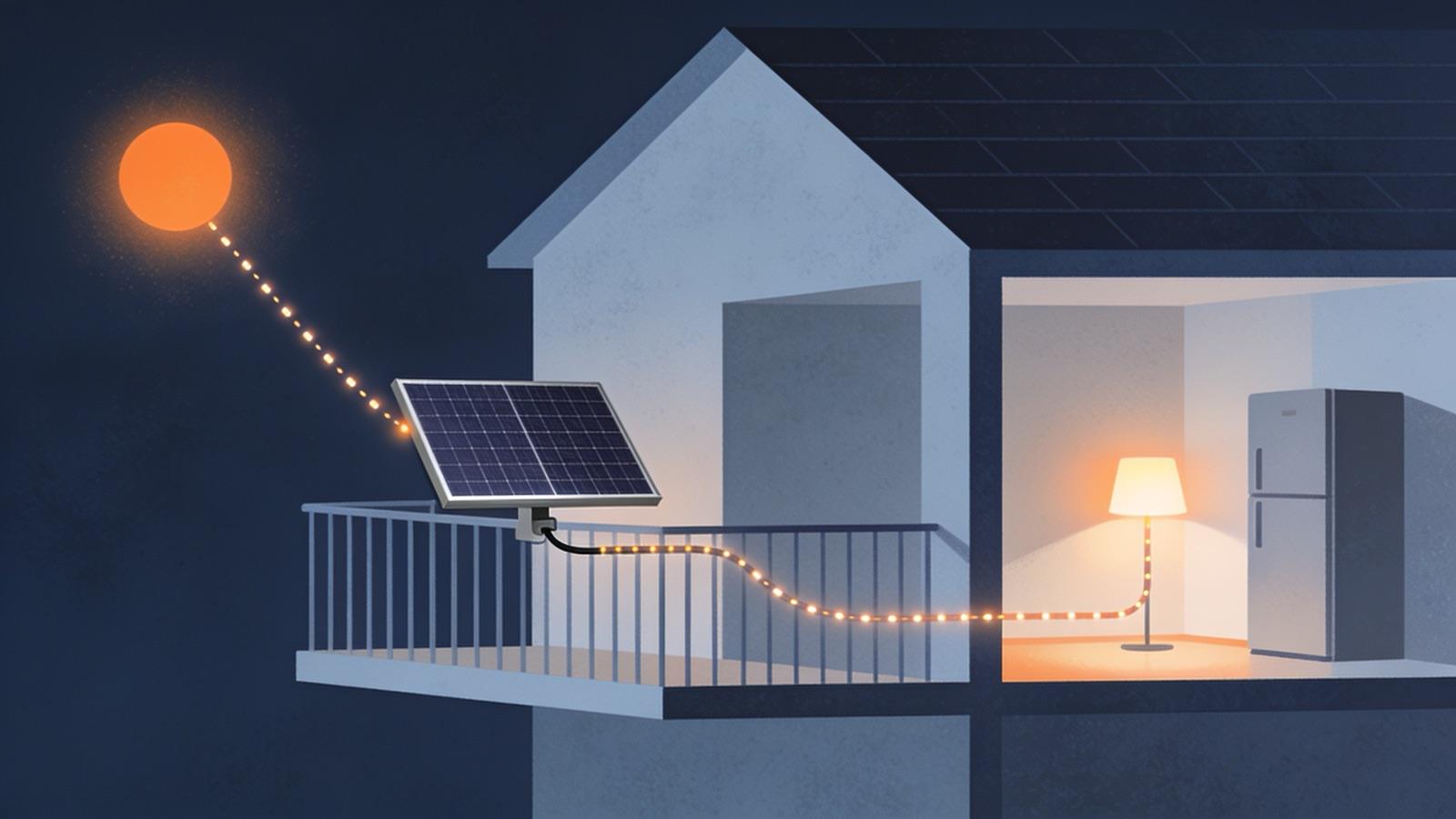
Add storage when your panels regularly produce more than the home uses at the same moment, that surplus has little export value, and you have enough evening or night demand to use the stored energy. A battery shifts energy in time; it does not create extra solar generation. If the home already consumes nearly every solar kilowatt-hour as it is produced, there may be little left to store.
The decision starts with an energy-flow problem, not a product shortlist. Measure or estimate three hourly curves: solar production, household demand and export. The gap between production and simultaneous demand is potential charging energy. The later demand that the battery can realistically serve is potential discharging energy. Storage is useful only where those two quantities overlap after conversion losses, operating limits and local rules.
There are also non-financial reasons to buy storage. A dedicated backup outlet can keep selected devices running, time-of-use charging may move grid purchases away from expensive hours, and a household may value learning or resilience more than a short payback. State those goals separately. A battery bought as insurance should not be justified with a savings claim it cannot earn.
How does a balcony solar battery work?
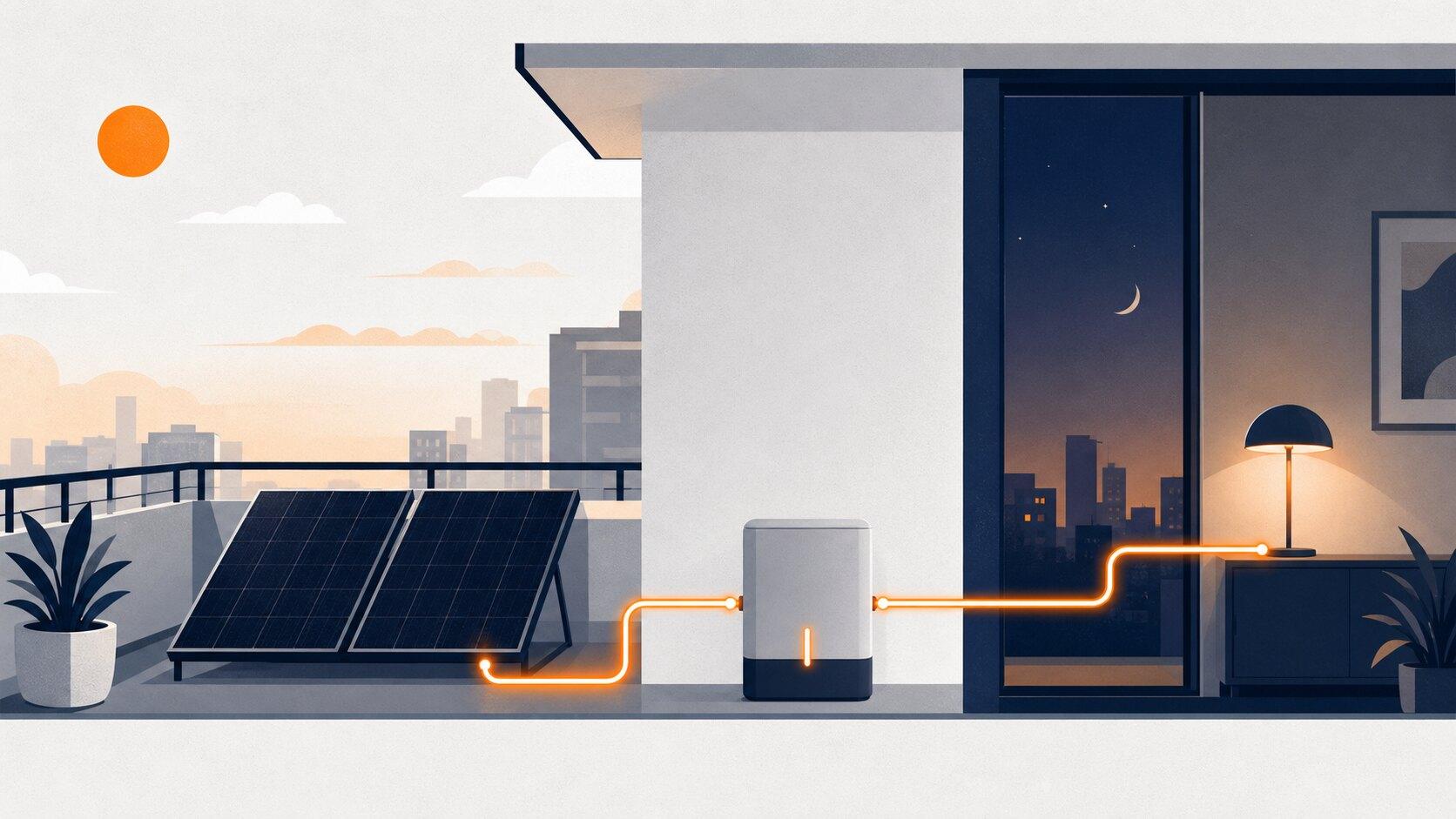
Solar modules make DC electricity. A charge controller tracks the panels, a battery stores DC energy, and an inverter converts energy to AC for household loads. Where those functions sit determines the system architecture. Current balcony products often combine several functions in one enclosure, so the marketing name is less useful than tracing every input and output on the exact manual.
| Architecture | Normal energy path | Best fit | Main check |
|---|---|---|---|
| DC-coupled integrated storage | Panels → MPPT/charger → battery → inverter → home or dedicated outlets | New system designed around one storage platform | Panel voltage/current, grid output, backup output and included parts |
| AC-coupled retrofit storage | Existing solar inverter → household AC → battery charger → battery → inverter → household AC | Adding storage without rewiring the panel side | Approved metering, charge control, regional grid settings and extra conversions |
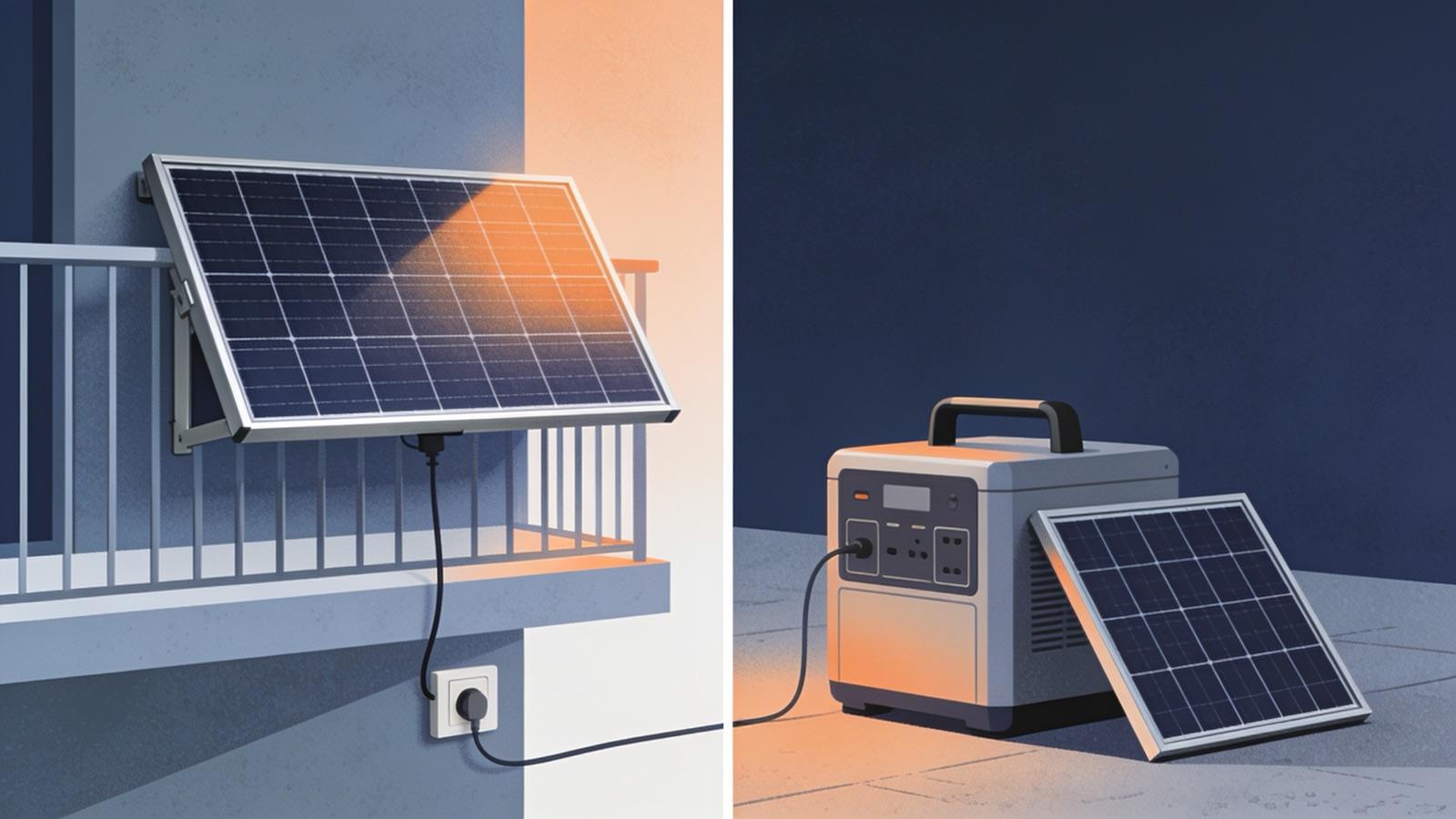
| Off-grid power station | Panels → power station battery → its own outlets | Portable or outage loads | It is not grid-tied unless an approved separate interface expressly provides that function |
DC-coupled storage
In a DC-coupled balcony system, the panels connect to a storage unit or hybrid device before household AC is produced. Solar can serve loads, charge the battery or do both within the device's limits. This arrangement can avoid converting solar to AC and back to DC before charging, but that does not guarantee high whole-system efficiency. Low-power operation, standby consumption, temperature and control logic still matter.
AC-coupled storage
An AC-coupled battery can sit alongside an existing grid-tied microinverter. It measures the home or solar flow, charges from AC when instructed, then later converts stored DC back to AC. That can make retrofits simpler at the panel side, but the energy crosses more conversion stages. Confirm that the meter, battery and inverter are designed to coordinate; a smart meter is a control input, not permission to improvise a grid connection.
A power station is a different system
A portable power station may use the same LFP battery chemistry and accept solar panels, but normally it supplies only its own receptacles. That isolated architecture is useful during an outage and does not intentionally energize fixed household wiring. Never connect a power station to a home outlet to backfeed the building. A manufacturer accessory that adds a grid-tied function must be evaluated as its own exact configuration, with its own instructions and approvals.
What happens to excess solar power when a battery is installed?
The controller follows a priority order. A common self-consumption mode serves current household demand first, charges the battery with available surplus second, and exports or curtails what remains after the battery reaches its charge limit. Other modes may preserve a backup reserve, charge from the grid at scheduled times or cap grid export using a meter. The manual—not the app's marketing label—defines the behavior.
| Operating condition | Likely energy flow | What to verify |
|---|---|---|
| Solar below household demand | Solar serves part of the load; grid or battery supplies the shortfall | Discharge schedule, reserve level and maximum grid-tied output |
| Solar above demand, battery not full | Surplus can charge the battery | Charge-power limit and whether metering responds quickly enough |
| Solar above demand, battery full | Remaining energy exports or is curtailed | Export tariff, zero-export behavior and local requirements |
| Evening or night | Battery discharges to eligible loads until its limit or reserve is reached | Usable capacity, standby draw and minimum state of charge |
| Grid outage | Grid-tied export stops; only a designed isolated output may remain available | Backup outlet rating, transfer behavior and solar recharge in island mode |
A zero-export setting does not mean that every surplus watt reaches the battery. If charging power is limited, the battery is full, communications fail or production changes faster than controls respond, the inverter may curtail generation or a small amount may still cross the meter. Treat export control as a documented system function with commissioning requirements, not as a universal characteristic of batteries.
What battery size do you need?
Size storage from energy you can move on an ordinary day. The practical ceiling is the smaller of two values: solar surplus available for charging and later load available for discharging. Then account for usable rather than nominal capacity, charge and discharge limits, conversion losses, seasonal variation and any reserve you intend to keep. Oversizing beyond that ceiling adds cost and embodied equipment without creating more savings.
A four-step sizing method
- Measure at least several representative sunny and mixed days. Interval data from a meter or monitoring system is better than a monthly bill.
- For each interval, subtract simultaneous household demand from solar production. Add only the positive results to estimate potential daily surplus.
- Add the later loads the battery could actually serve before the next solar window. Exclude loads above the battery's continuous output or outside its connection path.
- Choose a usable capacity near the lower of typical surplus and eligible later demand, then test winter, shoulder-season and summer cases rather than one perfect day.
Example: suppose interval data shows 0.8 kWh of typical afternoon surplus and 0.7 kWh of eligible evening demand. The first-pass target is about 0.7 kWh of delivered energy—not a 5 kWh battery. The nominal label may need to be somewhat larger because the system keeps a reserve and loses energy in conversion. Use the manufacturer’s usable-capacity and efficiency documentation for the exact model instead of applying a universal percentage.
| Sizing signal | Battery implication | Common mistake |
|---|---|---|
| Little or no measured export | Storage may add little self-consumption value | Buying from panel watts alone |
| 0.5–1.0 kWh regular surplus and similar evening use | A small usable battery may cycle productively | Jumping to a multi-kWh module because it is expandable |
| Large summer surplus but weak winter production | Model seasons separately | Sizing to the best July day |
| High evening energy but low solar surplus | A larger battery will not fill from solar | Confusing household consumption with charge supply |
| High-power kettle, heater or cooker | Check output watts and connection path | Assuming more kWh means more instantaneous power |
Capacity and power answer different questions
Capacity is measured in kilowatt-hours: a 1 kWh usable battery could theoretically deliver 100 W for ten hours or 500 W for two hours before losses and operating limits. Power is measured in watts: it determines whether the battery can run a particular combination of loads at once. Grid-tied output, dedicated off-grid output, AC bypass and solar input are also separate ratings. Never substitute one for another.
Will balcony solar with a battery work during a power outage?
Not automatically. The US Department of Energy explains that ordinary residential solar systems generally switch off when the grid fails; outage operation needs storage and a properly configured inverter that can form or supply an isolated electrical island. The same physical boundary applies to small balcony systems: grid-following output cannot keep backfeeding a circuit when the utility supply disappears.
| Claim on a product page | What it may mean | Question to ask |
|---|---|---|
| Battery included | Energy can be stored | Which loads can receive it during an outage? |
| Backup outlet / off-grid port | Selected appliances can plug directly into an isolated outlet | Continuous and surge watts? Solar recharge while islanded? |
| EPS / UPS mode | A defined output may transfer after grid loss | Transfer time, supported loads and installation requirements? |
| Whole-home backup | A transfer device and protected-load design may energize building circuits | What electrician, panel, permit and utility work is required? |
| Grid-tied output | The system can supply household wiring while the grid is present | Does this output shut down during grid loss? It normally must. |
A dedicated outlet can be genuinely valuable without being whole-home backup. List critical loads, their continuous watts, start-up surges and daily energy. A refrigerator may have a modest average but a higher compressor surge; a kettle may fit the energy budget yet exceed output power. Do not route extension cords through unsafe locations, and never defeat the separation between a backup outlet and fixed wiring.
Is a battery financially worth it?
Calculate the battery as an incremental purchase. Its annual value is the electricity delivered from storage multiplied by the retail rate avoided, minus the export value you gave up, plus any verified time-of-use benefit. Then subtract conversion losses, standby consumption and future replacement risk before comparing that value with the battery's additional installed cost. The panel system's savings should not be credited to the battery.
For a transparent upper-bound example, assume storage delivers 400 kWh per year that otherwise would have earned no export credit, and avoided electricity costs $0.25/kWh. Gross value is at most $100 per year before standby use, degradation and financing. If that exported energy would have earned $0.10/kWh, the gross spread falls to $60 per year. This is arithmetic, not a forecast; your interval data and tariff decide the inputs.
A battery may still be rational with a long savings payback if backup is valuable to you, but call that resilience spending. Conversely, dynamic tariffs can add value only when the price spread survives charge/discharge losses and fees. Do not assume one full profitable cycle every day, and do not assume an app's automation will remain compatible with every tariff.
How do current battery systems differ?
Manufacturer specifications show why the exact configuration matters more than the word “battery.” EcoFlow's STREAM Ultra manual describes an integrated inverter, MPPT controller and battery, with separate grid, solar, parallel and AC-outlet connections. Anker's UK Solarbank 4 page lists 5 kWh capacity, 800 W grid-tied output and a separate 2,500 W off-grid port. BLUETTI lists 5,024 Wh and 3,680 W for Balco 500 hardware, while the distinct Balco Transfer interface lists 800 W AC output.
Those figures are not a ranking and are not directly comparable packages. They illustrate four separate fields you must record: exact base unit, accessories required for grid connection, grid-tied AC limit and isolated-load output. Confirm the regional model and retailer bundle. A UK, EU or US product page does not prove that the same electrical configuration is sold or permitted in another market.
The UK is a particularly clear warning. The government's July 2026 plug-in solar outcome proceeds with a pathway and interim product specification for systems without batteries; the consultation explicitly says battery storage systems are outside scope. A battery product being marketed to UK customers is therefore not evidence that it qualifies for the battery-free plug-in route. Verify the current route for the whole battery configuration before connecting it.
Battery compatibility and safety checklist
- Exact architecture: grid-tied storage, isolated power station or a hybrid with clearly separated operating modes.
- Panel inputs: connector, voltage range, maximum current, total PV watts and whether series or parallel wiring is permitted.
- AC paths: grid-tied output, bypass, charging input and dedicated backup output identified separately in the manual.
- Meter and controls: supported meter model, communications behavior, response when data is lost and commissioning steps.
- Battery evidence: nominal and usable capacity, chemistry, operating temperature, enclosure rating, warranty and applicable system-level certifications for the market.
- Installation: manufacturer clearances, weather exposure, secure placement, cable protection and no extension cord or improvised adapter where instructions prohibit them.
- Location rules: grid connection, registration, utility process, output cap, fire/building requirements and landlord or shared-building approval.
- Outage behavior: which outlet remains live, transfer method, reserve setting, maximum load and whether solar can recharge while isolated.
UL Solutions distinguishes portable power packs from stationary residential energy storage systems and warns that a portable-product certification plus a separately certified inverter does not automatically establish the certification needed for a stationary installation. Apply the same evidence discipline everywhere: identify the standard, exact model and certification scope; do not infer complete-system approval from a battery cell, inverter component or marketing badge.
A practical decision rule
Buy only after you can complete this sentence with measured or verified values: “I can regularly store about ___ kWh that would otherwise be exported or curtailed, use about ___ kWh later through eligible loads, avoid ___ per kWh after export value, and the exact system is permitted and compatible here.” If any blank is guesswork, measure or verify it before choosing capacity.
Start with the smallest evidence-backed configuration that meets the job, then use monitoring to decide whether expansion is justified. Modular capacity is valuable because it preserves that option; it is not a reason to fill every expansion port on day one. If your primary goal is outage power, design around critical loads and the isolated output. If it is savings, design around recurring surplus and tariff spread.
Sources
Technical behavior and outage boundaries use US Department of Energy guidance on solar resilience and inverters. Configuration examples use current manufacturer manuals and product pages. Market-specific cautions use the UK government's July 2026 plug-in solar outcome and Germany's Bundesnetzagentur guidance. Product specifications and regulatory status can change; recheck the exact regional documentation before purchase or connection.
- US Department of Energy — Solar and resilience basics
- US Department of Energy — Inverters and grid services
- EcoFlow — STREAM Ultra and Pro user manual
- Anker SOLIX — Solarbank 4 E5000 Pro UK specifications
- BLUETTI — Balco Series specifications
- GOV.UK — Plug-in solar consultation outcome and battery-free scope
- Bundesnetzagentur — Balcony solar rules and registration
- UL Solutions — Portable packs versus stationary storage evidence
Frequently asked questions
Can I add a battery to an existing balcony solar system?
Sometimes. An approved AC-coupled battery may retrofit an existing system, while a DC-coupled battery usually needs compatible panel inputs and inverter controls. Match the exact voltage, current, connectors, meter, regional grid settings and manuals. Do not assume that sharing a brand name makes generations or accessories compatible.
What size battery is best for an 800 W balcony solar system?
There is no capacity implied by an 800 W inverter. Use interval data: find typical daily solar surplus and the later load the battery can serve, then size usable capacity near the smaller value. A shaded 800 W system may not fill 1 kWh reliably; an over-paneled system with low daytime load may justify more.
Can a balcony solar battery power my home in a blackout?
Only if the exact system provides a designed isolated output or approved transfer arrangement. A battery label and grid-tied output do not prove backup. Many systems can run selected appliances from dedicated outlets; whole-home or protected-circuit backup normally needs different hardware, electrical work and local approval.
Does a battery stop balcony solar from exporting to the grid?
Not necessarily. Storage can absorb surplus while it has charge capacity and the controller permits charging. Once full, power may export or be curtailed. Zero-export control needs compatible metering and documented commissioning, and real systems have response limits. Check the tariff and local connection rules even when a vendor advertises zero export.
Is a 5 kWh battery too large for balcony solar?
Often for solar-only charging, but not always. Compare it with measured daily surplus, evening demand and any legitimate grid-charging use. If panels usually offer 0.7 kWh of surplus, a 5 kWh module will spend much of its time partly empty unless another value stream fills it. Expansion capacity is not a sizing target.
Is DC-coupled or AC-coupled battery storage better?
DC coupling can reduce conversion stages when a new system is designed as one platform. AC coupling can be easier for a compatible retrofit. Neither wins universally: usable efficiency, standby draw, metering, regional approvals, backup behavior, warranty and total cost of the exact configuration matter more than the label alone.
Check your location
Framework status and exact product eligibility are separate checks.