What Happens to Excess Balcony Solar Power?
Follow balcony solar from live home use to grid export, compatible storage or inverter curtailment—without confusing physical flow with payment.

WattRank is reader-supported: we may earn a commission if you buy through links in this guide. This never affects our rankings.
Key facts
- Surplus is instantaneous: solar output minus the loads the system can serve at that same moment—not unused energy accumulated over a day.
- Physical export, a meter's export record and a bill credit are three separate events; one does not guarantee the next.
- A zero-export controller measures power at the service point and reduces inverter output when generation would exceed eligible household demand.
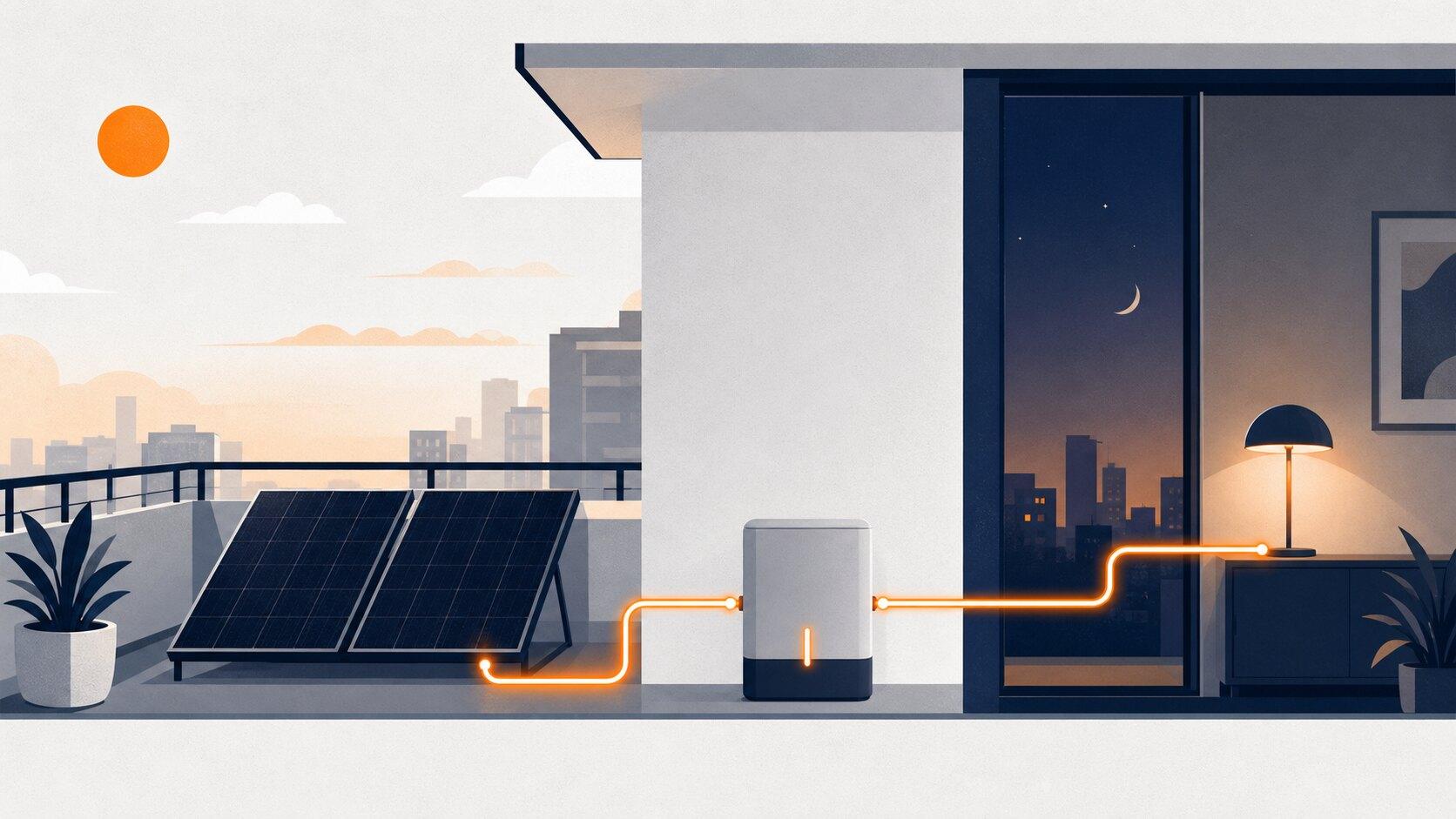
- A battery can absorb surplus only when the exact architecture and controls support charging, the battery has room, and its charge-power limit is not reached.
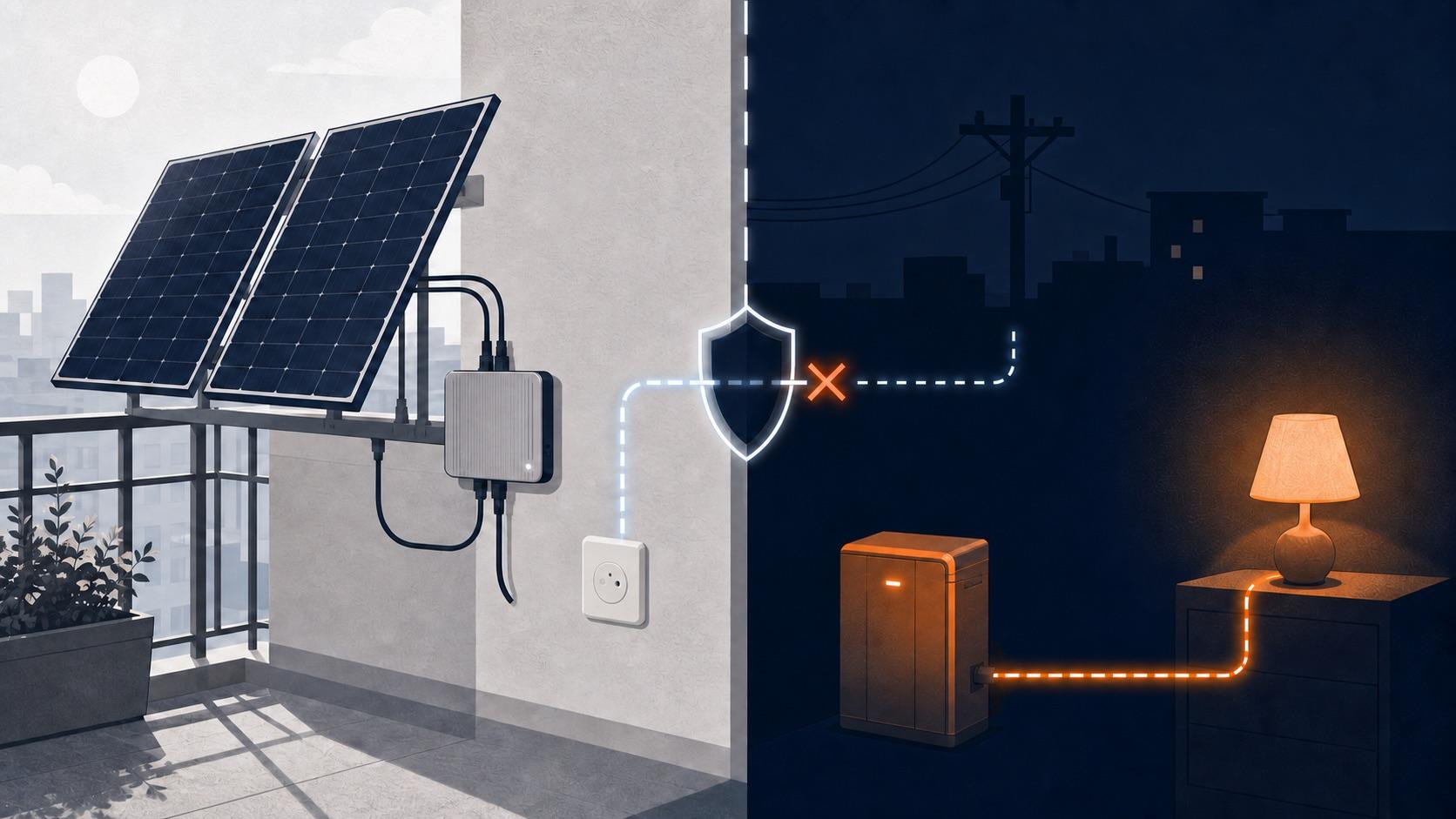
- During a grid outage, ordinary grid-tied output stops through anti-islanding; daytime surplus does not become backup power automatically.
What counts as excess balcony solar power?
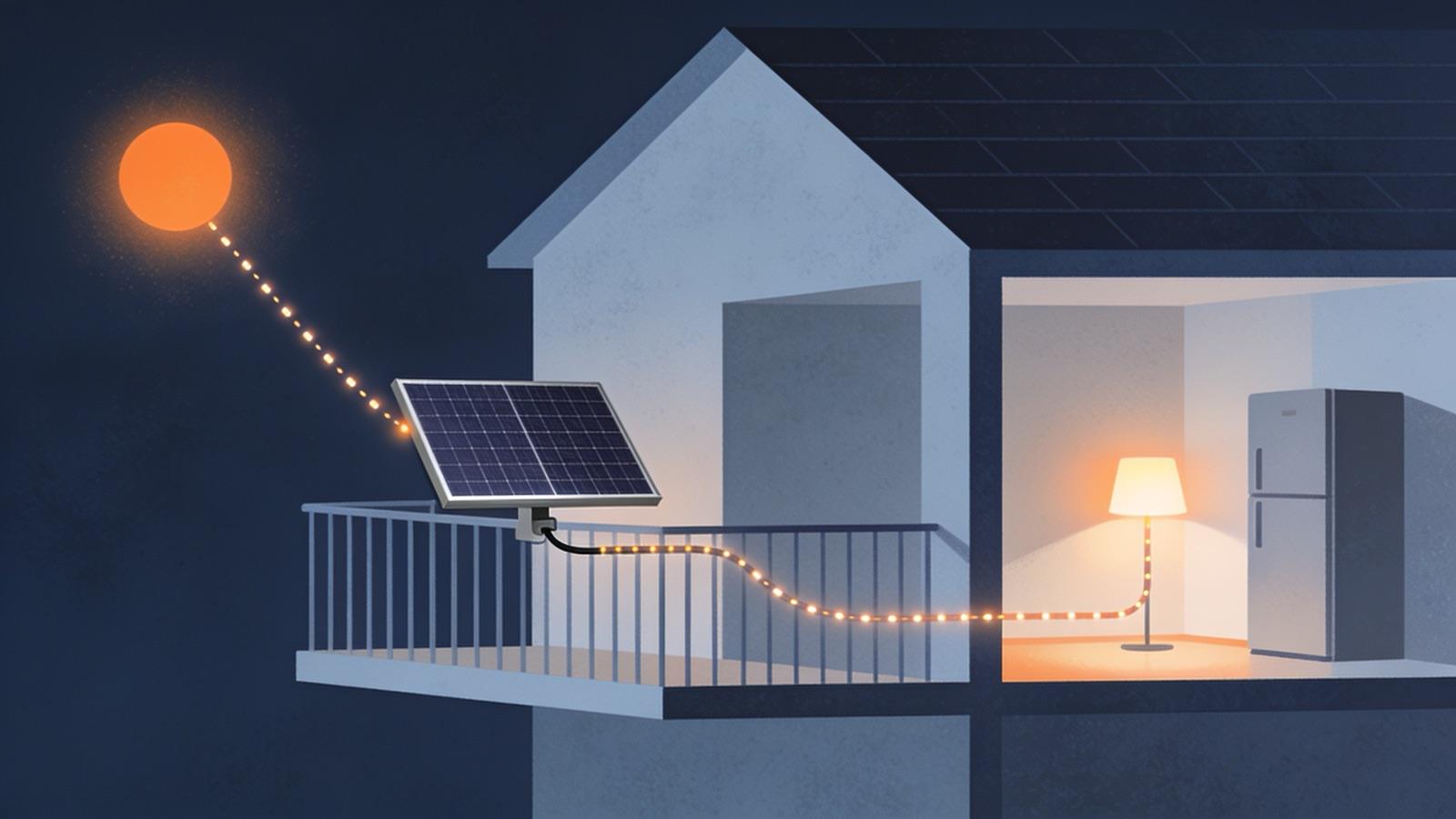
Excess power is the portion of solar output that the eligible household loads do not consume at the same instant. If a microinverter is delivering 600 W while those loads draw 250 W, the potential surplus is about 350 W before small system losses and any phase or control constraints. If a kettle starts and total demand rises above 600 W, there is no surplus during that interval; the grid supplies the shortfall.
This is a power balance measured in watts, not a daily energy balance measured in kilowatt-hours. A home can import electricity in the morning, export at noon and import again in the evening. Adding all three periods into one daily total hides the timing that determines self-consumption, export and battery value.
| Solar output | Eligible live demand | Potential meter-side result |
|---|---|---|
| 150 W | 400 W | About 250 W imported; no surplus |
| 400 W | 400 W | Near-zero net flow |
| 600 W | 250 W | About 350 W available to export, store or curtail |
| 800 W | 100 W, battery charging at 300 W | About 400 W remains for export or curtailment |
Where can the surplus go?
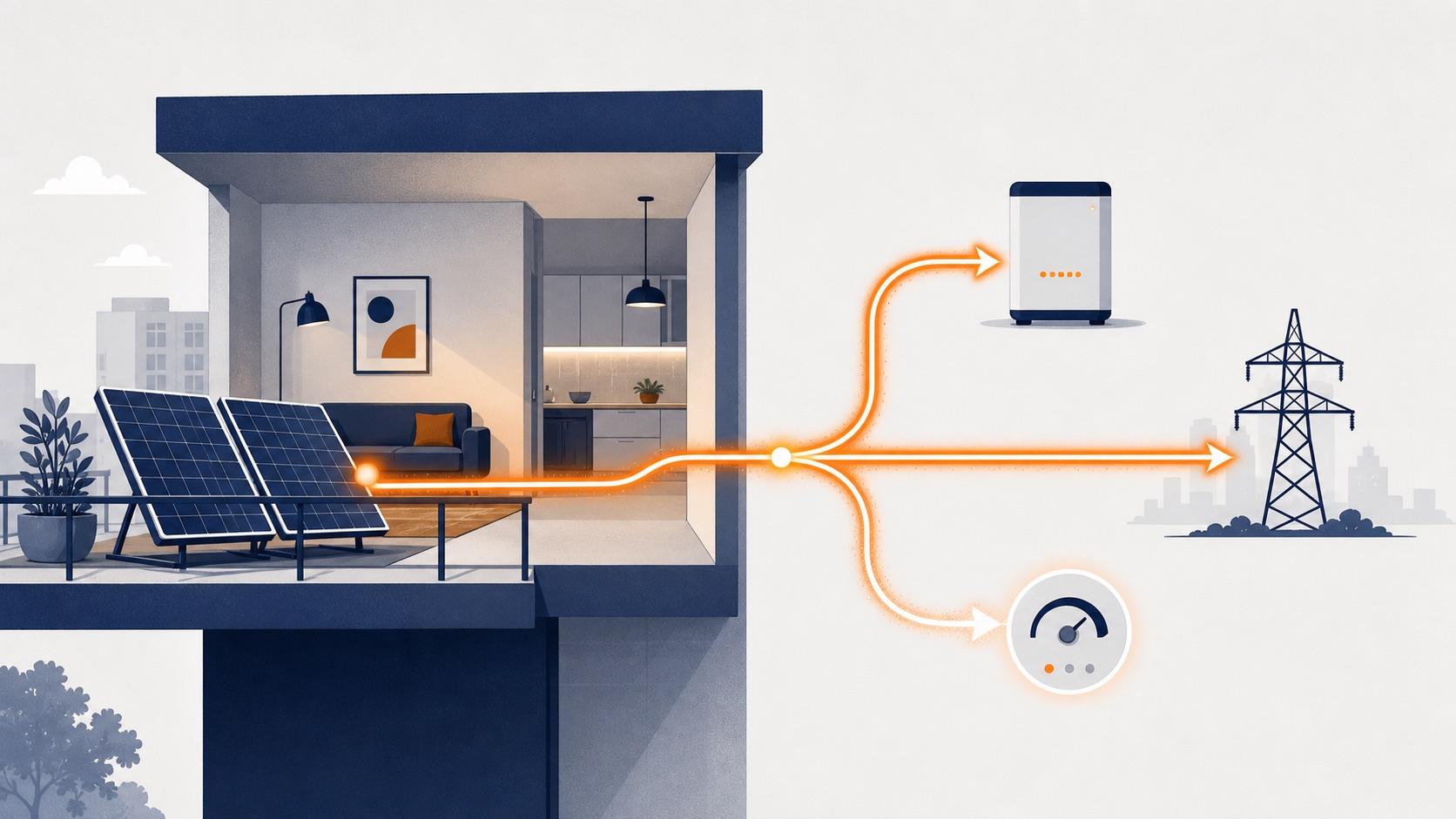
Household use comes before surplus: the solar contribution first offsets eligible live demand. There is no universal destination for the remainder. A plain grid-tied microinverter normally follows the available sunlight up to its AC limit, so the balance may cross the meter. A coordinated storage system can intercept some surplus. An export-limited system can instead command the inverter to reduce production. The real priority order comes from the wiring, meter placement, grid profile and operating mode—not from the word “smart” in an app.
| Outcome | What physically happens | When it has bill value | What to verify |
|---|---|---|---|
| Exported to the grid | Net power crosses the service meter outward | Only under an eligible tariff, credit or settlement rule | Connection permission, meter and export terms |
| Stored | A compatible charger converts surplus into battery energy | When later discharge avoids a purchase or earns a permitted export value | Architecture, losses, capacity, power limits and controls |
| Curtailed | The inverter operates below the power otherwise available from the panels | No direct bill value; it may enable compliance with an export limit | Sensor position, response behavior and approved settings |
Why does the home use solar before grid power?
“Solar first” is useful shorthand, but electricity is not routed like parcels. The inverter injects current into the household circuit while appliances draw current. The utility meter sees the net result. When load exceeds solar output, import falls by roughly the solar contribution. When solar exceeds load, net flow reverses unless storage or export control changes the balance.
The phrase also has limits. In multi-phase buildings, generation and demand may sit on different phases, while the meter or tariff may aggregate them in a jurisdiction-specific way. In an apartment, another unit's load normally sits behind another meter and does not become your self-consumption merely because it is nearby. Use the actual metering arrangement rather than assuming every load in the building absorbs your output.
Does exported power earn money or bill credit?
Not automatically. Physical export answers where energy flowed. Metering answers whether export was recorded. Billing answers whether the recorded export qualifies for a payment or credit and at what rate. Treat these as three ledgers. A bidirectional meter can record export while the bill still assigns it no value; an export program can exist while a particular plug-in configuration is ineligible.
The US Department of Energy describes net metering as compensation for exported generation, but stresses that qualification and bill-credit design depend on state and utility policy. In Great Britain, Ofgem's Smart Export Guarantee pays eligible generators for measured export after they apply to a participating supplier and meet the scheme criteria. Neither source creates a blanket export entitlement for every balcony kit or location.
| Billing treatment | Physical flow | Economic result |
|---|---|---|
| Retail-style net credit | Surplus exports and is recorded | Each eligible kWh may offset import under the tariff's accounting rules |
| Separate export tariff | Surplus exports and is recorded separately | Payment uses the contracted export rate, which may differ from retail import |
| Uncompensated export | Surplus still enters the grid | The owner receives no direct bill value for that energy |
| Zero-export setting | Control aims to prevent outward net flow | No export payment; value comes from self-use or compliant operation |
Do not assume an old meter will safely or lawfully “run backward.” Meter behavior, registration and replacement rules belong to the utility or metering authority. A display that shows negative power also does not prove that the billing system accepted the export. Confirm eligibility and settlement before assigning any export value in a payback model.
What does zero export actually do?
A zero-export system adds a feedback loop. A compatible meter or current transformer measures net flow near the utility connection. The controller compares generation with eligible load and commands the inverter to reduce output as the site approaches the configured export limit. Enphase's power-export-limit documentation, for example, requires specific gateway, production and consumption sensors and a grid profile; it does not describe a universal switch inside every microinverter.
Curtailment means the inverter does not harvest all the photovoltaic power that the sunlight could have produced at that moment. It changes the panels' operating point or otherwise caps conversion, so the unharvested potential never becomes usable AC energy that needs somewhere to “go.” There is no hidden tank of electricity and no requirement for a household dump load. The panels continue experiencing ordinary sunlight and thermal conditions while producing less electrical power.
Zero export is a feature, not legal permission
Export limiting can address a network requirement, but it does not by itself approve the equipment, connection method or installation. Utilities may require a specific fail-safe response, commissioning evidence, hard disconnection, registration or an approved grid profile. A vendor's “zero export” label should therefore be checked against the exact manual and local pathway.
| Control condition | Expected response | Possible limitation |
|---|---|---|
| Demand rises | Inverter can increase output up to available solar and its AC cap | Response speed and configured ramp rate |
| Demand falls | Inverter reduces output as export approaches the limit | Brief residual flow may occur during control response |
| Sensor communications fail | System follows its documented fail-safe behavior | Behavior differs; verify whether it limits or disconnects |
| Battery becomes full | Charging stops; remaining potential exports or is curtailed | A battery does not eliminate the need for an export rule |
Can a battery capture every excess watt?
No. The battery must be part of a compatible energy path, have unused capacity and accept power quickly enough. A DC-coupled balcony battery can charge before solar reaches the household AC side. An approved AC-coupled battery measures net flow and charges through another conversion path. A portable solar generator sitting elsewhere, or a home battery with no compatible control relationship, does not automatically detect and capture balcony-solar export.
The Australian government's consumer guidance explains the useful principle: storage can charge from excess generation that might otherwise be curtailed and release it later, but savings from avoided curtailment are often modest. For a balcony system, measure recurring surplus first. If only 0.3 kWh is available on a normal day, adding several kilowatt-hours of capacity does not create more solar to fill it.
Storage also changes the accounting. A kilowatt-hour sent through a battery experiences conversion losses and may give up an export payment. Its incremental value is approximately the later import price avoided minus the export value forgone, adjusted for losses, standby use and battery cost. Higher self-consumption is not automatically higher profit.
How should you measure your own surplus?
Use interval data from a trustworthy meter or energy monitor, ideally at the service point, and compare it with solar production over representative sunny, mixed and cloudy days. Production data alone cannot reveal export because it does not know the simultaneous household load. A monthly utility bill is also too coarse to distinguish midday export from evening import.
- Confirm which meter value represents import and which represents export; do not infer direction from an unsigned number.
- Record solar production, household net flow and battery charge or discharge on the same time scale.
- Separate inverter clipping from export curtailment: clipping follows the inverter's AC ceiling, while export control follows site flow or a grid setting.
- Repeat the measurement across seasons. A system can have summer surplus but almost none in winter.
- Check the utility bill or export statement against the local monitor; app totals are not settlement evidence.
| Observation | Likely interpretation | Next check |
|---|---|---|
| Solar production exceeds home demand and export rises | Plain grid export | Tariff eligibility and recorded export register |
| Solar output follows home demand below the available-sun curve | Possible export limiting | Configured limit, sensor orientation and event logs |
| Production stays at one flat maximum in strong sun | Possible inverter clipping | AC rating versus panel DC rating |
| Battery charges while meter export falls | Storage is absorbing part of the surplus | Charge losses, power limit and later discharge |
| Monitor shows export but bill shows none | Metering or tariff mismatch | Supplier or utility enrollment and settlement period |
How can you make surplus more valuable?
Start by matching system size to real daytime demand. Then shift flexible loads—such as a dishwasher or laundry cycle—into solar hours only when the appliance, circuit and household schedule allow it. Do not create wasteful consumption merely to avoid export: using 1 kWh unnecessarily is not a saving just because it came from solar.
Compare three options with the same interval data: accept export under the verified tariff, add export control, or add compatible storage. Export may be economically preferable when the tariff is strong. Load shifting may be nearly free. A battery may help when recurring surplus and later demand overlap, but it must recover its added cost after losses. The correct order depends on the local bill, not a universal priority list.
| Your situation | First action | Why |
|---|---|---|
| Most solar is self-consumed | Keep the simple system and verify with data | There may be too little surplus to justify more hardware |
| Regular export has a good tariff | Confirm enrollment and meter accuracy | Export can be more valuable than storage after losses |
| Regular uncompensated export | Try safe load shifting, then price storage | Direct use usually avoids the retail import rate |
| Export is restricted | Use only an approved control pathway | Technical limiting must match local requirements |
| Outage backup is the real goal | Evaluate isolated backup equipment separately | Grid-tied surplus does not keep circuits live in an outage |
A four-question surplus audit
- Flow: during which intervals does production exceed the loads this system can actually serve?
- Meter: does the installed meter record export correctly, and how are phases or apartment units treated?
- Bill: is the exact system eligible for export credit, at what rate and under what registration or contract?
- Control: after the home load, does the documented system export, charge compatible storage or curtail—and what happens when controls fail or the battery fills?
If any answer is unknown, do not assign the surplus a retail-rate value and do not assume zero export. Ask the utility, supplier or network operator about the actual connection and metering pathway, then verify the exact equipment manual. In locations without an explicit framework, “research required” is more accurate than declaring the system prohibited.
Sources
The physical-flow explanation follows grid-tied inverter and net-metering guidance from the US Department of Energy. Export-payment examples use current Ofgem guidance. Storage and curtailment behavior uses Australian government consumer guidance, while the control-loop example comes from Enphase's technical brief. These establish mechanisms, not permission for a specific product or location.
- US Department of Energy — Homeowner's Guide to Solar
- US Department of Energy — Inverters and grid services
- Ofgem — Smart Export Guarantee guidance for generators
- Australian Government — How solar pays for itself and batteries reduce bills
- Enphase — Power export limit for IQ7 and IQ8 systems
- Energy Networks Association — Engineering Recommendation G98
Frequently asked questions
Does excess balcony solar power go back to the grid?
It often does when a grid-tied inverter produces more than eligible household loads consume, but not in every configuration. Compatible storage may charge first, while zero-export controls may reduce inverter output. Whether export is permitted, recorded or paid depends on the exact meter, tariff, system and local connection rules.
Is excess solar power wasted?
Exported energy is not physically wasted; it enters the grid and serves network demand, though it may earn the owner no credit. Curtailed energy is different: the inverter harvests less of the power available from the panels, so that potential never becomes usable electricity. A battery may capture some surplus, subject to capacity and control limits.
Will my electricity meter run backward?
Do not assume it will or should. Modern bidirectional meters usually keep separate import and export registers, while legacy meters and billing systems vary. A negative live reading does not prove you will receive credit. Ask the utility which meter, registration and export tariff apply before connecting generation.
What happens when a balcony solar battery is full?
Once charging stops, any remaining surplus must follow the system's other permitted path: it may export to the grid or the inverter may curtail production. A full battery does not absorb more energy, and it does not make zero export automatic. The documented operating mode and export control decide the result.
Can I use a smart plug to prevent solar export?
A smart plug can schedule a suitable appliance, but it is not a certified export-limiting system and cannot guarantee zero flow at the service point. Appliance minimum run times, changing sunlight and control delays matter. Where export is restricted, use the meter, inverter profile and commissioning pathway required by the local authority or utility.
Does excess solar keep my home powered in a blackout?
No for an ordinary grid-tied system. Anti-islanding makes the inverter stop when the utility reference disappears, even if the panels have unused sunlight. Backup requires a battery and inverter designed to supply an isolated outlet or approved transferred circuits. Never backfeed a home outlet from a portable power station.
Check your location
Framework status and exact product eligibility are separate checks.