400W vs 800W Balcony Solar: Which Size Wins?
A five-number comparison of panel watts, inverter limits, annual energy, household overlap and surplus—plus a practical sizing audit.

WattRank is reader-supported: we may earn a commission if you buy through links in this guide. This never affects our rankings.
Key facts
- Panel wattage is a DC rating measured under standard test conditions; it is not a promise of continuous household AC output.
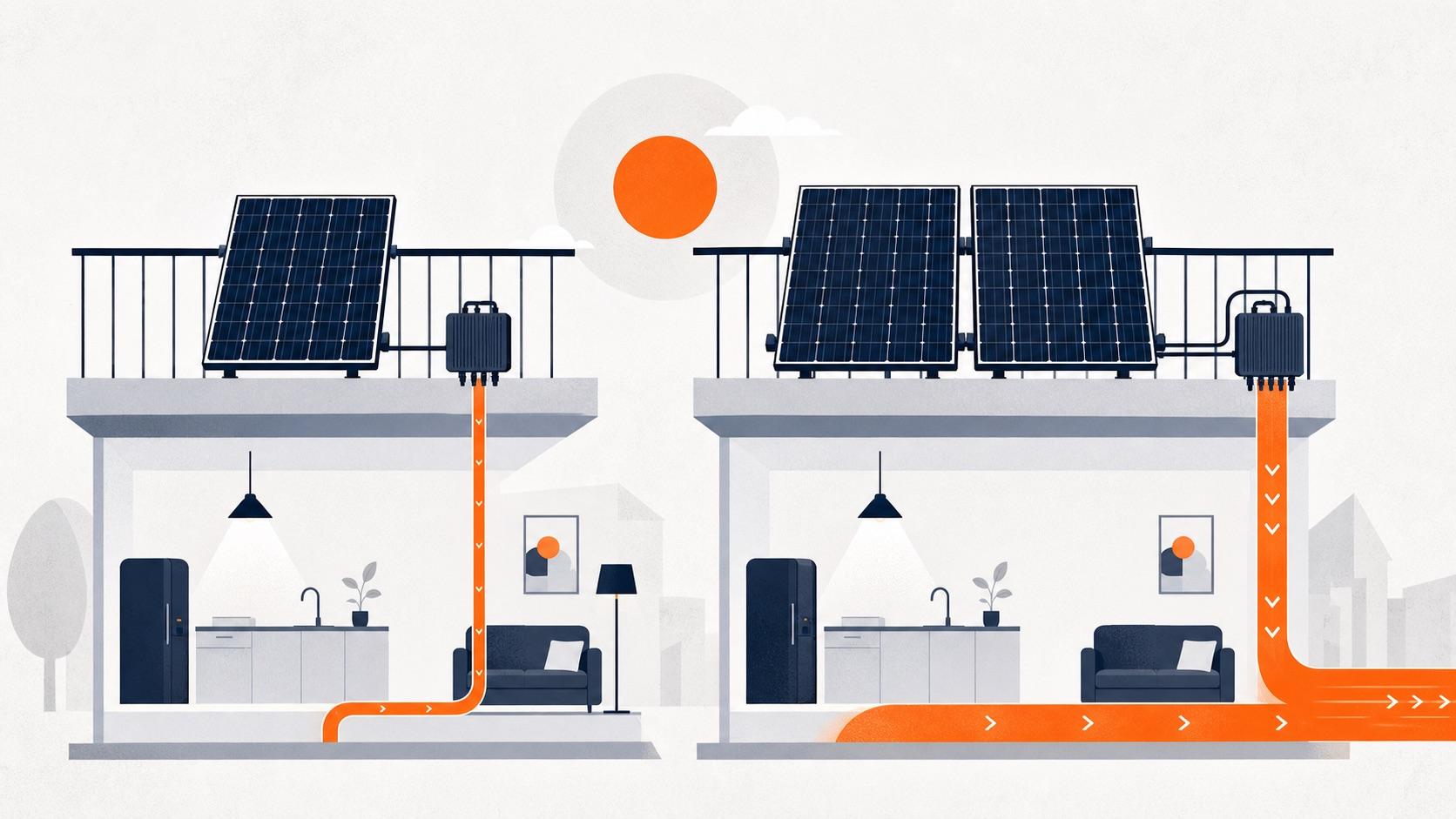
- An 800W array can model close to twice the gross energy of a matched 400W array, but not necessarily twice the self-consumed energy or bill savings.
- The inverter's AC nameplate caps instantaneous grid-connected output; extra panel capacity can improve shoulder-hour harvest while clipping some peaks.
- The decisive economic metric is additional useful kWh from the larger system, not its additional nameplate watts.
- Neither 400W nor 800W establishes legal eligibility, circuit suitability, export credit or blackout capability.
400W vs 800W: the direct comparison
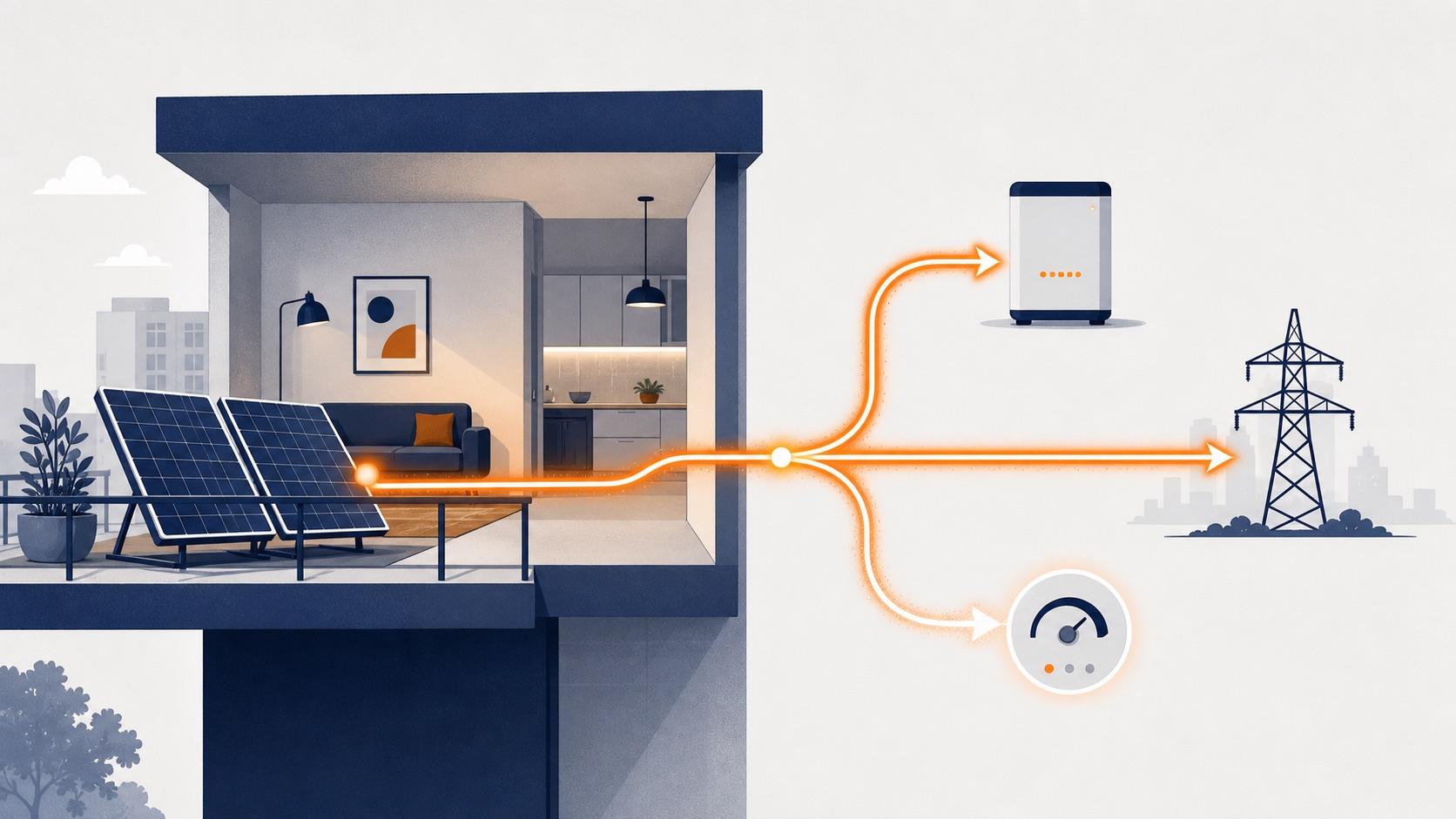
For two otherwise matched systems, 800 W of panel capacity offers roughly twice the gross generation potential of 400 W. That makes 800 W the higher-energy option. It does not automatically make it the better-sized option. The home only avoids buying electricity when solar output overlaps eligible household demand; the rest may be exported, stored or curtailed according to the system and local rules.
| Decision factor | 400W class | 800W class | What decides |
|---|---|---|---|
| Typical physical form | One current full-size module, or an equivalent smaller array | Two current full-size modules, or an equivalent array | Usable mounting area and the exact module dimensions |
| Gross generation potential | Lower | About twice as high before different shade, orientation, losses or clipping | A location-specific hourly or monthly model |
| Instantaneous household offset | Lower ceiling | Higher ceiling if the inverter and connection permit it | Simultaneous AC output and eligible home load |
| Surplus risk | Usually lower | Usually higher when midday demand is modest | Export value, storage and control behavior |
| Upfront cost | Usually lower | Usually higher | Complete installed configuration, not panel count alone |
| Best fit | Space-limited or lower daytime-load sites | Two good panel positions and recurring daytime load or useful storage | Measured demand plus site evidence |
The honest answer is therefore conditional: 800 W wins on available solar energy; 400 W can win on utilization, simplicity and incremental payback. A well-sited 400 W system can deliver more useful value than a poorly oriented or shaded 800 W system whose additional energy arrives when the home cannot use it and export earns nothing.
What do the 400W and 800W labels actually mean?
Start by separating watt-peak DC from watt AC. A module's watt rating is normally its maximum DC power under standard test conditions. The US Department of Energy identifies those conditions as 1,000 W/m² irradiance and a 25°C cell temperature, and notes that real sunlight is often weaker while operating cells are often hotter. A 400 W panel will therefore spend most of its life away from exactly 400 W.
The inverter has a different rating: maximum AC output to the household connection. A package advertised as “800W” might contain about 800 Wp of panels and a lower AC limit, exactly 800 W AC with more panel capacity behind it, or a battery platform that accepts far more DC while restricting grid-connected output. Record module Wp, inverter AC watts, battery charge input if present and any software export limit as separate fields.
| Number on the specification | Unit | What it answers | What it does not answer |
|---|---|---|---|
| Panel or array nameplate | Wp or W DC | Peak DC capacity at laboratory reference conditions | Continuous production or household AC output |
| Inverter nameplate | W AC or VA | Maximum conversion/output capability under its approved profile | Annual energy, legal permission or self-consumption |
| Energy estimate | kWh/year | Modeled production over time | How much the home will use or what export earns |
| Household demand | W now; kWh over time | Power overlap and total energy need | Which circuit or tariff rules apply |
| Battery capacity | kWh | Usable or nominal stored energy | Grid output, backup power or system compatibility |
Will an 800W system produce twice as much electricity?
If two arrays use the same module technology, orientation, tilt, shade and losses, and the inverter scales with the array, doubling DC capacity from 400 Wp to 800 Wp approximately doubles modeled gross energy. JRC's PVGIS asks for nominal PV power alongside location, mounting, slope, orientation and losses because capacity is only one input. Change the balcony geometry or shade and the clean two-to-one relationship disappears.
Inverter sizing can also break the simple ratio. PVWatts documentation explains why arrays are often larger on the DC side than the inverter's AC rating: more panel capacity can capture additional energy in morning, evening and lower-light periods, while output is clipped when predicted AC power exceeds the inverter nameplate. Clipping is not automatically a design failure; it is a trade between a broader production curve and lost peaks.
Gross kWh is not useful kWh
For bill reduction without storage, calculate each interval this way: useful direct solar equals the lower of solar AC output and eligible household load. Surplus equals solar AC output minus that load, but never below zero. Doubling generation can therefore add less than double the value when the smaller system already covers much of the daytime load.
| If the extra 400W produces... | Physical result | Economic treatment |
|---|---|---|
| While the home is importing | More grid electricity is displaced | Usually valued near the avoided retail rate |
| Above eligible household demand | Surplus follows the permitted export, storage or curtailment path | Use the verified export or storage value—not the retail rate by default |
| Above the inverter AC limit | The inverter clips the available peak | No extra AC energy during that interval |
| During shade on the second module | Added output can be small or intermittent | Use the actual panel plane and tracker arrangement in the model |
| During an outage on a plain grid-tied system | Grid-connected output shuts down | Neither size provides ordinary household backup |
How do you match system size to daytime load?
Do not size from the home's annual electricity bill alone. Annual consumption mixes day and night, while an unbuffered balcony system produces only when irradiance is available. Use smart-meter or monitor data in the shortest practical intervals, ideally covering weekdays, weekends and more than one season. Identify the recurring load during the hours your balcony receives sun, then compare that load curve with a location- and orientation-specific solar curve.
Start with the load that actually persists—refrigeration, networking, ventilation, working-from-home equipment or other site-specific uses—then add flexible loads only if you truly run them in solar hours. Do not size to a kettle, oven or other brief high-power appliance merely because its wattage appears on a label. A short peak can be larger than the solar system while contributing little energy overlap across the day.
| Evidence from your home | Sizing implication | Do not conclude |
|---|---|---|
| One panel's modeled curve sits below recurring demand most sunny hours | The second panel may add highly usable energy | That an 800W label guarantees 800W output |
| One panel already exceeds demand for long midday periods | Price the larger system using its export or storage value | That all extra kWh avoids retail electricity |
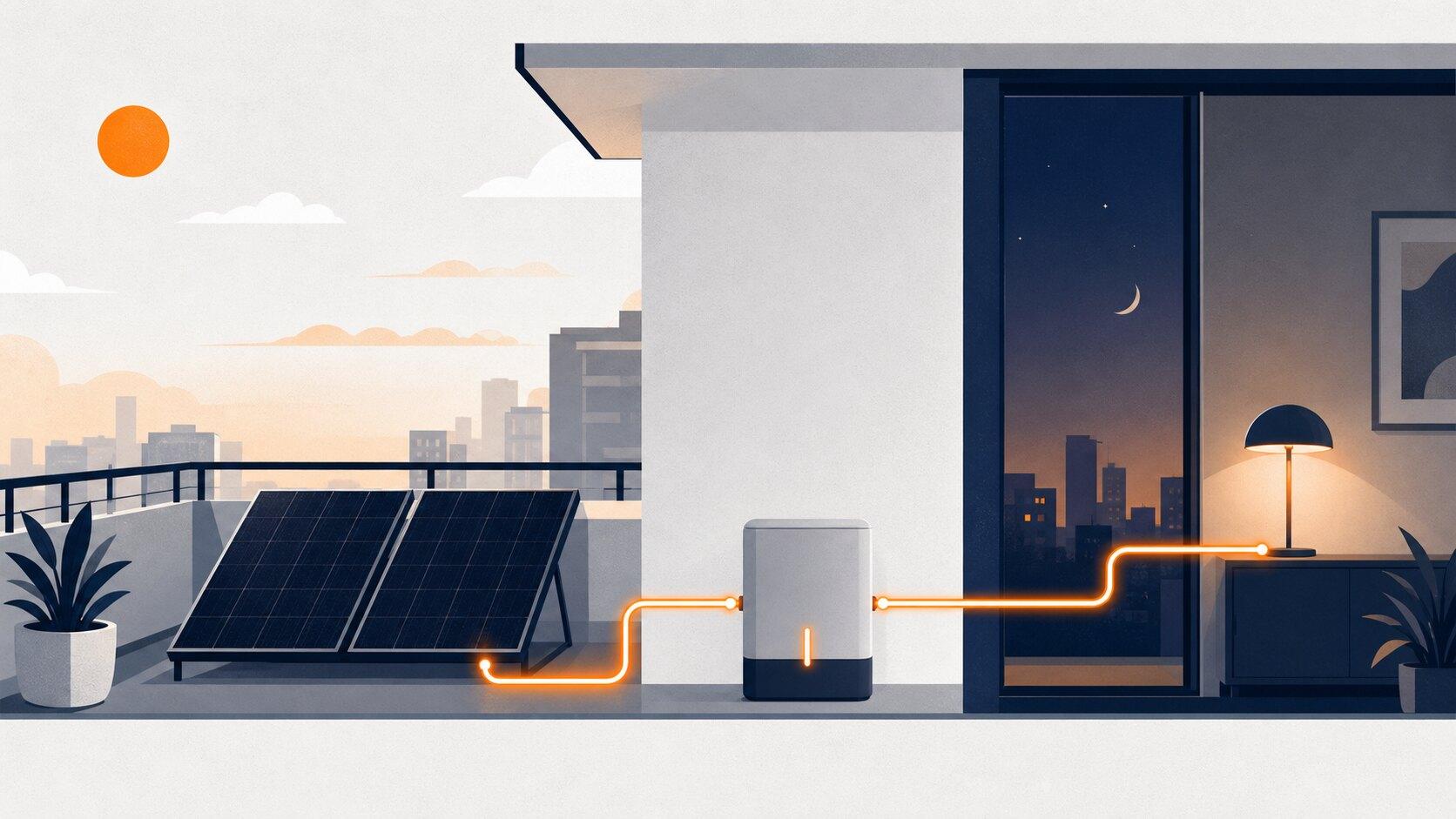
| Demand rises mainly after sunset | Shift safe flexible loads or evaluate storage separately | That more panels alone solve evening demand |
| The two panel positions face different directions or shade patterns | Model each plane and verify independent tracker inputs | That one average orientation represents both modules |
| Monitoring data are unavailable | Start conservatively and measure before expanding | That a generic household baseline is your baseline |
A useful sizing sentence is: “At this balcony, the extra panel is expected to produce ___ kWh per year, of which ___ kWh overlaps demand, ___ kWh has a verified export or storage value, and the additional complete-system cost is ___.” If those blanks are not supportable, the larger configuration is still a guess.
When is 400W the better choice?
- Only one module can be mounted with the required structural, wind, access and landlord clearances.
- Measured daytime demand is modest and uncompensated export would dominate the second panel's production.
- The second available position is materially more shaded or faces a poor direction, and separate modeling shows little added yield.
- You want the lowest-cost way to measure real production, household overlap and export behavior before expanding.
- The larger inverter, mounting, circuit or registration pathway adds cost or complexity not repaid by the additional useful energy.
The strongest case for 400 W is not “small apartments always have small loads.” It is evidence that one panel captures most of the valuable overlap at this site. Modular hardware can preserve an expansion path, but verify voltage, current, connectors, tracker inputs and warranty compatibility before assuming a second panel can be added later.
When is 800W the better choice?
- Two modules have secure, comparably productive positions and the complete mounting system is rated for the exposure.
- Interval data show recurring daytime demand above much of a 400 W system's expected AC curve.
- Flexible loads genuinely operate during solar hours, rather than being moved only for optimistic spreadsheet assumptions.
- Surplus has a documented export value or a compatible, economically justified battery can use it later.
- A larger DC array behind a permitted AC limit improves shoulder-hour or winter harvest enough to justify its incremental cost.
The strongest case for 800 W is a second panel that remains productive when its energy is useful. East- and west-facing modules can broaden the production window, while two panels on the same unshaded plane increase the curve's height. Use PVGIS or another traceable model for each plane and check the exact inverter's tracker layout; do not assume every two-panel input operates independently.
Which size pays back faster?
Compare the upgrade, not two isolated headline paybacks. Additional annual value equals the extra self-consumed energy multiplied by the avoided import rate, plus extra compensated export, plus any verified storage value after losses. Divide the additional installed cost of the 800 W configuration by that additional annual value. This incremental payback shows whether the second panel earns its own place.
Include every changed cost: module, larger or additional inverter channel, mounting, cable, meter or control, shipping, permission work and any professional electrical work. Do not credit a battery with the panel system's generation, and do not value exported energy at the retail import rate unless the actual tariff does. Use low, middle and high cases because weather, shade, load and prices move.
| Payback input | Evidence source | Conservative treatment |
|---|---|---|
| Additional generation | Same model, location and mounting assumptions for both sizes | Model each panel plane and include system losses |
| Direct self-consumption | Interval load matched to modeled or measured solar output | Do not infer from annual household consumption |
| Export value | Current utility or supplier terms for the exact setup | Use zero until eligibility and rate are verified |
| Battery value | Measured surplus, later load and round-trip behavior | Treat storage as a separate incremental purchase |
| Additional installed cost | Complete like-for-like quotes | Include mounting, controls and required electrical work |
Safety, legality and configuration checks
A size comparison does not authorize a connection. Verify the effective framework, utility implementation, inverter AC limit, plug and voltage, circuit requirements, system instructions, mounting loads, building rules and landlord or shared-property permission. The UK's 2026 plug-in solar process illustrates why current primary records matter: its government materials define a specific battery-free product route rather than a worldwide rule for anything marketed below a watt threshold.
Do not use extension leads, power strips, improvised adapters or double-ended cables. Do not assume a normal outlet's load rating proves it may accept generation. And remember that ordinary grid-tied 400 W and 800 W systems both stop their household output when the grid reference disappears; panel size is not backup capability.
| Final check | Question to answer | Evidence |
|---|---|---|
| DC | What is the exact array Wp, voltage and current at each input? | Module data sheet and inverter input table |
| AC | What is the inverter's approved continuous output and configured limit? | Regional manual, grid profile and commissioning record |
| Energy | What does the site model predict by month and panel plane? | PVGIS/PVWatts inputs and saved result |
| Use | How much modeled output overlaps eligible household load? | Interval meter or monitor data |
| Pathway | May this exact complete system be connected here? | Current authority, utility and property requirements |
A five-minute 400W or 800W decision
- Map one and two physically safe panel positions, including shade, direction, wind exposure and cable route.
- Write down panel Wp and inverter AC output separately for each exact configuration.
- Model monthly energy for every panel plane using the same source and loss assumptions.
- Match the solar curves with interval household demand; separate self-use, export, storage and clipping.
- Calculate the second panel's incremental cost and value, then confirm the complete legal and electrical pathway before buying.
If the larger system's added useful energy and pathway are both clear, choose 800 W. If its value depends on unverified export credit, imaginary daytime loads or a poorly sited second panel, choose 400 W or wait for better evidence. The right system is the smallest one that performs the intended job with a defensible expansion case.
Sources and next steps
The comparison uses DOE guidance for standard test conditions and PV design, PVWatts documentation for DC/AC sizing and clipping, and the European Commission JRC's PVGIS for location- and mounting-specific energy modeling. The UK source demonstrates why country pathways must be checked in current primary materials. These sources support the method; they do not predict an individual balcony without its inputs.
- US Department of Energy — Optimizing solar photovoltaic performance
- US Department of Energy — Solar photovoltaic system design basics
- NREL — PVWatts Version 5 manual
- NLR — PVWatts API and current model inputs
- European Commission JRC — PVGIS grid-connected PV tool
- GOV.UK — Plug-in solar regulatory amendment and product specification
Frequently asked questions
Is an 800W balcony solar system better than 400W?
It has more gross generation potential, but it is better only when the second panel is well sited and its additional energy has value. Compare inverter AC output, modeled annual generation, interval daytime load, export or storage treatment and incremental installed cost. If one panel already creates long periods of low-value surplus, 400 W may pay back faster.
Does an 800W solar system produce 800 watts all day?
No. The panel rating is measured at reference irradiance and cell temperature, while real output changes with sun angle, clouds, shade, temperature and system losses. The inverter may also impose a lower AC ceiling. Use watts for instantaneous power and a location-specific kilowatt-hour estimate for production over a day, month or year.
Will 800W solar generate twice as much as 400W?
Approximately in a matched gross-energy model when capacity, inverter and every other input scale together. Real balconies rarely match perfectly: the second panel may face another direction, receive more shade or encounter inverter clipping. Even when gross generation nearly doubles, self-consumed energy and savings usually rise by a smaller amount if daytime demand is already covered.
How many panels are needed for 400W or 800W balcony solar?
With current full-size modules, the 400 W class is often one panel and the 800 W class often two, but use exact data sheets rather than a panel-count shortcut. Modules vary in power and dimensions, while some systems deliberately use more DC capacity than their AC output limit. Mounting area, electrical input limits and local rules all matter.
Can I add a second panel later?
Only if the exact inverter has a compatible unused input or documented expansion method. Check maximum input voltage and current, tracker arrangement, connector type, allowed module combinations, mounting capacity, warranty and the location's output pathway. A spare-looking socket or shared brand name is not proof of compatibility.
Do I need a battery with an 800W balcony solar system?
No. First determine how much of the larger system's output the home uses directly and what happens to surplus. A battery may shift recurring midday surplus into later demand, but it adds cost, conversion losses and compatibility requirements. Size storage from measured surplus and later load; do not infer battery capacity from an 800 W inverter label.
Check your location
Framework status and exact product eligibility are separate checks.